Biography
Ephraim of Katounakia
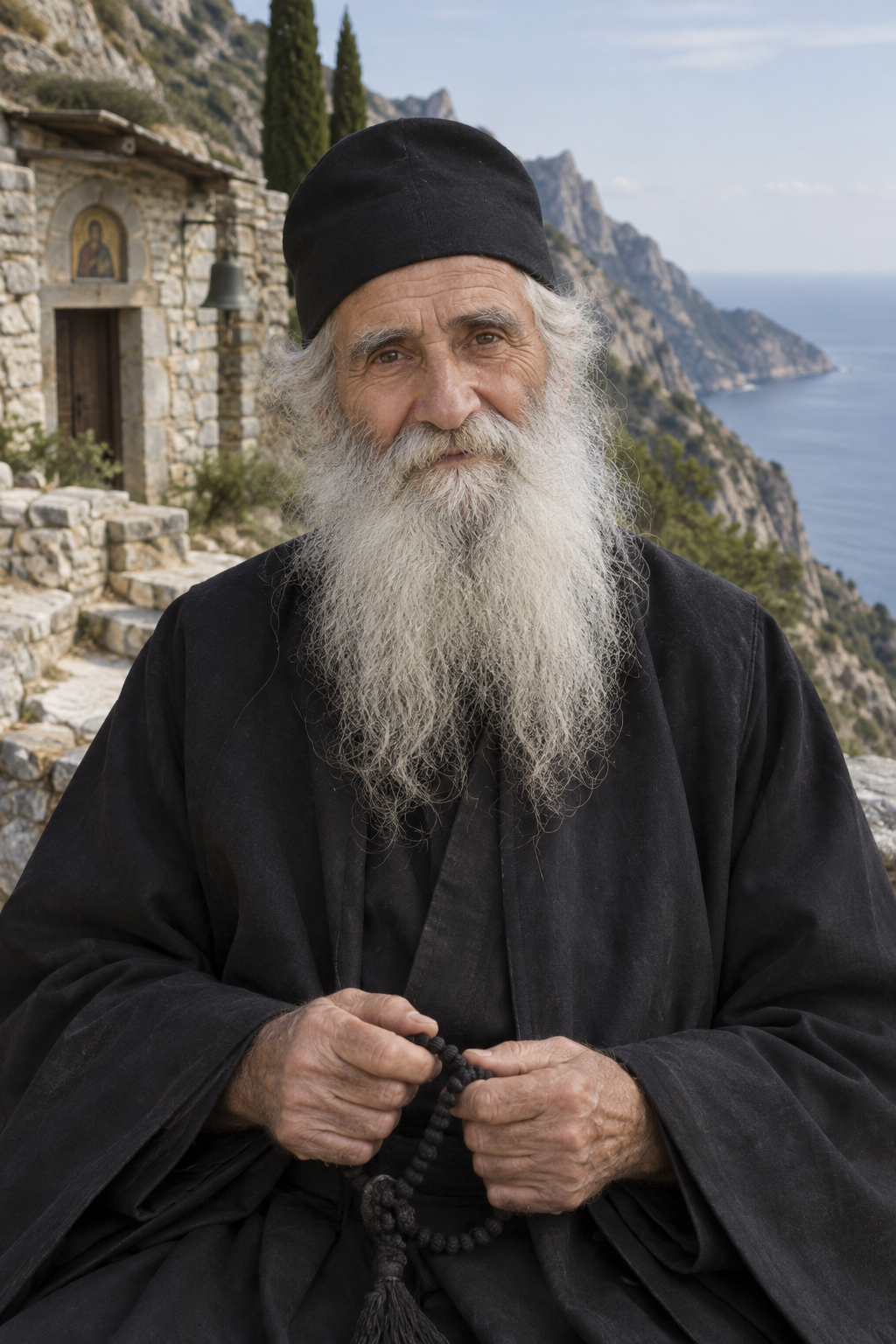
About Ephraim of Katounakia
Ephraim of Katounakia was an Orthodox monk and priest who made his home in a small religious community on Mount Athos. Born in 1912 at Ampelochori near Thebes, he was named Evangelos before entering monastic life. He came to Katounakia in 1933, received the monastic name Ephraim in 1935 and was ordained the following year. With his elder Nikephoros's permission, he received guidance from Joseph the Hesychast and studied the Philokalia.
Visitors encountered a man whose solitude was carefully protected. Father Nicholas Palis recalled seeking help from the hymnographer Gerasimos to arrange a visit, then arriving in rain and negotiating with monks who were reluctant to admit him. He eventually met Ephraim, and on another visit saw him with a doctor and a group of students. Palis remembered being questioned about the cold and the difficulty of finding another place to stay before being admitted. Palis recalled Ephraim telling a story in which a straw basket held water while its carrier continued the Jesus Prayer, then leaked when conversation interrupted the prayer. This reported teaching story presents a miracle; Palis's recollection does not independently verify the event it describes.
For Ephraim, prayer included remembering particular people. In a recorded conversation about priesthood, he recalled the names of his schoolteachers and classmates and keeping names at the place where he prepared the Eucharistic gifts. Arsenios also supplied names for him to commemorate.
His ministry also involved conversation, correspondence and confession. Metropolitan Athanasios of Limassol recalled frequent meetings with him, serving the liturgy together and receiving letters from him. Athanasios would go to him for confession as well as discussion. The two communities maintained close contact through Joseph of Vatopedi, who loved Ephraim. Athanasios recalled returning for counsel, corresponding when apart and sharing worship. His solitude did not mean the absence of enduring friendships.
Athanasios illustrated Ephraim's attention to conscience with an account involving a letter. Ephraim boarded a boat to deliver it and did not disembark before the boat set off. The boatman had to turn back and was angry. According to the recollection, Ephraim later walked to Saint Anne's to apologize to him, even though the journey meant going out again at night. The point of the story is a specific act of reconciliation: he did not regard another person's irritation as too small to address before returning to prayer. The episode is preserved as Athanasios's recollection, not as a dated contemporary travel record.
Another visitor's memory shows him acknowledging his own need for rest. Athanasios recalled Ephraim telling a group that he was tired of the rocks of Katounakia and wanted to spend time at Monoxylites, a greener part of Mount Athos. The younger monks were surprised that a man they regarded as holy could want a change of surroundings. Ephraim also told them that Joseph the Hesychast had once asked him to bring an amusing lay acquaintance to lift his spirits. He had been surprised by his own elder's request, just as the visitors were surprised by his. These recollections allow room for weariness and laughter within an ascetic life, without suggesting that he abandoned his vocation.
Ephraim shared more intimate accounts of prayer with Hierotheos of Nafpaktos. Having read some of Hierotheos's books, he wanted experiences known to few people to be made useful to a wider readership. Hierotheos remembered a conversation about repentance and tears in which Ephraim described a vision of three lights filling his cell. Ephraim distinguished the tears accompanying repentance from his experience of divine light, explaining that in the latter experience the tears stopped. The account records Ephraim's religious experience and the visitor's belief in it; it does not independently establish a supernatural event. What Hierotheos particularly remembered was a man who avoided display and contact with crowds while speaking openly in a trusted conversation. His wish to help other readers also shows a way in which teaching could leave the cell without turning him into a public lecturer.
In his final illness, he depended on care from others. The account preserved by his community describes the effects of a stroke in November 1996, including difficulty speaking and swallowing. It also remembers that he remained responsive and could communicate through a smile. He died in February 1998.
His influence remained personal for those who had known him. Writing in 2019, John Chryssavgis included Ephraim among the elders he had met and whose lives had shaped his ministry. He welcomed their recognition while warning against confusing holiness with ecclesiastical power or an idealized image of religious authority.
In March 2020, the Holy Synod of the Ecumenical Patriarchate added Ephraim to the calendar of saints alongside Daniel of Katounakia and Joseph the Hesychast. The announcement identifies him specifically as a priest-monk of Katounakia.
His February 27 commemoration is observed in Greek diocesan worship; Nea Ionia announced an evening liturgy for it in 2025.
Wondering how to weigh the stories and sources? Learn how to read a saint biography.
Explore similar vocations
Prayers for Ephraim of Katounakia
Ephraim of Katounakia: petition
μὴ διαλείπῃς Χριστὸν ἡμῖν καθιλεούμενος.