Biography
Eucherius of Lyon
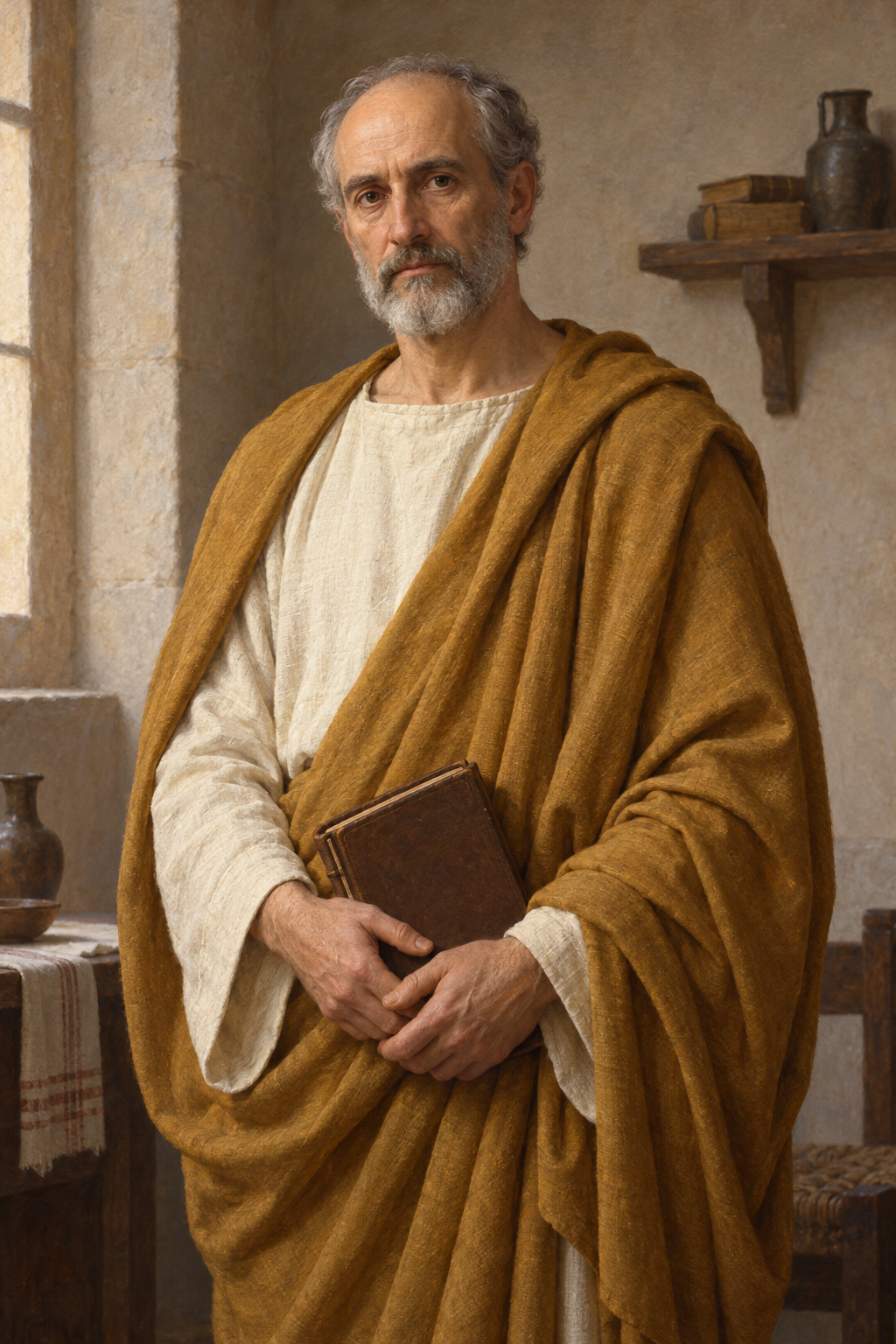
About Eucherius of Lyon
Eucherius of Lyon was a bishop and Christian writer in fifth-century Gaul. He belonged to an aristocratic family and was the father of Salonius and Veranus, who also became bishops. The scholarly JERIHNA account places him with his family on the island of Sainte-Marguerite, associated with the religious community of Lérins, before his election to the episcopate. His exact birth date and birthplace are uncertain. The same reference places his death around 450.
The New Catholic Encyclopedia names his wife as Galla and describes their agreement that he should withdraw to monastic life. His religious career therefore developed within an existing family, rather than beginning with an unmarried youth entering a monastery. The sons for whom he later wrote remained part of his intellectual and spiritual work. His movement from aristocratic society into ascetic life did not end those relationships.
He was also connected with other important religious teachers. The Catholic Encyclopedia records his interest in the Eastern hermits and his correspondence with John Cassian. It places his election as bishop of Lyon around 434, while identifying his attendance at the Council of Orange in 441 as secure evidence of his episcopate. The distinction matters: participation in a dated council establishes his office more firmly than an approximate reconstruction of when it began.
An early witness to his literary reputation is Gennadius of Marseille. In his catalogue of Christian writers, Gennadius praises the learning and reasoning of Eucherius’s letter to his relative Valerianus. He also mentions explanations of difficult biblical passages addressed to his sons and an abridgment of works by Cassian. This short notice provides evidence that his reputation as an author was established in late antiquity; it is not simply the result of later devotional biography. Gennadius places his death during the reigns of Valentinian and Marcian, rather than supplying an exact day.
The letter to Valerianus, usually called On Contempt for the World, begins with affection rather than denunciation. Eucherius writes as a kinsman who wants the recipient’s good. He acknowledges Valerianus’s honours and standing, then urges him to seek a lasting good beyond inherited prestige. He presents knowledge and worship of the Creator as the purpose of human life. The argument asks its reader to judge success by something more enduring than rank.
His comparison between bodily and spiritual care makes that appeal practical. People accept effort and treatment to preserve bodily health, he observes, yet may neglect the soul. He calls for attention to the part of life that he considers most precious and lasting. The letter’s severe language about worldly uncertainty belongs to this ascetic argument: temporal advantages cannot provide the security of eternal life. It is a religious exhortation addressed to someone he loves, rather than a detached description of society.
His biblical teaching is especially clear in the preface to the Formulae, addressed to Veranus. Eucherius offers a collection intended to help the reader understand and remember Scripture. He distinguishes the written account from moral and spiritual meanings and warns against treating descriptions of God’s eyes, hands or feet as statements that God possesses a human body. Figurative language requires interpretation rather than an unthinking literal reading.
The work also connects careful study with the conduct of everyday life. Its preface describes active knowledge in terms of correcting one’s habits, alongside contemplation of heavenly things and discussion of Scripture. Eucherius organizes the material under subjects that include the natural world, human beings, ordinary objects and numbers. His purpose is to lead readers through familiar words toward religious understanding, using scriptural passages to support the meanings he proposes. The opening discussion also compares religious learning with the divisions of classical philosophy. Its vocabulary brings an educated reader’s habits of thought into the service of biblical study.
Modern study helps explain the assumptions behind this teaching. Tomasz Skibiński’s analysis of animal symbolism finds that Eucherius drew heavily on earlier sources and expected readers already familiar with the Bible. Animals could signify Christ, the Holy Spirit, hostile spiritual powers or human moral qualities. The work thus belongs to a learned tradition of interpretation, and was intended for readers beyond the two sons named in its dedications.
A different part of his legacy concerns the martyrs of Agaunum. David Woods identifies a letter to Bishop Salvius as the principal early account of Maurice and the Theban legion. Scholars have sharply disputed the historical basis of that narrative. Its importance as an early Christian text does not settle whether the events occurred as described.
Care is also needed with the wider body of works circulated under his name. The Catholic Encyclopedia distinguishes genuine writings from doubtful and falsely attributed texts. His surviving work is best approached through that distinction: a fifth-century bishop’s substantial literary legacy should not be enlarged by assigning him every text preserved under his name.
Wondering how to weigh the stories and sources? Learn how to read a saint biography.