Biography
Eugenius II of Toledo
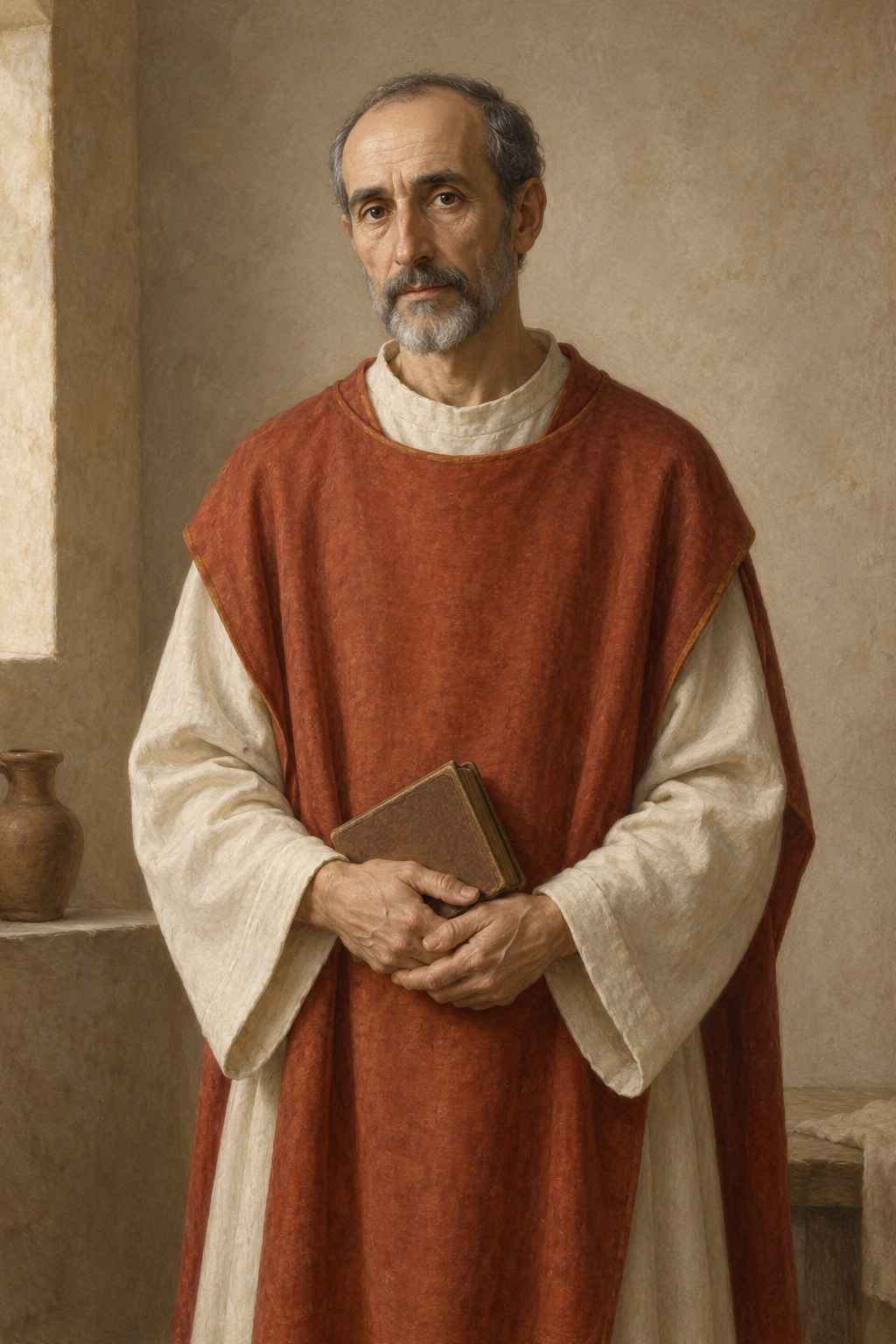
About Eugenius II of Toledo
Eugenius II of Toledo was a seventh-century bishop and Latin poet. His career joined the religious communities of Zaragoza with the royal city of Toledo. The modern critical edition places his return to Toledo and appointment as bishop in 646, followed by his death there in 657. Beyond his family’s connection with Toledo, its editor finds no secure information about his parents. A precise birth date cannot be recovered.
Before his episcopate, he lived near the shrine of the Eighteen Martyrs in Zaragoza and became archdeacon at Saint Vincent’s church. His return to Toledo came through King Chindaswinth’s intervention. Braulio, bishop of Zaragoza, wanted him to remain. The surviving correspondence supports this movement between the two cities, while the language of flight in his later biography does not establish that he had been a political refugee.
His new responsibilities brought difficult pastoral questions. In a letter to Braulio, Eugenius describes a man serving as a priest whose ordination was said to have been deliberately defective. According to the report he received, his predecessor had omitted the laying on of hands and substituted a curse for a blessing while the clergy sang. Eugenius asks what this meant for the man’s ministry and for Christians he had baptized or anointed. He presents the allegation as a problem requiring advice, rather than treating it as a settled judgment.
The same letter raises another concern: some priests were using chrism they had prepared themselves, contrary to the canons. Eugenius admits that he does not know the appropriate remedy. His appeal shows a bishop willing to seek help over questions affecting ordinary worship and the people who depended on it.
Braulio’s answer counsels caution. He argues that the priest should not bear the blame if the previous bishop had publicly recognized his ministry and allowed him to serve. He also warns against overturning the community’s sacramental life on allegations disclosed only after that bishop’s death. His reasoning distinguishes the responsibility of the person accused of deception from the standing of worshippers who had received ministry in the Church.
For unauthorized chrism, Braulio proposes a different response. He advises anointing those affected with properly consecrated chrism, while distinguishing correction of an error from punishment of deliberate presumption. The exchange preserves a specific pastoral difficulty and the advice sought to resolve it; it does not tell us every measure Eugenius eventually took.
Eugenius’s literary work also served religious teaching. Mark Lewis Tizzoni discusses poems against drunkenness and gluttony alongside pieces commemorating Zaragoza’s churches. Other verses remind readers of mortality and the brevity of life. These compositions connect ascetic concerns with a bishop’s work of instruction. They should not be reduced to private reflections detached from the communities for whom he wrote.
His poetry travelled into education as well. Tizzoni identifies verses on animals, biblical subjects and natural knowledge that circulated in medieval teaching manuscripts. Such short compositions offered material for learning vocabulary, grammar and metre together. Julian of Toledo remembered Eugenius as his teacher. This reception places his work within a continuing culture of Latin learning, reaching beyond his own lifetime and city.
One poem addressed to God expresses the conduct he desired: truthful speech, prudence, humility and freedom from injustice. It asks for faithful friendship, sufficient food and health, while rejecting wealth, ostentation and quarrels. These requests are a poet’s statement of aspiration, not evidence that he perfectly attained every virtue. The prayer holds spiritual discipline together with the ordinary needs of a human life.
His verse could also be sharply observant. The poem on summer describes oppressive heat, damaged crops, thirst, sweat and biting insects before asking God for rest. In the poem on mortality, worldly brilliance gives way to the reminder that good and just actions matter beyond death. His self-written epitaphs turn toward mercy and resurrection. The range is wider than solemn praise alone: physical discomfort, moral reflection and hope all enter his poetry.
The Catholic Encyclopedia also records his revision of works by the North African poet Dracontius at the king’s request, including material on creation. It credits him with reforming church chant and mentions a lost work on the Trinity. His remembrance as a saint therefore belongs alongside a substantial literary legacy, although several works known to early readers no longer survive.
An older account of his correspondence preserves another glimpse of the writer’s modesty. Asked by Protasius of Tarragona for a Mass and sermons connected with Hippolytus, he reportedly declined because he doubted the quality of his own composition. The same reference describes prose and poetry together in his output, rather than presenting him as a poet alone. Its detailed chronology must be checked against modern scholarship, but the distinction between surviving texts and lost works remains useful. A later reputation for literary excellence does not restore writings that have disappeared or remove the need to examine attribution carefully.
Wondering how to weigh the stories and sources? Learn how to read a saint biography.