Biography
Eulalia of Barcelona
About Eulalia of Barcelona
Eulalia of Barcelona is remembered through one of Barcelona's most important local saint traditions. The identifies her as Saint Eulalia, virgin and martyr, and presents her as patron of Barcelona. The same source is careful to frame the life story as local tradition, attested from at least the sixth century, rather than as a contemporary record from the age of persecution.
That distinction belongs in the catalog record. Eulalia should not be written as though every detail of a later passion account were securely documented history. The reviewed source does support the shape of the received devotion: a young Christian woman associated with Barcelona, honored as a virgin and martyr, and remembered by the local Church on February 12. It does not justify adding a precise birth date or a precise death date.
The tradition places Eulalia in Roman Barcino during the persecution associated with Diocletian. In that setting she is remembered as a young believer whose public fidelity brought her into conflict with imperial authority. The profile can say that this is how Barcelona's Church remembers her witness, but it should avoid turning traditional narrative into unqualified event reporting.
The Archdiocese's own language allows an honest middle path. It does not erase the tradition as meaningless, because the tradition itself is old and central to Barcelona's Christian memory. It also does not require the catalog to repeat every dramatic detail as fact. A slow-vetted profile should preserve both parts: the depth of the devotion and the limits of the evidence.
For that reason, the death fields should remain empty. The source connects Eulalia with the Diocletian-era persecution, but the reviewed evidence does not give a secure catalog-grade day, year, or age for her death. The February 12 field is a feast observance, not proof of a date of death. Keeping the date blank is more truthful than filling it from later convention.
The place fields also need careful wording. Barcelona and Barcino are supported as the tradition's setting, so the existing place entries may be retained as traditional geographic markers. The prose should still make clear that this is the Barcelona tradition, not an archaeological reconstruction of her daily life or a modern claim to exact coordinates.
Later passion traditions include severe suffering and a final death scene. The public biography should not dwell on graphic details, because doing so would shift the record away from its strongest evidence. The stronger editorial claim is that Barcelona venerates Eulalia as a virgin and martyr whose courageous witness became part of the city's Christian identity.
The same caution helps distinguish Eulalia of Barcelona from Eulalia of Merida. The two names are close, and later traditions can be confused by readers or secondary retellings. This packet concerns the Barcelona saint only. It should not import facts, geography, patronage, or feast material from the Merida tradition unless a future source explicitly supports a comparison.
Barcelona's medieval devotion gives the profile firmer historical texture. The Archdiocese says her body is venerated in the Gothic crypt beneath the cathedral altar. It also reports a tradition that her remains were discovered in 878 at the basilica of Santa Maria de las Arenas and later placed in an urn in 1339. Those claims should be described as veneration history and tradition, not as new proof for every detail of the passion narrative.
The February 12 feast should be treated as one of the strongest catalog fields, because it is part of the Archdiocese's current santoral presentation. Feast observance is different from reconstructing an ancient chronology. It is a present liturgical and devotional marker, and it can be stored without pretending to know the exact day of Eulalia's death. This distinction lets the page be specific where the source is specific and restrained where the source is traditional.
This cathedral setting matters because Eulalia's memory is not only a private legend. She is tied to Barcelona's public worship, civic patronage, and cathedral identity. Her name remains attached to the local calendar and to the city's sense of Christian continuity. The catalog can responsibly present that continuity while still marking the ancient narrative as traditional.
The final profile should therefore be warm but disciplined. It can name her as Eulalia of Barcelona, virgin and martyr, honored on February 12 and venerated as a patron of Barcelona. It can summarize the traditional witness in Roman Barcino and the cathedral devotion that preserved her memory. It should not add precise life dates, sensational martyrdom description, or unsupported comparisons with other saints.
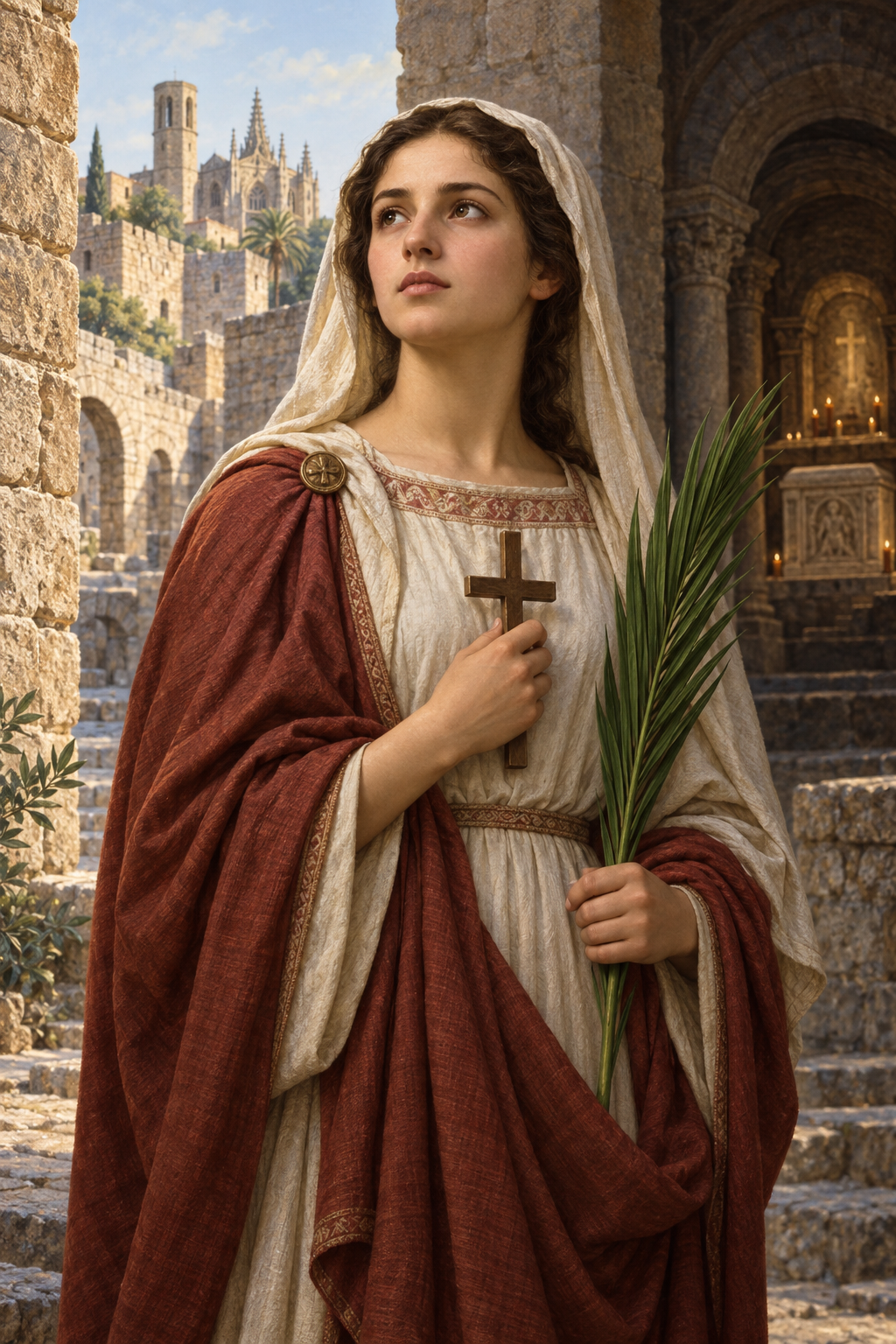
Artwork should follow the same restraint. A young woman holding a palm branch or small cross in an ancient Barcelona setting is appropriate, because those symbols express virgin-martyr devotion without claiming a literal portrait. The image should avoid torture scenes, weapons, blood, textual labels, and modern city details that would either sensationalize the story or confuse the period.
Wondering how to weigh the stories and sources? Learn how to read a saint biography.