Biography
Euphrosyne of Polotsk
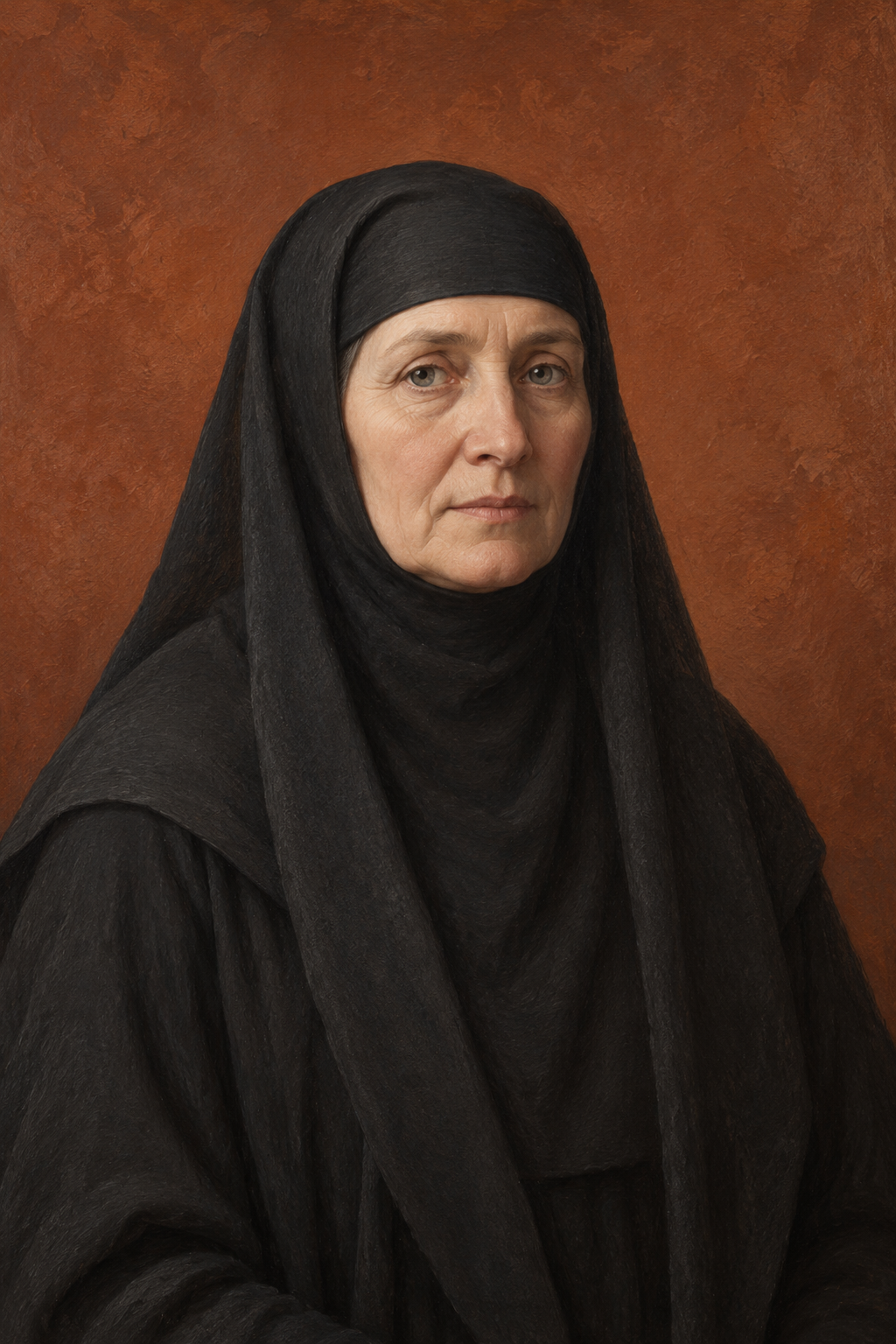
About Euphrosyne of Polotsk
Euphrosyne of Polotsk was born into the ruling family of a city in what is now Belarus. Before becoming a nun she was called Predslava. Her father was Svyatoslav, whose baptismal name was George, a son of Prince Vseslav. Her birth is usually placed near the beginning of the twelfth century; the Orthodox Encyclopedia gives about 1104.
Her medieval life presents a girl who loved learning and resisted the marriage planned for her. At twelve, according to this account, she sought admission to a convent led by a widowed relative. The abbess initially hesitated, fearing both her youth and her father’s reaction. Predslava persisted, received the name Euphrosyne, and entered monastic life. The story preserves her determination through speeches composed in the language of religious biography; it is not a verbatim record of family conversations.
With Bishop Elias’s permission, she later lived in a cell at the cathedral of Holy Wisdom in Polotsk. There she copied books by hand and gave the proceeds to people in need. The account connects study, work, and charity in a concrete practice: her learning became a means of supporting others.
The Polotsk museum’s account associates her with the foundation of communities for both women and men. Their schools, libraries, and manuscript workshops made them centers of religious learning. The stone Church of the Savior, built by the architect John for her women’s monastery, survives. The men’s monastery dedicated to the Mother of God does not. These different histories help distinguish the buildings associated with her from the institutions remembered under her name.
The church she commissioned gave this community a lasting place of worship. The Belarusian heritage description records a compact building with three aisles, six supporting pillars and a dome raised above them. Its medieval walls and vaults survive beneath later alterations. Two small rooms stand beside the choir; one has been associated with Euphrosyne, although that proposed use is uncertain.
Its paintings also require distinctions between periods. Restorer Daria Skobtsova argues that the south chapel’s frescoes were added after the church’s main painted ensemble and relate stylistically to early thirteenth-century art. The chapel’s memorial character thus belongs to the continuing history of the foundation, rather than securely documenting a decorative scheme ordered personally by Euphrosyne.
A cross commissioned in 1161 provides an unusually precise link to her patronage of religious art. The goldsmith Lazar Bogsha made it as a reliquary for the Savior church. Its inscription named Euphrosyne, dated the gift, and directed that it remain in the monastery. Another inscription identified the craftsman. These recorded details give the object a historical importance alongside its devotional role.
The cross later passed through churches and museums and disappeared during the Second World War. Accounts of its removal conflict, so responsibility for its loss cannot be assigned with confidence from those accounts alone. A reconstruction made by Nikolai Kuzmich in 1997 was placed in the monastery. The modern object continues the cross’s devotional presence, while remaining distinct from the missing medieval work.
Near the end of her life, Euphrosyne traveled through Constantinople to Jerusalem, where she died. The year remains disputed. The familiar date of 1173 appears in later publications, while 1167 is another scholarly possibility. Her medieval life supplies no year. Its account of an encounter with Emperor Manuel during a Hungarian campaign has been used to reconstruct the chronology, but has not produced agreement.
The day also requires care: Nadson notes that the life gives May 24 for her death, although the feast is May 23. A liturgical commemoration should therefore not automatically be treated as a securely established date of death.
Her memory remains visible in Polotsk beyond the monastery itself. The museum describes the monument made by Igor Golubev in 2000 and recalls the return of her relics to Polotsk in 1910. It also identifies her inclusion in the Synaxis of Belarusian Saints in 1984. That collective commemoration was not the beginning of her veneration, which reaches much further back.
The Eurasian Library Assembly describes her as a heavenly patroness of Belarus. Its account also emphasizes her religious foundations and the cross associated with her. This is evidence of an established devotional and cultural association, rather than a record of a single modern decree granting patronage.
Historian Viktor Koronevskii studies how this national patronage developed. He traces a Belarusian association to Simeon of Polotsk’s poetry in 1663, with renewed emphasis during the nineteenth century and especially around the 1910 relic translation. His research places that language within changing religious and national identities. Euphrosyne’s medieval life and the later meanings attached to her memory belong to connected but distinct historical settings.
Her devotion also traveled with communities abroad. Saint Euphrosynia Orthodox Church in South River, New Jersey, explicitly names her as its patron saint. The parish belongs to the American Carpatho-Russian Orthodox Diocese under the Ecumenical Patriarchate. Its dedication provides a specific example of her continuing place in Orthodox community life.
Wondering how to weigh the stories and sources? Learn how to read a saint biography.