Biography
Eustace
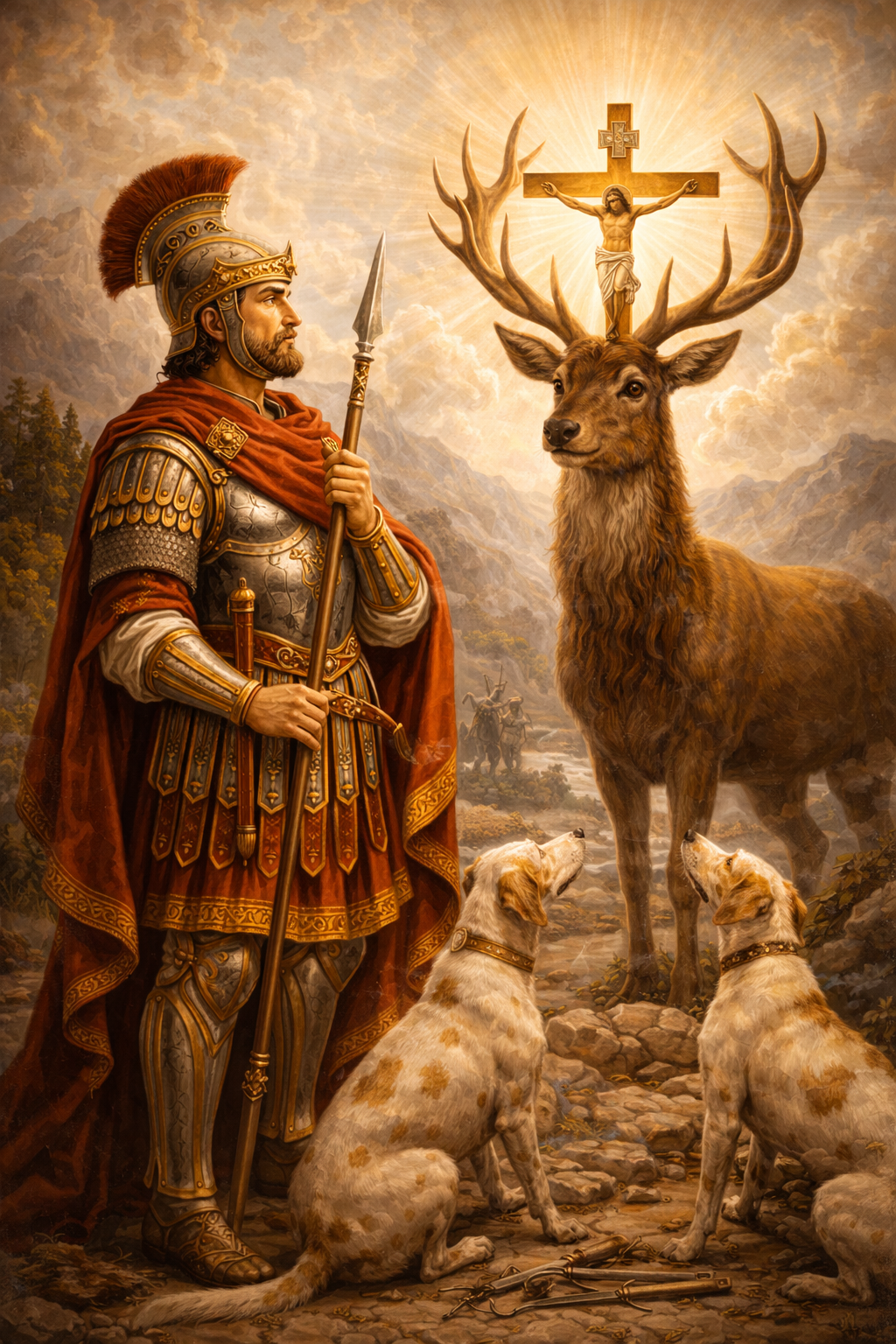
About Eustace
Eustace is the central figure in a Christian legend about a Roman officer, a family separated by disaster, and fidelity under violent pressure. The story places him in the reigns of Trajan and Hadrian and calls him Placidus before baptism. Surviving evidence does not establish that this person lived, served in the Roman army, or died in the second century. An early-twentieth-century Catholic reference calls the Acts certainly fabulous and dates their production to the seventh century. Modern scholarship studies the narrative as a hagiographic work transmitted and reshaped across medieval Europe. A careful biography must therefore describe the legend and its reception, not present its plot as archival history.
In the received account, Placidus is a successful general who also gives generously to people in need. While hunting, he pursues a stag and sees a radiant cross or an image of Christ between its antlers. A voice identifies the one he persecutes and calls him to baptism. Textual scholarship shows that versions differ over whether the stag, the cross, or the image speaks, a reminder that the famous scene developed through transmission. The vision becomes the turning point of the story, but it is legendary rather than a report from Placidus or a contemporary witness. No exact forest or hunting route can responsibly be mapped.
The Orthodox Church in America's life says that Placidus brings his wife and two sons to a Christian bishop. All four are baptized: he becomes Eustathios, his wife becomes Theopistē, and the sons become Agapios and Theopistos. A second revelation warns that he will suffer like Job. Soon servants die in a plague, livestock perish, and the household loses its wealth. These scenes connect conversion with loss rather than immediate security. They also supply names by which the family is venerated. None is independently verified, so the names and baptism remain part of the received family legend rather than documented Roman prosopography.
The family's flight unfolds through coercion and separation. According to the life, they leave secretly and board a ship toward Egypt. The shipmaster takes Theopistē when the family cannot pay, leaving Eustathios with the boys. At a river crossing, animals carry off one son from each bank while their father stands between them. The children survive and are raised apart, but he believes them lost. The narrative does not minimize his helplessness, and modern retelling should not turn the abduction of his wife into a colorful travel episode. Because the locations and sequence belong to legend, this packet records only broad narrative settings and draws no route.
Eustathios then lives for years as a hired worker and village watchman. When war threatens the empire, the story says Trajan's officers Antiochos and Akakios search for their former commander and eventually recognize him. He resumes military command, recruits soldiers, and unknowingly enlists his sons. After a campaign, the two young men tell their histories near the house where Theopistē is living; mother and sons recognize one another, and she later identifies Eustathios by a scar. Reunion is the legend's emotional center. It borrows familiar recognition motifs and cannot establish an imperial appointment, named campaign, or historical itinerary.
The final movement begins after victory. The life shifts the imperial setting to Hadrian and says the family refuses to sacrifice to pagan gods. Eustathios answers that he is Christian and offers sacrifice only to Christ. The emperor strips him of rank and orders the four exposed to wild beasts, but the animals do not attack. He then sentences them to a heated brass bull. The family enters the instrument and dies together. This is a story of state-enforced worship and execution, told with a spectacular torture motif. Its violence should remain visible, while the untouched bodies and conversions attributed to witnesses remain legendary claims.
The story also raises difficult moral questions beyond persecution. Eustathios returns to military command and leads an imperial campaign, yet the life gives little sustained attention to those harmed by war. His family's suffering is repeatedly framed as a divinely permitted test modeled on Job. Such framing belongs to the theology of the legend; it cannot prove why real suffering occurs or make abduction, bereavement, and execution morally uncomplicated. The most defensible virtues are therefore actions inside the received narrative—aid to the poor, persistence while dispossessed, and refusal of coerced worship—not a claim that every choice or institution surrounding him was exemplary.
Eustace's historical footprint is clearest in the life of the text and cult. Manuscript scholarship identifies a Greek passion and a widely diffused Latin tradition catalogued as BHL 2760. Medieval writers translated, versified, and adapted it for different audiences in England and Scandinavia. The Catholic reference records an old cult in Greek and Latin churches and a Roman church bearing his name by 827. It also lists the stag, cross, and oven as emblems and remembers Eustace among the Fourteen Holy Helpers and as a patron of hunters. These are documented facts of reception, not confirmation of the narrative's second-century setting.
The Orthodox Church in America commemorates Eustathios with Theopistē, Agapios, and Theopistos on September 20. Older Western references also give September 20, although a calendar feast cannot establish a death anniversary. The family's continuing significance lies in a powerful, repeatedly adapted story about conversion, catastrophic loss, reunion, and resistance to religious compulsion. Historical care changes how that significance is expressed: Eustace is not a verified Roman general whose itinerary can be reconstructed, but a legendary martyr whose narrative shaped medieval devotion, art, and reflection on endurance for centuries.
Wondering how to weigh the stories and sources? Learn how to read a saint biography.