Biography
Eustochia Smeralda Calafato
About Eustochia Smeralda Calafato
Eustochia Smeralda Calafato was born in Messina on March 25, 1434. The catalog stores Messina as her birthplace and preserves the full date, and this draft keeps both fields unchanged.
Her story belongs to fifteenth-century Sicily and to the Franciscan world of women's religious life. The page should begin there, not with a generic image of medieval sanctity.
The sources remember her as a Poor Clare and as a woman drawn toward stricter observance. That does not require dramatic language. It can be stated plainly: she sought a life of prayer, poverty, enclosure, and discipline.
The catalog classifies Eustochia as `Virgin` and `Monk / Nun`. This draft preserves both fields because they fit the public tradition and the Poor Clare identity recorded by the sources.
Eustochia's family name, Calafato, roots her in Messina. The page should avoid turning her background into aristocratic decoration; her significance lies in religious reform rather than social status.
She entered religious life and became associated with the monastery of Montevergine in Messina. Local sources preserve Montevergine as the principal place of memory.
The biography should describe Montevergine as a real monastic place: prayer, community, poverty, work, austerity, and devotion within a Sicilian urban and coastal setting.
Her reforming zeal should be handled carefully. It is tempting to make reformers sound severe or combative. The stronger account shows disciplined fidelity within a religious community.
Franciscan sources emphasize austerity and devotion. This draft uses that memory without importing unverified miraculous stories or dramatic ascetical details that would distract from the documented outline.
The page should mention that she is venerated in connection with Messina and the monastery. It should not invent exact conversations, private motives, or daily schedules where the evidence is not that precise.
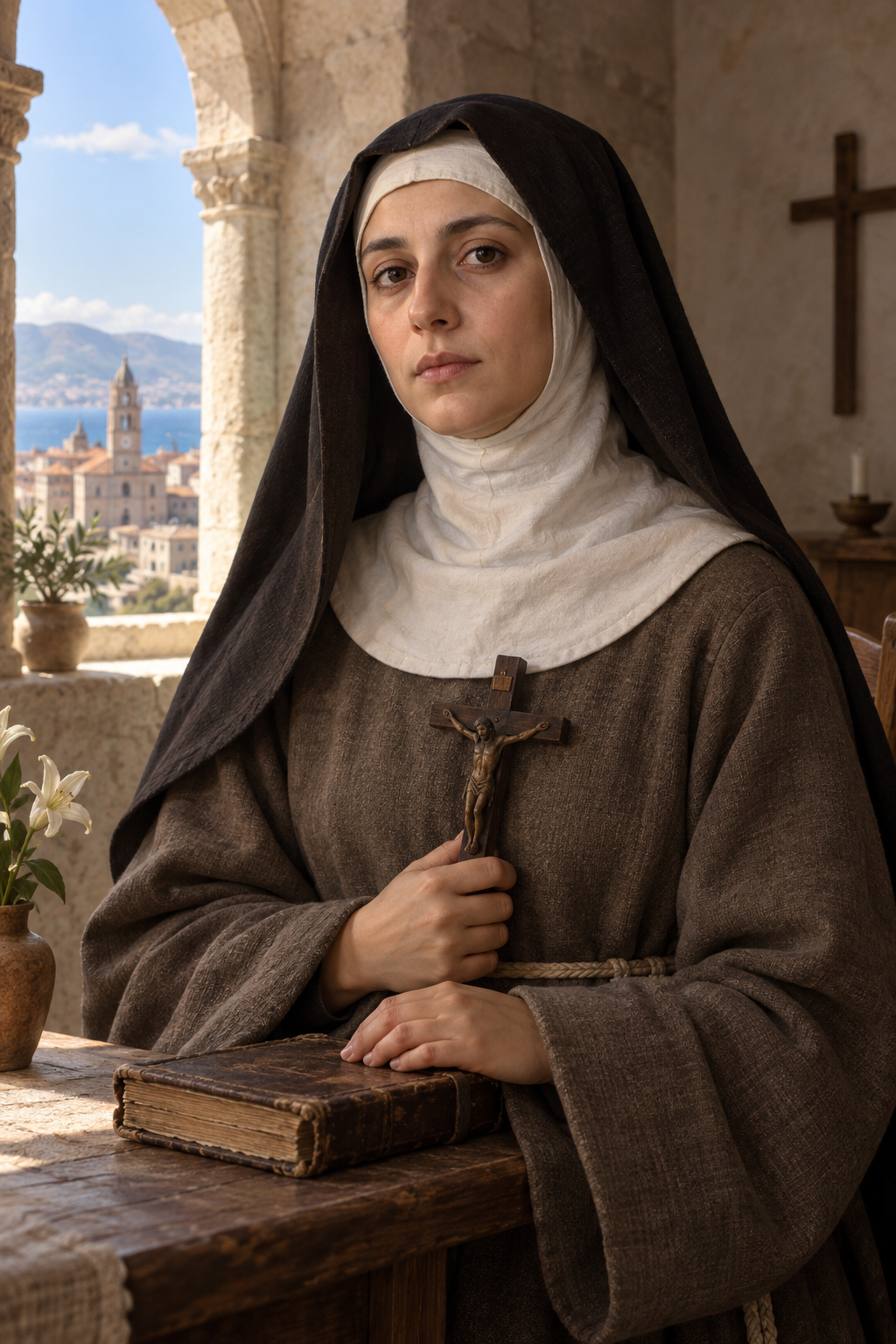
Artwork should show a Poor Clare, not a queen, noblewoman, or generic veiled saint. The generated portrait uses a simple Franciscan habit, veil, crucifix, prayer book, and Messina/monastery background.
That visual restraint matters because Eustochia's witness is marked by poverty and enclosure. Jewel-like clothing or theatrical mysticism would contradict the sources' basic emphasis.
The death date requires explicit care. The current catalog stores January 29, 1485, as the death date and January 20 as the Roman Catholic feast.
The Dicastery profile supports the death at Montevergine and gives the liturgical memorial separately, so this draft preserves both the death date and the feast field while flagging the reconciliation for final review.
That distinction should be visible to reviewers. A feast day is not always a death date, and this packet should not overwrite either field merely to make them match.
Eustochia died at the Monastery of Montevergine, Messina. The catalog already stores that death place, and local sources support the place memory.
She was canonized by John Paul II in Messina on June 11, 1988. The canonization homily locates her within the Church's public recognition and within local Sicilian devotion.
The canonization setting matters because it returns the story to Messina, where her life, death, and memory are concentrated.
The final biography should therefore keep the scale local and monastic. It need not stretch thin evidence into a sweeping history of Sicily or Franciscan reform.
What can be said responsibly is clear: Eustochia Smeralda Calafato was a Messina Poor Clare whose pursuit of stricter religious life and Montevergine community became an enduring Catholic memory.
Her witness is not spectacular power but disciplined poverty, prayer, and the renewal of a religious house. That is enough to make the page meaningful.
The final page should leave readers with a Sicilian Poor Clare in a simple monastery room, holding crucifix and prayer book, rooted in Messina and in the Franciscan search for a poor and faithful life.
This modest focus protects the evidence. The surviving public record supports birth, place, Poor Clare identity, Montevergine, death, feast, and canonization; it does not require a long catalogue of legends. A shorter but honest emphasis on reforming fidelity is stronger than decorative storytelling.
The profile should also explain the date distinction clearly enough for readers and reviewers. January 29, 1485, remains the death date in the catalog, while January 20 remains the liturgical feast. Treating both as reviewed fields avoids the common mistake of turning a feast into a biographical date or vice versa.
Within those boundaries, Eustochia can still be presented warmly. Her life shows the dignity of women religious whose hidden discipline shaped a place, a house, and a local Catholic memory over centuries.
That memory is enough for a responsible page. It gives readers a named woman, a named city, a named monastery, a tested Franciscan vocation, and a canonized public witness without forcing the profile into unsupported drama.
Artwork should avoid wounds, extreme fasting imagery, jewels, aristocratic display, glowing visions, readable text, halo, and exact-likeness claims. The badge should keep her face, veil, crucifix, prayer book, and Messina context visible.
Wondering how to weigh the stories and sources? Learn how to read a saint biography.