Biography
Euthymius the Younger
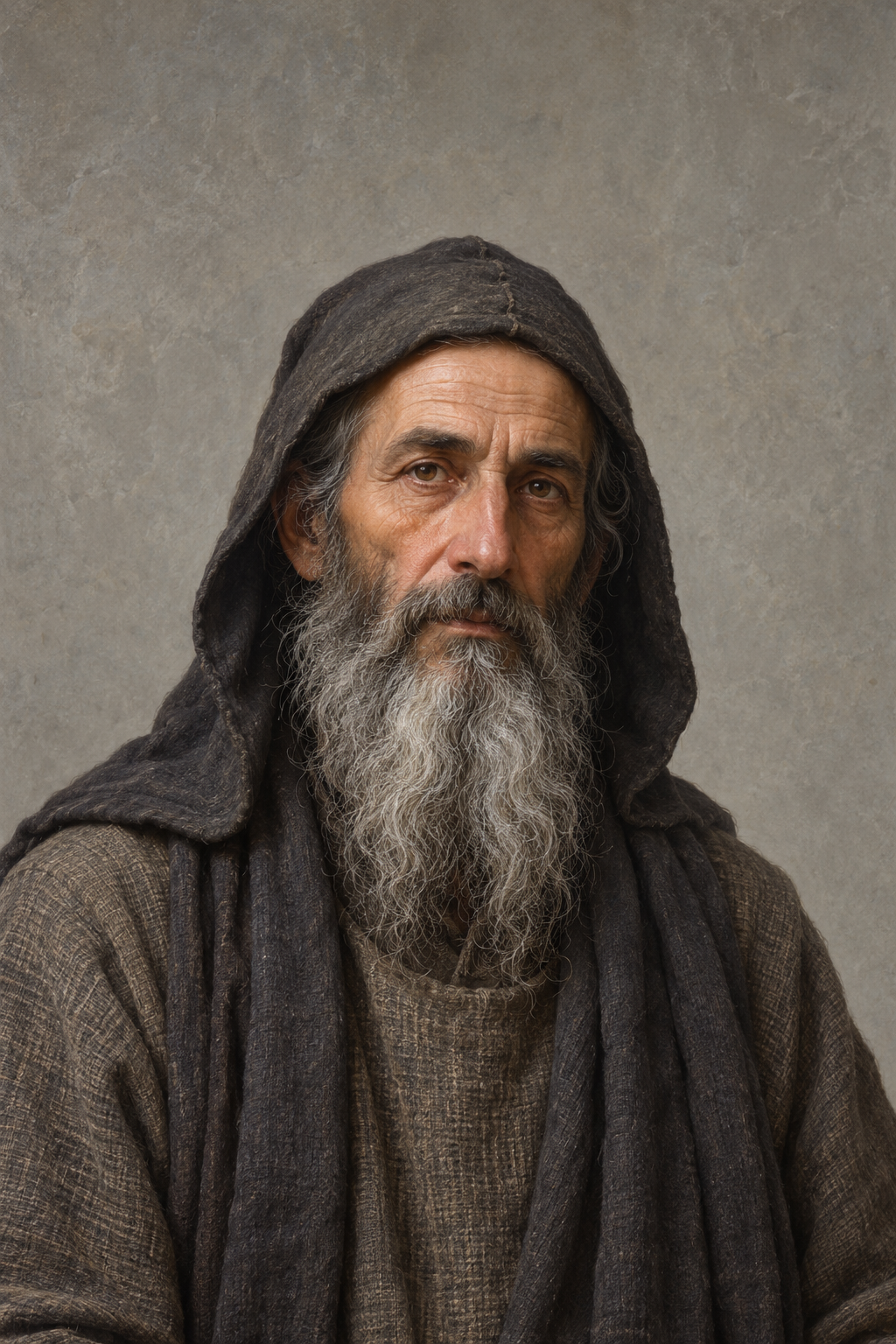
About Euthymius the Younger
Euthymius the Younger was a ninth-century monk whose life moved between solitary retreats and the leadership of communities. He came from the region of Ancyra and became one of the early figures of monastic life on Mount Athos. His story survives in a medieval Life, presented in a modern critical edition and English translation in Holy Men of Mount Athos.
His place in Athonite history belongs to its earlier hermit tradition. He lived before Athanasios founded the Great Lavra in the following century, when large communal institutions became a more prominent feature of the mountain’s monastic life.
Before becoming a monk, he was called Nicetas. The Orthodox account describes his military service, marriage and the birth of a daughter. He then left home secretly to enter a monastery on Mount Olympus in Bithynia. The decision separated him from his family; the account does not describe a departure agreed upon with his wife. Years later, on his way to Athos, he learned that she and his mother were alive and sent word of his monastic life.
On Athos he practiced a particularly solitary form of ascetic life. He also lived as a stylite near Thessalonica, receiving visitors who sought his advice. The same tradition remembers him as both a seeker of silence and a teacher to those who came to him.
His life also included care for an earlier teacher. He returned to Olympus and brought Theodore to Athos, building a cell for him. Theodore’s illness later required a move to Thessalonica; after his death, Euthymius went there to honor his grave. The scholarly prosopography traces further moves between Athos, islands and the mainland. It reports the Life’s account of capture by pirates and a release attributed to a miracle. After this danger, Euthymius and his companions sought safer places. Near Brastamu, he provided cells for disciples while withdrawing into a nearby ravine himself. Scholars differ over whether this settlement should already be called a monastery or understood as a group of separate cells.
The local church connects his later work with the monastery of Saint Andrew at Peristera. Its account describes the rebuilding of a neglected church and the formation of communities for men and women. His family eventually became part of this monastic history: his grandson Methodios and granddaughter Euthymia were appointed to lead the respective communities before he withdrew again.
At Peristera, the rebuilding required local cooperation. The Life describes the ruined church as so deeply buried that its remains served as an enclosure for animals. Euthymius helped uncover the foundations, and local people contributed materials and labor. This account makes the foundation a shared undertaking, involving villagers as well as the monk who became its spiritual leader.
The repeated journeys are a striking part of his story. In her study of Byzantine monastic travel, Irene Jacobs distinguishes journeys for training, loyalty to earlier companions, safety and leadership from those made in search of inner stillness. She observes that the Life gives special prominence to this last motive. The search did not always lead to lasting seclusion: a reputation for holiness could attract the very crowds from which an ascetic had withdrawn. Jacobs reads Euthymius’s movements as part of the author’s presentation of spiritual growth, while recognizing the continuing demands of care for others.
He spent his final days on the island called Hiera, where the local account dates his death to October 15, 898. The Life was written by Basil, a disciple who had known him. It is also a work of praise, shaped to honor a spiritual father and encourage devotion. Jacobs notes that its precise date and original setting for public reading remain uncertain. This closeness to the saint gives the account particular value, but its devotional purpose still matters when reading its descriptions of virtue, ascetic struggle and extraordinary events.
The foundation at Peristera also has a history beyond its founder. Architectural historian Alessandro Taddei places it before the great expansion of Athonite monasteries in the tenth century. He describes its later loss of independence and incorporation into the Great Lavra’s network. Of the earlier monastic complex, the church alone survives. Its unusual plan arranges curved spaces around a central square, with additional chapels beside the sanctuary. Taddei suggests that it may have influenced some later monastic churches, while presenting that architectural connection as a possibility. The building therefore remains evidence of an early community whose institutional fortunes changed after Euthymius’s death.
His remembrance remains closely tied to Peristera. The church of Saint Andrew houses relics venerated during the annual October celebrations. Municipal notices describe services beginning on the eve of his feast and continuing on October 15.
The Metropolis of Ierissos, Mount Athos and Ardameri explicitly calls him Peristera’s patron. His connection with the village thus includes both its monastic past and its continuing worship.
Wondering how to weigh the stories and sources? Learn how to read a saint biography.