Biography
Fantinus the Younger
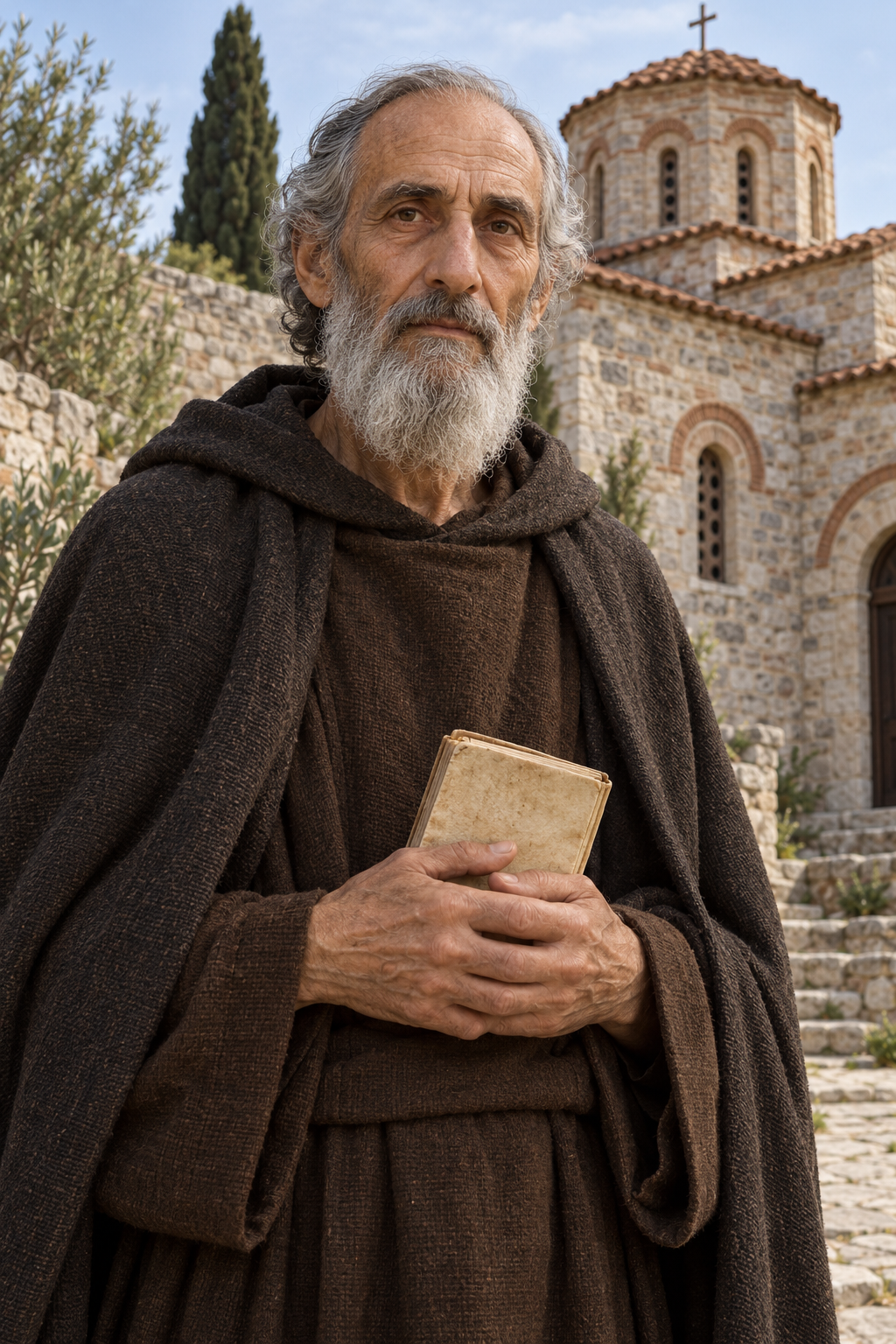
About Fantinus the Younger
Fantinus was a Calabrian monk whose life carried him from the mountains of southern Italy to Thessalonica. He combined periods of solitude with the founding and care of communities. His surviving biography remembers both the severity of his ascetic practice and his concern for people who needed help.
His birthplace is known only broadly. The medieval author identifies Calabria but gives no secure settlement, describing it from the distant perspective of Thessalonica. The museum catalogue cautions against reading more precision into that account. According to the Life, his parents placed him in a monastery as a child, where his formation was associated with an abbot named Elias, probably Elias the Cave-Dweller. The account later describes a long retreat from communal life into the mountains.
The critical prosopography records his early duties in the kitchen and then in the church. It also identifies him as a copyist. His later foundations received members of his own family, and his brother Luke took responsibility for administering the men’s community. The sources also associate Fantinus with the formation of Nilus of Rossano in the Mercurion region.
The sequence cannot be assigned an exact timetable. The chronology of his own Life conflicts with that of the Life of Nilus: one places him in solitude when the other describes him receiving Nilus in a community. The modern prosopography explicitly warns against harmonizing those accounts.
His name once caused another difficulty. Older scholars sometimes separated the Calabrian teacher from the monk who died in Thessalonica, because different groups of sources emphasized different parts of the story. Enrica Follieri’s recovery and publication of a fuller Life connected the two. Its Calabrian monk meets Nilus and later travels east. This Fantinus must nevertheless remain distinct from Fantinus the Elder of Taureana, whose earlier tradition concerns a servant remembered for caring for horses.
The Calabrian account gives a prominent place to a vision of judgment and blessedness. The museum study compares it with the different treatment in the Life of Nilus.
The Life presents his departure as a response to an angelic command. He traveled with two disciples, Vitalius and Nicephorus, crossing to the Peloponnese and passing through Corinth and Athens. Georgios Tsiaples notes that the biographer supplies little detail about those stops. After recovering from an illness, Fantinus stayed at the church of Achillius in Larissa, where the narrative describes him teaching.
At Larissa the narrative also attributes to him a warning about a future Bulgarian attack. The listeners initially understand his words as a reference to an earlier disaster, but he insists that something worse lies ahead. Tsiaples discusses this episode in relation to the city’s sacred history.
On reaching Thessalonica, he stayed for nearly four months at the church of Menas. News of his arrival reached the city’s governor and archbishop. His Life also recounts an encounter with Athanasius of Athos and Paul, another Athonite monk, near an eastern gate.
In Thessalonica, his reputation extended beyond the monastery. Francesca Luzzati Laganà’s study of the Life emphasizes its portrait of an ascetic involved in public affairs. The narrative describes him challenging an oppressive judge and intervening when officials intended to destroy buildings outside the walls before an attack. Such stories show the role his community attributed to him as an advocate for vulnerable people. Their miraculous elements belong to the hagiographic account.
Follieri reconstructed a lifetime beginning around 902 and ending in 974. Her edition dates the surviving Life after 986 and probably before 996, placing its composition relatively near his death. Luzzati Laganà explains that this reconstruction draws on comparisons with other saints’ Lives and manuscript evidence. The approximate years are useful, but the conflicts within the narratives caution against presenting every age and interval as equally certain. Fantinus died at Thessalonica, the city that preserved the final part of his story.
His remembrance also continued in Calabria. Lubrichi honors him as its patron, and its local heritage account documents the statue used in that devotion. The early twentieth-century figure replaced an older image and was welcomed in 1908. A community fundraising effort supported its restoration in 2015, with the completed work presented alongside the local pastoral community and diocese.
Wondering how to weigh the stories and sources? Learn how to read a saint biography.