Biography
Felix of Cantalice
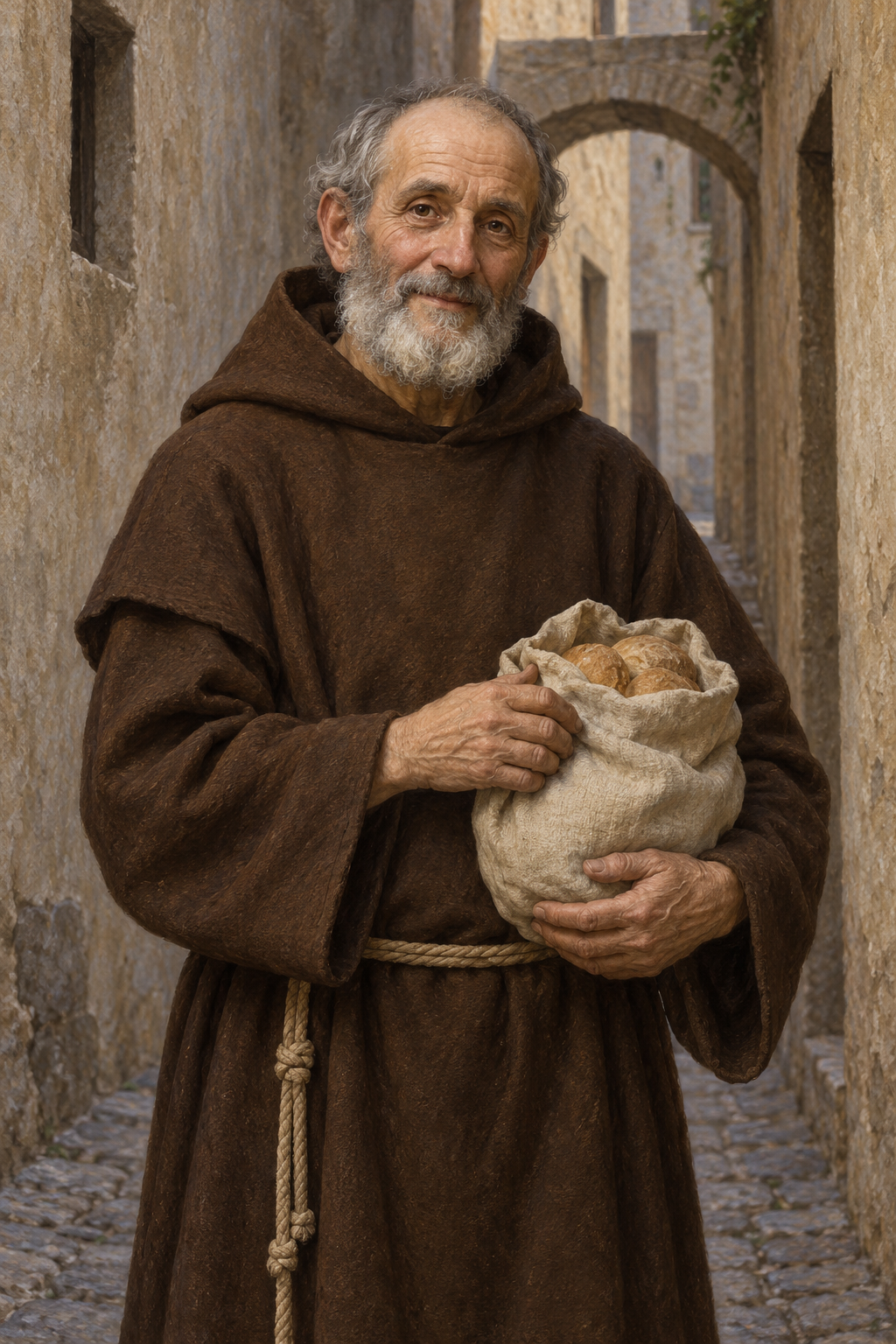
About Felix of Cantalice
Felix of Cantalice grew up among farming families near the village of Cantalice, northeast of Rome. The New Catholic Encyclopedia dates his birth to 18 May 1515. As a child and young man, he worked with animals and on the land. This was practical work requiring long days away from books, and the later accounts agree that he never learned to read.
The Catholic Encyclopedia describes his early attraction to the lives of the Desert Fathers. It says that he sought a form of religious life in which prayer and work could be held under a community rule. The Capuchins, a newly established branch of the Franciscan family, eventually admitted him. He received the habit at Anticoli in 1543 and made his profession the following year.
After several years of formation, Felix was sent to Rome in 1547. The New Catholic Encyclopedia says that he remained there for about forty years as a lay brother serving his friary as a questor. He walked through streets and shops asking for food and alms for the community. His work also brought him into contact with people who needed the food and help that the brothers could share. This was the ordinary shape of his vocation, repeated day after day rather than concentrated in a single dramatic journey.
The Capuchin order remembers him as a man who greeted others with “Deo gratias,” or “Thanks be to God.” The same account says that he assisted sick and poor people and invited children to sing religious songs. His task of seeking gifts made him a familiar presence in the city; his encounters with children became part of how he taught. His work joined practical care to a public religious witness in a way that did not require schooling or an ordained office.
The Catholic Encyclopedia gives a concrete example from the famine of 1580. It says that Roman charity organizers asked his superiors to make him available to gather alms for those without food. The request suggests that his daily rounds had given him both a network of donors and the trust needed to ask on behalf of hungry neighbours. The old account praises his endurance, but it does not provide an independently counted total of the food he secured.
He also formed friendships across the city. The Capuchin account names Philip Neri as a close friend and says Charles Borromeo sought his conversation. The Catholic Encyclopedia adds stories about meetings with prominent churchmen and Roman residents. Such anecdotes are shaped by later devotional writing; they should not turn Felix into an adviser to every famous figure of his century. They do show the unusual reach of a brother whose formal assignment was to gather the friary’s daily support.
Felix died in Rome on 18 May 1587 according to the New Catholic Encyclopedia and the Catholic Encyclopedia. The Capuchin order’s short biography instead gives 8 May, a conflict that should remain visible to reviewers. The encyclopedia dates are supported by its feast-day notice and by the account that he died on the anniversary of his birth and profession. The profile uses the corroborated 18 May date, but neither source is a contemporary death register.
Urban VIII beatified Felix in 1625, and Clement XI canonized him in 1712. The New Catholic Encyclopedia identifies him as the first Capuchin saint. His tomb in the Capuchin church of the Immaculate Conception in Rome and his 18 May commemoration continued the city’s memory of him. Later images often show him holding the infant Jesus, referring to a visionary tradition. That motif is not a documented likeness or an event this profile treats as ordinary history.
In a 2015 letter on lay brothers, the Capuchin general minister placed Felix of Cantalice beside Felix of Nicosia, another brother who served as a questor. He presented their work as a model of fraternity and service, rather than a lesser form of religious life. That connection still matters: Felix’s legacy rests in a sustained practice of meeting people, gathering what they could give, and carrying help to those who lacked it.
Wondering how to weigh the stories and sources? Learn how to read a saint biography.