Biography
Finbarr of Cork
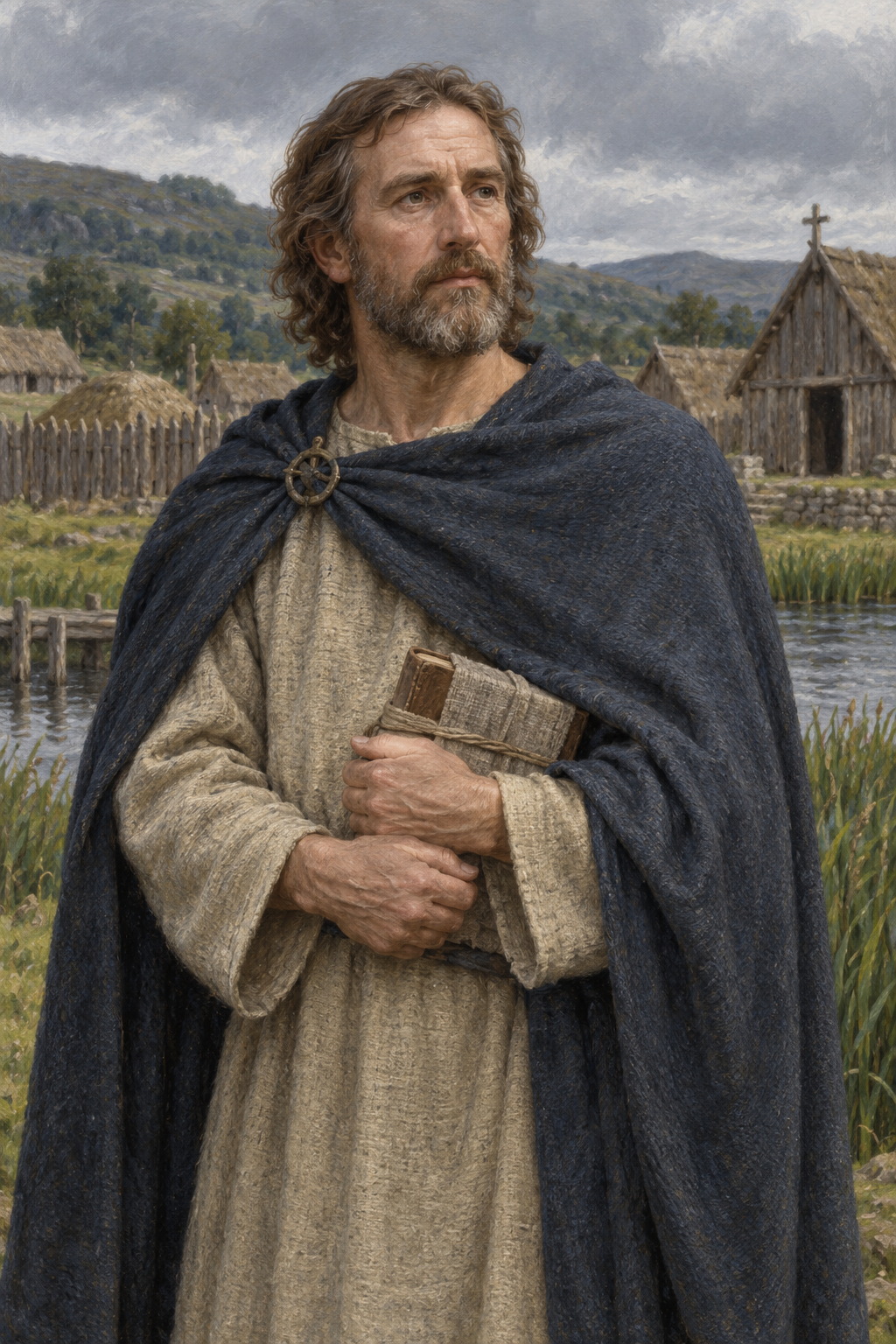
About Finbarr of Cork
Finbarr of Cork is remembered as the church founder whose name remains attached to Cork and to places along the River Lee. The Church of Ireland cathedral and the Catholic shrine at Gougane Barra preserve this local devotion. The familiar story places him in the sixth or early seventh century, but the earliest surviving extended Life was written much later. A reader can therefore follow both the remembered life and the history of how Cork came to tell it.
According to the cathedral’s traditional account, his father Amergin settled in the Muskerry area and the boy was first named Luan or Lochan. It says that three clerics took him for education and that a comment on his fair hair led to the name Finn Barr. The same narrative includes a storm that saved his parents from execution. These are features of a later saint’s Life, not facts preserved in a contemporary birth record.
The cathedral history also places his teaching and monastery at Cork around 606 and his death at Cloyne in 623. It says his remains were brought back to the cathedral site. These precise years are not supplied by a contemporary chronicle. Pádraig Ó Riain’s Dictionary of Irish Biography entry explains that the surviving Life first took written shape at the end of the twelfth century, centuries after the events it describes. The profile therefore leaves life dates and death place unset while recording the later account clearly.
That late Life connects Finbarr with a series of religious sites: a church near Macroom, Gougane Barra, and finally a school and church at Cork. The Catholic Diocese of Cork and Ross continues to maintain the shrine at Gougane Barra, which the tradition treats as a place of retreat and prayer. The cathedral stands on another site long associated with the saint. Such sites show the durability of his memory; they cannot by themselves prove each stage of the itinerary.
Ó Riain offers a further historical caution. He argues that important episodes of Finbarr’s Life can be explained by the ecclesiastical concerns of late twelfth-century Cork. The bishop of Cork then had reason to establish claims over neighbouring religious areas, including Cloyne and Ross. The story of teachers and churches honoring Finbarr may express those institutional claims as much as memories of a single founder’s travels. This does not erase the local tradition, but it changes how its detailed route should be read.
There is also an unresolved identity question. Ó Riain suggests that the Cork saint may have been a local version of an older figure known as Finnian or Findbarr of Movilla. Noel Kissane’s Dictionary of Irish Biography entry on Finnian of Clonard reports the same argument and regards it as persuasive. Shared names, teaching reputation and a nearby cluster of feast days are part of the case. The proposed identification is a scholarly conclusion, not an established personal record that permits the two profiles to be silently merged.
The 25 September feast is itself evidence of a long Cork cult. Ó Riain notes that it lies close to dates associated with Finnio or Finniavus, a connection relevant to the identity debate. In the present, Church of Ireland communities in Cork commemorated a traditional 1400th anniversary of Finbarr’s death in 2023. That celebration illustrates his enduring importance to Cork, while the historical arithmetic depends on accepting the traditional year 623.
Finbarr remains a patron of place, worship and learning in Cork. His name marks the cathedral, a Catholic shrine and the wider city’s memory. The strongest evidence in this profile concerns that continuing devotion and the medieval construction of his Life; the individual’s exact family, movements and dates remain uncertain. Presenting those layers together lets the local story be heard without turning every feature of a late narrative into an early historical fact.
Wondering how to weigh the stories and sources? Learn how to read a saint biography.