Biography
Fintán of Taghmon
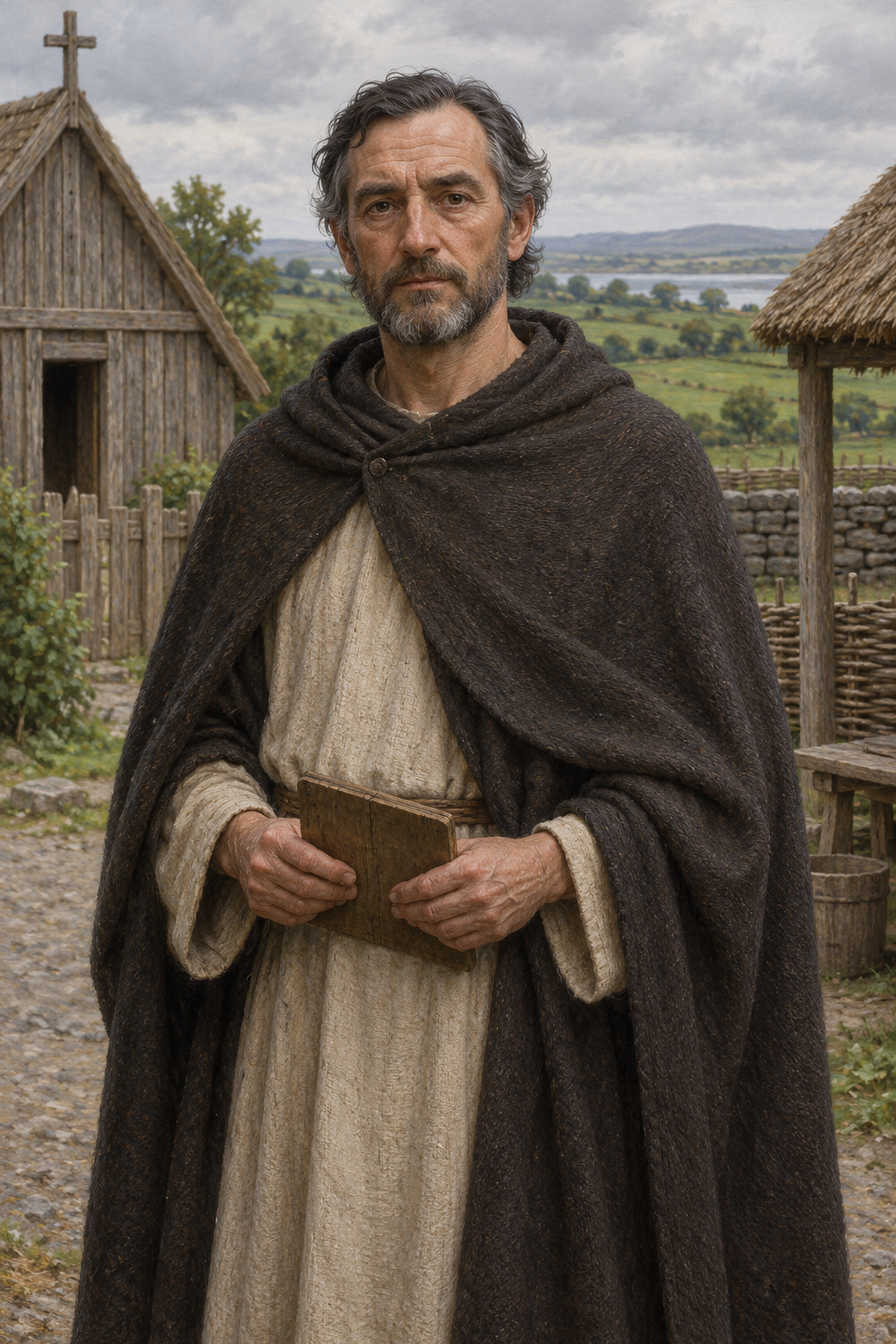
About Fintán of Taghmon
Fintán of Taghmon, also called Munnu, was an Irish abbot associated above all with the monastery of Tech Munnu in what is now County Wexford. He is separate from Fintan of Clonenagh, another early Irish monastic founder. Aidan Breen’s Dictionary of Irish Biography entry records Munnu’s death in 637, while older reference works give 634 or 635. The profile uses the critical entry’s year and leaves the date and place of birth unsettled.
Breen describes his early training at Achad Broan under a priest named Grellán and later at Bangor under Comgall. A medieval Life translated by University College Cork tells these years with signs and wonders, including a tale of wolves guarding his father’s sheep. Such details show the saint’s remembered calling, but do not furnish eyewitness evidence for the events of his childhood. The Life names his father Tulchán; this belongs to its transmitted genealogy.
A story in Adomnán’s Life of Columba, summarized by Breen, places Fintán at Iona after Columba’s death. Abbot Baíthéne declines his request to join, explaining that Columba had said Fintán should be an abbot himself. The story gives religious meaning to a journey and to his later leadership. Its prophetic element is part of the narrative, not an independently verified prediction. The New Catholic Encyclopedia also links Munnu with Scotland before his foundations in Ireland.
Breen says Fintán established a house called Taghmon in what is now County Westmeath, then spent twelve years at Aird Chrema in the south-east. Later he moved to Achad Liathdroim, where a local leader named Dímma granted land. The place became Tech Munnu, or Taghmon, in County Wexford. Taghmon Heritage retells that foundation tradition and notes the survival of later abbots in Irish annals. The community developed a lasting institutional identity, even if every stage of its founder’s itinerary is not equally secure.
His community was remembered for strict discipline. Breen describes a difficult relationship with monks at Aird Chrema and later stories in which Fintán’s severity brought consequences to himself. The medieval Life includes accounts of illness and miracles; its purposes are devotional as well as biographical. These traditions should neither be flattened into a medical diagnosis nor used to excuse harsh treatment as a general rule for religious leadership.
Fintán also appears in a dispute about the calculation of Easter. Breen says that he resisted the newer cycle accepted by the southern Irish churches and did not attend the synod at Mag Léne. He later opposed reforming views at another synod, Mag nAilbe. A letter from Cummian to Ségéne may allude to him, but the identification is inferential rather than certain. The issue concerned the date of the central Christian festival and showed how monastic communities negotiated differing inherited practices.
The Dictionary of Irish Biography notes several Lives and later dedications in County Wexford. Taghmon Heritage traces the monastery’s continued presence in annalistic records into the eleventh century. These traces matter because Fintán’s significance is not confined to the narratives about his own conduct; a community linked to his name endured after him. Irish martyrologies commemorate him on 21 October, while some other reference traditions use different dates.
The University College Cork edition makes the medieval Life available with its manuscript and translation history. It identifies the surviving text as part of a larger group of Irish saints’ Lives, rather than a contemporary journal kept by Fintán. Reading that Life alongside annals, reference scholarship and local heritage gives a more careful account of Munnu: an abbot whose monastery and Easter dispute are historically significant, with many personal episodes preserved as tradition.
Wondering how to weigh the stories and sources? Learn how to read a saint biography.