Biography
Francesco Maria da Camporosso
About Francesco Maria da Camporosso
Francesco Maria da Camporosso was born on December 27, 1804, at Camporosso near Ventimiglia. The catalog stores that birthplace and full date, and this draft preserves both fields.
His public Catholic memory is Capuchin and local. He is remembered not as a priest or preacher in vestments, but as a lay brother whose holiness was shaped through humble service.
That distinction is important. The artwork and article should avoid Mass imagery, priestly stoles, or any suggestion that he held clerical office.
Francesco entered Capuchin religious life and took up the ordinary discipline of prayer, fraternity, poverty, and service. The Capuchin sources preserve him as a brother of practical charity.
He became associated especially with Genoa. There, his work as questor brought him into contact with households, workers, the poor, and the port city's daily needs.
The biography should explain questor in simple terms rather than leaving it as an opaque title. He sought alms and help for the friars and the poor, turning a humble assignment into a path of charity.
That role can be easy to romanticize. The page should not portray poverty as picturesque. Francesco's witness was made of repeated errands, listening, prayer, and material help.
The Archdiocese of Genoa source connects him with local devotion as "Padre Santo," a popular title that should be explained without making him a priest in the artwork.
The catalog classifies him as `Monk / Nun`, which functions here as a broad religious class. This draft preserves the field but makes the lay-brother identity explicit in prose.
Francesco's life was not defined by public office. That makes the story particularly useful: holiness appears in a person without worldly power, performing ordinary service with extraordinary constancy.
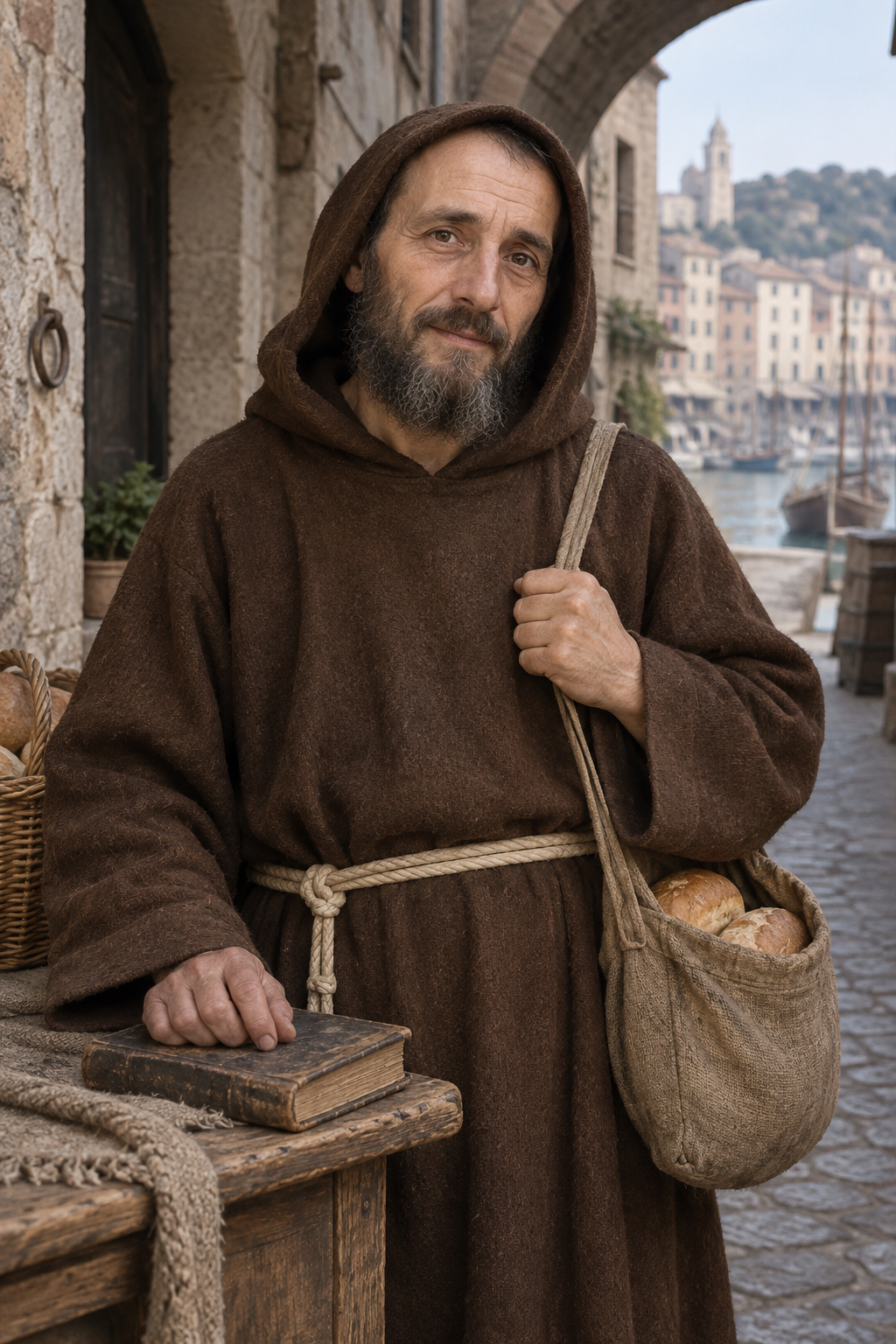
The generated portrait follows that reading. It shows a Capuchin brother in a brown habit with cord, alms bag, bread, book, and Genoese street or port context.
Those visual details are not proof of a historical likeness. They are devotional symbols chosen to communicate the supported identity: Capuchin lay brother, charity, and Genoa.
The sources place his death on September 17, 1866. The catalog stores that death date and Roman Catholic feast day.
The structured death-place field is currently blank. Sources strongly connect his final life and death with Genoa, but this draft preserves the blank field until final review rather than changing it silently.
That boundary should be visible in the approval packet. The biography can still show Genoa as central without mutating a structured field before approval.
Francesco was beatified by Pius XI in 1929 and canonized by John XXIII on December 9, 1962.
The canonization belongs near the end. His story is not chiefly a ceremony in Rome; it is a pattern of Capuchin charity in Genoa.
The article should avoid inflated claims that he single-handedly transformed the city. The reliable witness is more concrete and more credible: he served people, gathered help, prayed, and became a beloved sign of mercy.
It should also avoid turning him into a generic Franciscan. The Capuchin habit, lay-brother status, alms bag, and Genoa context give the page its shape.
His enduring significance is the dignity of small service. Francesco shows how a humble religious assignment can become a lifelong ministry of presence, mercy, and practical help.
The final page should leave readers with a Capuchin brother walking through Genoa with an alms bag, meeting need without spectacle and making charity a daily habit.
That daily habit is the center of the profile. Francesco's work was public in the sense that people encountered him in streets and homes, but it was not public office or performance. He becomes memorable precisely because he carried out small services with steadiness, humility, and tenderness.
The death-place question should remain visible. The sources strongly connect his final life and death with Genoa, but the current structured field is blank. The final approval packet can decide whether to update it; this draft records the evidence without silently altering the catalog.
His Capuchin identity should also shape the tone. Poverty, fraternity, begging for others, and simple presence among the poor are not decorative details; they are the supported frame for understanding his holiness.
The final page should therefore be concrete rather than ornate. Bread, an alms bag, a worn habit, a convent doorway, and Genoa's streets communicate more than grand spiritual language would. They fit the sources and keep his lay vocation clear.
This also protects the profile from a common mistake. Because many canonized men are priests, readers may assume Francesco was one. The biography and art should gently correct that assumption by naming him as a Capuchin lay brother whose holiness was visible in service rather than sacramental office.
Artwork should avoid priestly vestments, Mass imagery, halos, readable text, modern charity branding, dramatic plague scenes, and exact-likeness claims. The badge should keep his face, hood, cord, alms bag, book, and Genoa context visible.
Wondering how to weigh the stories and sources? Learn how to read a saint biography.