Biography
Franz Jägerstätter
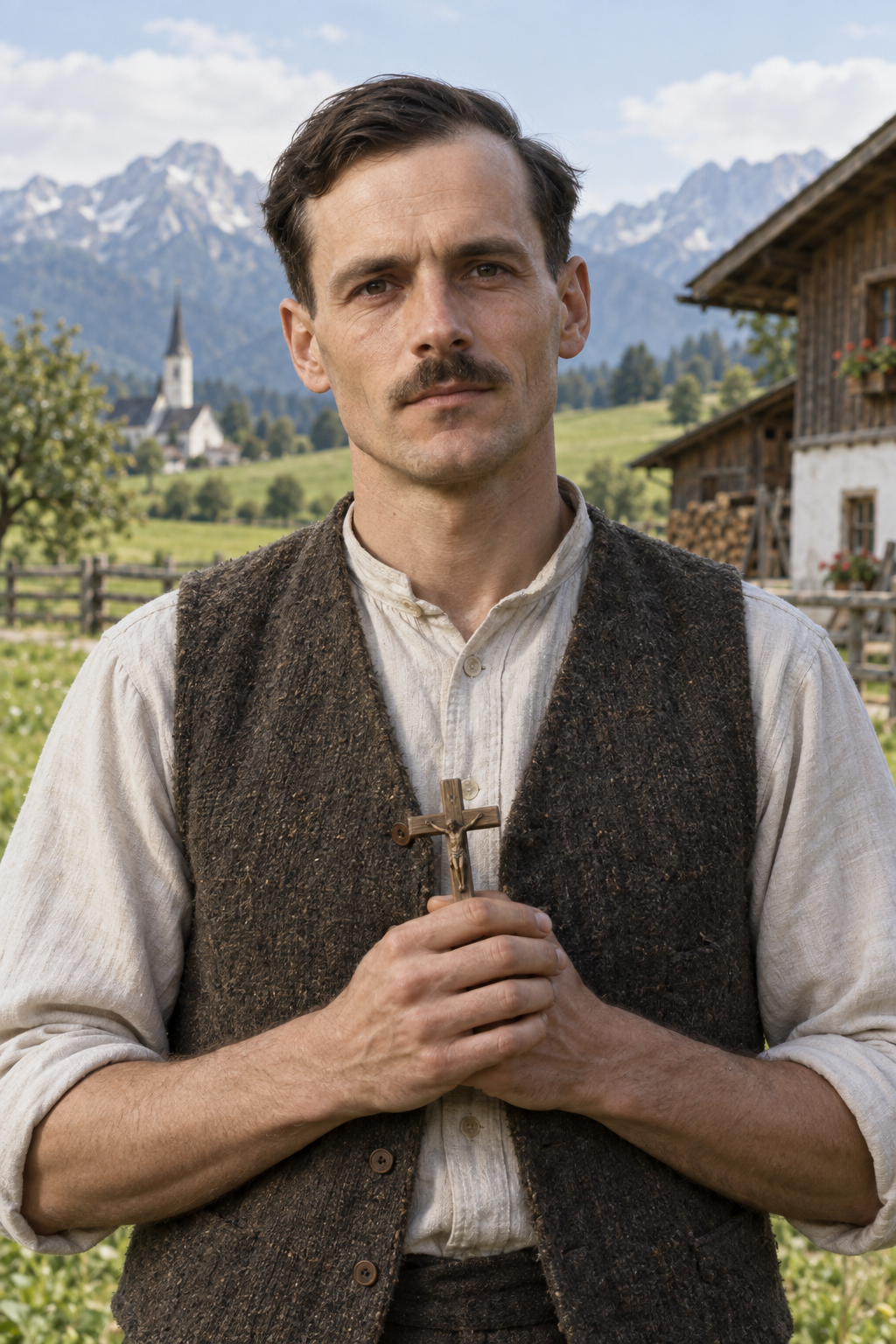
About Franz Jägerstätter
Franz Jägerstätter was born on May 20, 1907, at Sankt Radegund in Upper Austria. His parents were not married, and his father died in the First World War. After his mother married Heinrich Jägerstätter, the boy was adopted into the farming household. His formal schooling was modest, but reading gave him opportunities beyond the classroom. He was not remembered only as a solemn religious figure: as a young man he enjoyed a motorcycle. The choices for which he later became known grew out of a life with work, family ties and pleasures of its own.
He worked away from home in Eisenerz before returning to the farm. In 1933 he became the father of Hildegard, whose mother was Theresia Auer. His marriage to Franziska Schwaninger in 1936 brought a renewed seriousness to his Catholic faith. They had three daughters together. Family life and prayer were not separate worlds for the couple. The diocesan biography recalls their shared religious life and Franz's growing involvement in the parish. He served as sacristan, while continuing the responsibilities of a farmer and father.
Hildegard later remembered him as an attentive father. He visited her and invited her to the annual fair. She recalled his effort to notice what she liked and make sure she received it. Her recollection adds a relationship that can disappear when his family is described only through the three children of his marriage.
The Nazi takeover of Austria sharpened the demands on his conscience. He rejected the Anschluss in 1938. The persecution of clergy and the murder of disabled people strengthened his opposition to National Socialism. In 1940 he joined the Franciscan Third Order. Faith shaped his resistance.
An undated reflection, probably written shortly before his final call to service, shows him working through the problem of obedience. He had once accepted military duty as something owed to lawful authority. But he came to see that the Nazi state required allegiance to its ideology, not just performance of a soldier's task. Compulsory participation in the Hitler Youth helped him recognize that distinction. He also challenged the description of the war as defensive. His argument allowed for legitimate defense while rejecting the war being fought by this regime. That distinction matters to his story: his final refusal was a considered judgment about the service demanded of him, not evidence that he had always refused every possible war.
He had already served as a military driver in 1940 and 1941. His home community obtained his release to return to agricultural work. Back at home, he attended Mass, prayed and fasted while considering what another summons would require. Friends and clergy urged a different course, but his judgment became more definite. He could not agree to fight for Hitler.
When called again in 1943, he reported but refused military service. He offered to undertake work that would not require violence. Arrest separated him from his wife and children, first in Linz and then in Berlin. The decision was now being tested in custody, far from the farm.
The military justice system gave him no protection for acting from religious conviction. As historian Verena Lorber explains, its rules treated conscience as no exemption from punishment. The courts placed the demands of the Nazi war effort above the defendant's moral reasoning. Procedures were designed for speed, and the ordinary possibilities of appeal had been removed. For Franz, explaining his conviction could not make the authorities recognize it as a right. He faced a system in which refusal itself was punishable, even when grounded in faith rather than an attempt to encourage others to rebel.
His prison correspondence still turned toward home. He wrote about plants and birds, and remembered the children's flowers. His writings distinguished rejection of Nazi ideas from condemnation of individual people. He left the ultimate judgment of those who served or died at the front to God.
Franziska did not find his decision easy. Their marriage had begun with a honeymoon pilgrimage to Rome. They had shared a happy family life together, including his enjoyment of caring for their three young children. She had hoped to save his life, yet she continued to stand beside him. During his absence she had the farm and children to look after, carrying the practical burdens of their separation as well as its uncertainty and grief. In July 1943 she traveled to Berlin with their parish priest for a final visit. Guards refused the food she brought. They embraced and received the priest's blessing. The separation left her to continue caring for their family while he awaited execution.
Franz was executed at Brandenburg on August 9, 1943.
Franziska lived to attend his beatification in Linz in 2007. When she was welcomed there, the congregation's response made visible how differently his witness had come to be received.
Wondering how to weigh the stories and sources? Learn how to read a saint biography.
Explore similar vocations
Prayers for Franz Jägerstätter
Petition through Blessed Franz
Gewähre uns auf seine Fürsprache, dir mit ungeteiltem Herzen entgegenzugehen, der du allein unser Leben und unser Heil bist.