Biography
Franziska Schervier
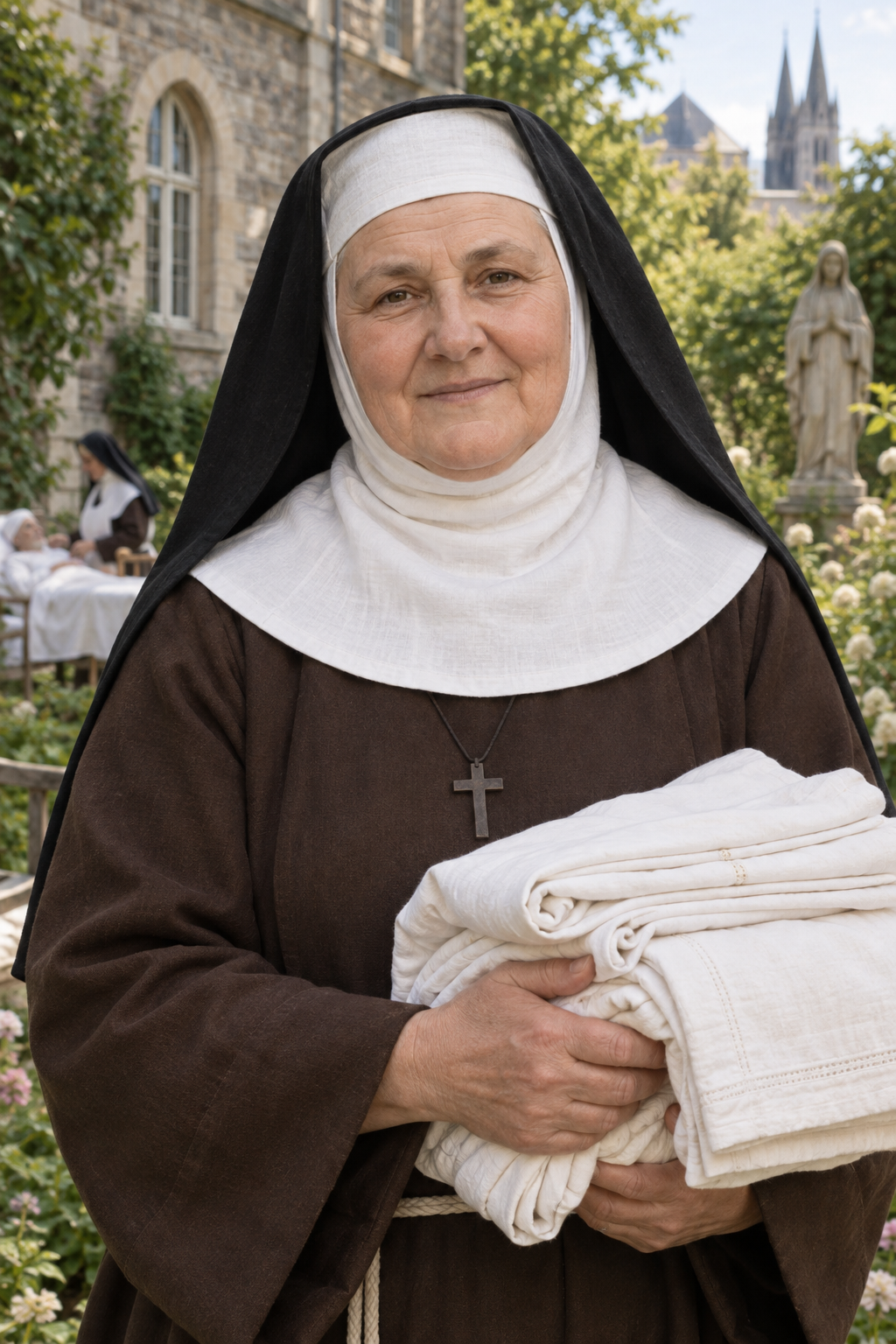
About Franziska Schervier
Franziska Schervier was born in Aachen on January 3, 1819, into the household of a prosperous needle manufacturer. Aachen stood in a western German industrial region near Belgium and France. New manufacturing created wealth while leaving many workers and families without secure housing, education, or medical care. Paul VI placed her life explicitly within these social changes when he spoke at her 1974 beatification. The official record gives the broad span of her life, from 1819 to 1876, and describes the unequal conditions that shaped her attention to poor people. Later institutional biographies add the exact birth date and identify her father’s trade. These sources were written after the events, but their converging chronology and the formal cause record make the basic facts well documented.
Her family’s position gave Franziska material security, but it also placed industrial poverty close to her daily world. Accounts maintained by her congregation and Aachen parish describe her work in Saint Paul’s soup kitchen and sickrooms before she founded a community. She helped arrange housing for working families and schooling for factory children, and she nursed people during cholera and smallpox outbreaks. These were practical responses to needs that public provision did not adequately meet. The record does not support a sentimental picture in which one benefactor solved Aachen’s poverty alone. Franziska worked beside other women, parish networks, civic authorities, and the people receiving care. Her early service is best understood as organized local action within a city undergoing rapid economic change.
At Pentecost in 1845, when she was twenty-six, Franziska and several companions began the Poor Sisters of Saint Francis in Aachen. The community joined Franciscan simplicity and prayer to direct care for people who were sick or excluded. Its members served poor households, prisoners, women in prostitution, condemned prisoners, orphans, older people, and those wounded by war. The name sometimes appears in English as the Franciscan Sisters of the Poor, but the German foundation should not be confused with every later congregation using similar words. Franziska’s role was that of a religious sister and foundress, not an ordained minister. The foundation depended on companions who accepted common disciplines and carried the work into institutions that one person could never have sustained.
The congregation’s growth required administration as well as compassionate presence. Franziska dealt with church and state officials, secured recognition, formed new members, and answered requests for service. Her institutional biography remembers that she did not avoid difficult disputes with bureaucracy. Communities spread beyond Aachen during her lifetime, including foundations outside Germany. Their work took different forms according to local need, especially nursing and social care. The historical significance lies less in a count of houses than in the durable structure she and her companions built. They made care repeatable by training sisters, sharing a rule, and establishing communities capable of remaining after an emergency had passed. Describing this organization prevents charity from being reduced to private feeling or isolated heroic scenes.
Her community’s sources describe a spirituality in which contemplation and service belonged together. A sentence attributed to Franziska’s letters says that she recognized her divine Lord so clearly in poor and suffering people that it was as if she saw him with bodily eyes. The surviving web account does not identify a letter number, so the quotation is attributed to the congregation’s presentation rather than to a critical edition. It nevertheless expresses the rationale that the institution has consistently associated with her practice. Paul VI also emphasized this union at the beatification, describing external charitable activity as rooted in sustained prayer. A careful biography can report that Catholic interpretation without claiming independent access to every private spiritual experience described in later devotional lives.
Franziska’s service included people whose circumstances respectable society often ignored. Congregational and parish accounts specifically name prisoners, women engaged in prostitution, and people condemned to death. She accompanied rather than merely classified them. During epidemics the sisters accepted nursing work that involved serious personal risk, while other projects addressed food, shelter, and education. These actions demonstrate compassion through concrete responsibilities: entering sickrooms, maintaining kitchens, organizing instruction, and standing beside people facing punishment. They also show moral courage in crossing social boundaries. The sources sometimes use exalted devotional language about her motives; this packet retains the actions while avoiding claims that every feeling, conversation, or spiritual prompting can be historically reconstructed.
Franziska died in Aachen on December 14, 1876. Her burial place is in the motherhouse church there. The community survived her and continued forms of health and social care, though later institutions must be judged in their own historical contexts rather than treated as her personal deeds. On April 28, 1974, Paul VI beatified her in Rome. The official address calls her the founder of the Poor Sisters of Saint Francis and records the Catholic Church’s recognition of her virtues and local veneration. Beatification supports the title Blessed; it does not turn every devotional anecdote into documented biography. The Diocese of Aachen observes her memorial on December 14, her death anniversary, rather than assigning the observance a universal status not shown by the reviewed sources.
Franziska Schervier remains significant as a nineteenth-century organizer of sustained care. She used the resources and access available to a manufacturer’s daughter, left the security expected of her social position, and built a women’s religious community around needs visible in industrial Aachen. Her virtues appear in actions: nursing during epidemics, serving people pushed to social margins, negotiating for a new community, and sharing authority with companions who extended its work. The evidence also sets limits. No mapped route can represent the full expansion of the congregation, no devotional image supplies her appearance, and no unlocated saying should be treated as a transcript. Her enduring contribution is the practical connection she made between contemplation, shared religious life, and organized service.
Wondering how to weigh the stories and sources? Learn how to read a saint biography.