Biography
Fulbert of Chartres
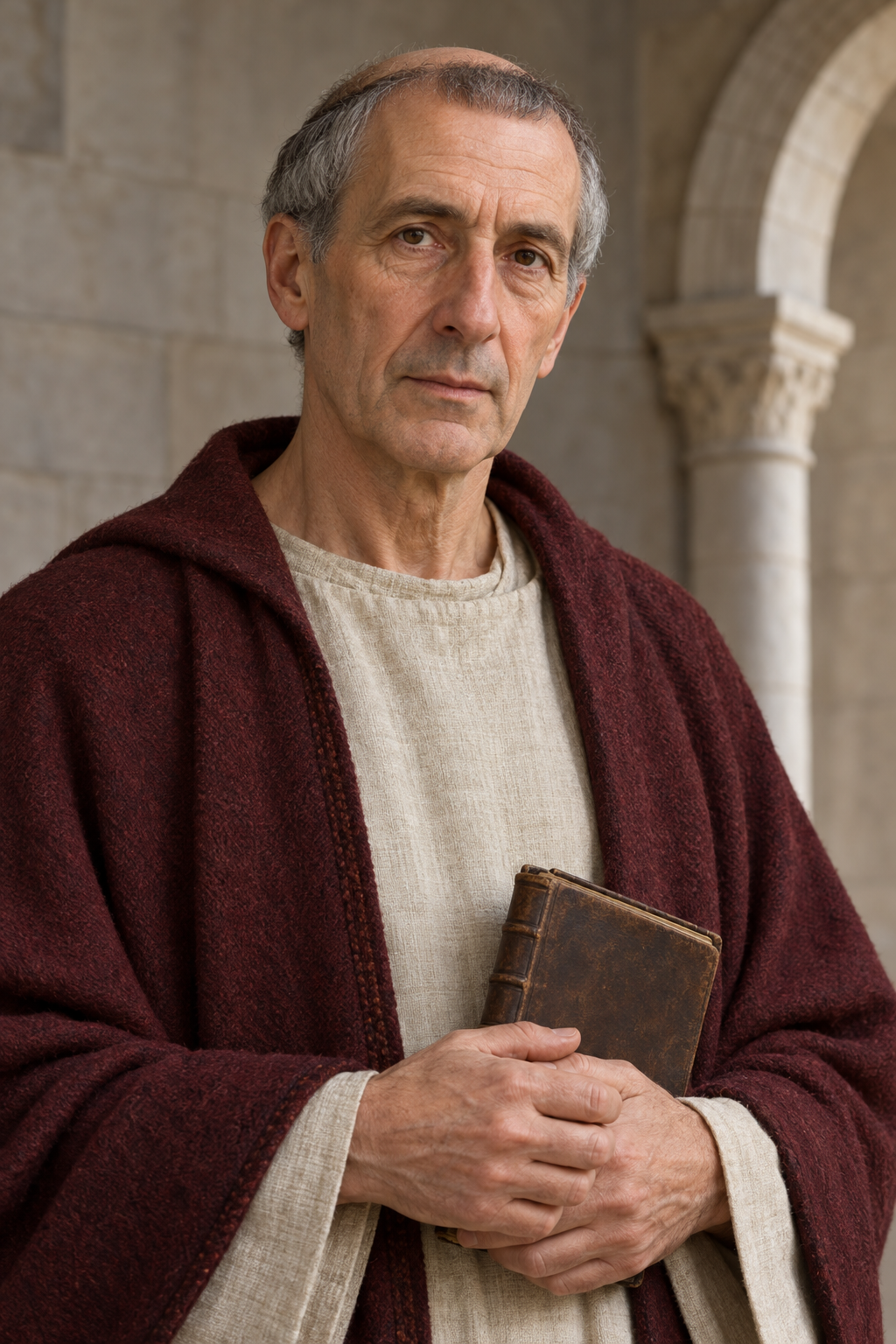
About Fulbert of Chartres
Fulbert taught students at Chartres before becoming its bishop in 1006. His work joined the life of a school to the responsibilities of a cathedral community. He was already a deacon at Chartres by 1004, when his surviving correspondence begins. His early life is less certain: the circumstances of his education and arrival in the city cannot be securely reconstructed from the available evidence.
Accounts of his birthplace disagree. Auguste Molinier suggested Aquitaine, while presenting that origin as uncertain. He describes Fulbert’s progress from teaching at Chartres to service as the cathedral’s chancellor. Such notices help trace his career, but their proposed details of his youth should not be treated as an established family history. No birthplace is assigned here.
The historian Pierre Riché places Fulbert among the learned churchmen active around the year 1000. In 1004, Fulbert contacted Abbo of Fleury about canon law. Riché emphasizes that Fulbert’s own writings are especially important because contemporary narratives say comparatively little about him. Letters, theological discussions and poems therefore provide a firmer starting point than an elaborate story of his childhood.
At Chartres, his teaching embraced both religious study and the liberal arts. Students encountered grammar, rhetoric and dialectic, alongside arithmetic, geometry, astronomy and music. Fulbert also had medical knowledge and introduced his pupils to the Bible and the Church Fathers. Riché points to Adelman of Liège’s commemorative poem of 1033 as evidence for the circle of pupils who remembered him. This was a school community with identifiable people, not merely a later reputation for learning.
His appointment as bishop did not sever his connection with teaching. Michael Ott’s account describes him continuing at the school while holding episcopal office and retaining the treasurership of Saint-Hilaire at Poitiers. Ott also distinguishes him from the monastic leaders with whom he corresponded: Fulbert was neither an abbot nor a monk. His place was within the cathedral clergy, even though his friendships reached beyond it.
A surviving letter to William of Aquitaine shows the practical questions brought to him. Asked to explain fidelity, Fulbert sets out duties that protect a lord’s person, security, honor, possessions and ability to act. He then insists that avoiding harm is not enough: the faithful person must also offer counsel and assistance. The letter addresses a relationship of service, with responsibilities expressed in both negative and positive terms.
Fulbert makes those responsibilities reciprocal. A lord who refuses the corresponding duties toward his follower is himself guilty of bad faith. This is advice about how the relationship ought to work; the letter does not establish that either party consistently followed it. Its closing lines return to Fulbert’s immediate difficulties. He explains that rebuilding the city and church after a destructive fire has left him little time to write at greater length.
The fire struck Chartres in September 1020. The city’s historical account credits Fulbert with promptly undertaking reconstruction and obtaining support from major rulers and local powers, including the king of France, the count of Chartres, the duke of Normandy and the king of England. The rebuilding belonged to a network of donors and institutions. Fulbert’s initiative did not mean that he carried out the construction alone.
Nor did he live to see the new cathedral dedicated. Juliette Clément dates the dedication to 1037, after his death and after another fire during construction. She describes the expanded lower church as a space for pilgrims beneath the upper church used for liturgical celebrations. The surviving structure carries his memory, but the later completion of the building must be distinguished from the work accomplished during his episcopate.
His literary work was another lasting part of his ministry. Ott describes letters, hymns, sermons and theological treatises, including Christian polemic directed against Jewish interpretation of scripture. Several sermons concern Mary, reflecting an important theme in Fulbert’s devotion. These writings belong to their medieval setting; their historical importance does not require treating every argument as uncontroversial. Ott also warns that the life of Aubert of Cambrai sometimes attributed to Fulbert was probably written by someone else.
The Bibliothèque nationale de France records his birth around 960 and his death on 10 April 1028. The birth year remains approximate. Its authority record also links the French name Fulbert de Chartres with the Latin Fulbertus Carnotensis, identifying the teacher, author and bishop as one person.
Older accounts sometimes give 1029 instead. Ott records both years; the date used here follows the national library record and the recent necrology-based study.
His remembrance continues locally on April 10, the feast listed by Nominis. That notice recalls both his contribution to liturgical music and his efforts to rebuild after the fire. The school, the surviving writings and the cathedral works give substance to this remembrance: they connect a named teacher and bishop with the intellectual and material life of Chartres.
Wondering how to weigh the stories and sources? Learn how to read a saint biography.