Biography
Geltrude Comensoli
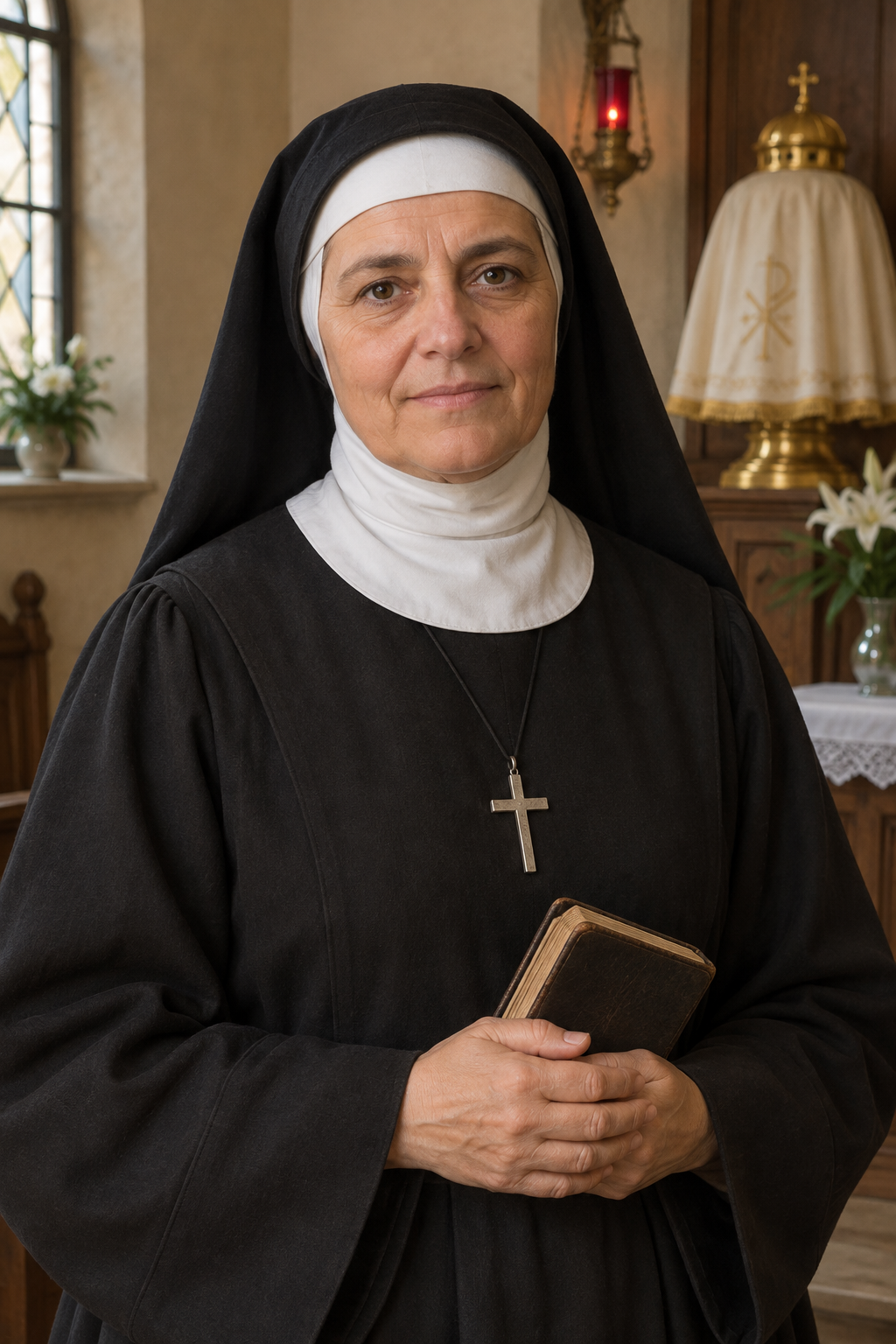
About Geltrude Comensoli
Caterina Comensoli was born on 18 January 1847 in Bienno, in the Val Camonica of the province of Brescia. She was the fifth of ten children of Carlo Comensoli and Anna Maria Milesi, and the congregation she later founded describes the household as modest and deeply believing.
Bienno was a village of ironworks, and local tradition remembers her father as a smith in its forges and her mother as a seamstress. Of the ten children, only three are said to have survived into adulthood. The family house on Via Contrizio can still be visited.
Her official biography says that from early childhood she was attracted to prayer and spent long periods in church. According to that account, at about seven she received Communion in secret in the church of Saint Mary and promised her lifelong love to Jesus.
As a young woman she gathered the more devout girls of the village into a Guard of Honour dedicated to the Eucharist, and took as the rule of her life the desire to love Jesus and to make him loved. The municipal history of Bienno adds that she entered the Company of Saint Angela Merici in 1867.
In 1862 she entered the Sisters of Charity at Lovere, the community founded by Saint Bartolomea Capitanio. A serious illness soon forced her to leave, and after recovering she had to find another path.
She went into domestic service, first in the household of Father Giovanni Battista Rota, then parish priest of Chiari and later Bishop of Lodi, and afterward with the family of Countess Fé-Vitali. During these years she also taught and cared for the children of San Gervasio near Bergamo.
At Christmas 1876 she wrote out for herself a demanding rule of life, and on the feast of Corpus Christi in 1878 she made her vow of chastity perpetual. After her parents died she confided her hope of a Eucharistic foundation to Bishop Speranza of Bergamo, who encouraged her to believe it was God's will.
In 1880, travelling to Rome with the Fé-Vitali family, she managed to speak with Pope Leo XIII about her plan. He reshaped it, suggesting that adoration be joined to the education of young women who worked in the factories.
Around this time she met Father Francesco Spinelli, a young Bergamo priest who shared her desire to honour the Eucharist and serve the poor. On 15 December 1882, supported by Bishop Guindani, the two of them and a few companions began the new institute with an hour of adoration before an image of the Sacred Heart.
The community grew quickly, reaching around a hundred sisters within a few years. On 15 December 1884 Caterina received the religious name Sister Geltrude of the Blessed Sacrament.
Serious trouble followed. In January 1889 Spinelli's finances collapsed, and he had to leave both the institute and the Diocese of Bergamo, eventually finding refuge at Rivolta d'Adda, where a separate branch later became the Sisters Adorers of the Blessed Sacrament.
The sisters who remained kept up their work under the name of Sacramentines and recognized Geltrude as their foundress. With their first house lost, they found shelter in the Diocese of Lodi under Bishop Rota, her former employer, and made a house at Lavagna di Comazzo their temporary motherhouse.
On 8 September 1891 Bishop Rota canonically erected the institute by decree. On 28 March 1892 Mother Geltrude returned to Bergamo, and the official biography credits her with giving the community firm and clear direction from then on.
The institute continued to spread in Lombardy. The Bienno municipal history records a house opened at Castelnuovo Bocca d'Adda on 1 November 1894, in addition to the community at Lavagna.
Her sisters recall that she led the institute through hardship and suffering with faith and love, keeping perpetual adoration at its centre while running schools and care for working girls.
Mother Geltrude died in Bergamo at midday on 18 February 1903. In 1926 her remains were moved from the Bergamo cemetery to the congregation's mother house.
The diocesan inquiry into her life opened on 18 February 1928 and closed in 1939. Pope John XXIII declared her Venerable on 26 April 1961, and Pope John Paul II beatified her on 1 October 1989 after the approval of a healing in Brazil attributed to her intercession.
A second healing, at Agnosine in the province of Brescia, was accepted for her canonization. Pope Benedict XVI proclaimed her a saint in St Peter's Square on 26 April 2009, and her feast is kept on 18 February.
In his homily that day, Benedict XVI said that adoration of Christ in the Eucharist had become almost the habitual condition of her life, and that it was before the Eucharist that she understood her mission, especially toward young people.
The Pope summed up her institute as an effort to translate the charity contemplated in the Eucharistic Christ into charity lived out for a neighbour in need. That pairing of silent adoration and practical service remains the mark of the Sacramentine Sisters of Bergamo.
In Bienno, her birthplace is open to visitors, and each February the village marks her feast with a Via Lucis procession through its historic centre.
Wondering how to weigh the stories and sources? Learn how to read a saint biography.