Biography
Genesius of Rome
About Genesius of Rome
Genesius of Rome belongs to the part of the catalog where honesty about genre is essential. The identifies him in the Roman tradition as a comedian or actor martyred under Diocletian and gives his feast as August 25. The same article, however, warns that the Acts behind the famous story are late and very doubtful as history.
The received legend is well known. Genesius is said to have led a theatrical troupe in Rome and to have performed before Diocletian in a satire of Christian rites. During the mock baptism, the story says, he confessed Christian faith in earnest. The emperor first took the performance as realistic acting, but then recognized that Genesius meant what he said.
That account can be summarized in the public page only as legend or passio. It should not be turned into a secure transcript of an imperial performance. The reviewed sources support the existence of the story and its devotional meaning, but they also require the profile to mark the narrative as traditional rather than documented biography.
The martyrdom claim should be handled in the same way. New Advent reports that the legend ends with torture and beheading, but it also says the historical value of the seventh-century Acts is very doubtful. Encyclopedia.com calls Genesius the Comedian a legendary martyr and says his origin is unknown. For the catalog, the class Martyr may be retained as a traditional identity, while exact death date, death place, and execution details should remain unstored.
New Advent also reports a deeper Roman veneration. Even while questioning the Acts and noting that Genesius's very existence has been called into question, it says he was venerated at Rome in the fourth century and that an early church was built in his honor. This is important: the skeptical source does not simply erase the devotion. It separates the late dramatic story from evidence of an old Roman cult.
That distinction gives the profile its shape. The catalog can present Genesius as a saint of the stage, honored by later Christians as a martyr and patron of actors, without pretending to know a modern biography. Readers should see both the drama of the legend and the editorial caution that keeps the legend in its proper category.
The patronage field is stronger than the life chronology. New Advent says he is honored as patron of theatrical performers and musicians, and Encyclopedia.com calls him patron of actors. The existing catalog patronage "Actors" is therefore reasonable, though it should be described as traditional devotion rather than a document from the saint's lifetime.
That patronage is also the reason Genesius has enduring pastoral usefulness for modern readers. Actors, musicians, and other performers often work through persona, timing, audience expectation, and public vulnerability. The tradition of Genesius speaks to that world without requiring the catalog to prove the details of the ancient stage scene. It can say that Christians have remembered him as a patron for performers and then invite reflection on truthfulness within public roles.
The August 25 feast is also well supported as a traditional observance. Both reviewed sources give that date for Genesius the Comedian or Genesius of Rome. The importer in this deferred packet will not mutate structured feast fields, but the final acceptance plan can add or confirm August 25 once the consolidated batch receives approval.
The fourth-century veneration note is especially useful for separating devotion from dramatic detail. New Advent reports old Roman veneration and an early church in his honor, even while questioning the later Acts. That means the final profile does not have to choose between credulity and dismissal. It can preserve evidence of old worship while treating the seventh-century passio as a later story about that worship.
The page should also distinguish Genesius of Rome from Genesius of Arles. New Advent treats them in the same article but as separate figures: the Roman comedian tradition and the Arles notary tradition have different settings, source problems, and patronage. This record concerns the Roman actor-martyr tradition only.
Because the story centers on performance, the spiritual reflection can be rich without becoming overconfident. Genesius is remembered as someone whose role on a stage became, in Christian imagination, a moment of real confession. The page can invite readers to consider integrity in public roles while still making clear that the detailed scene is legendary.
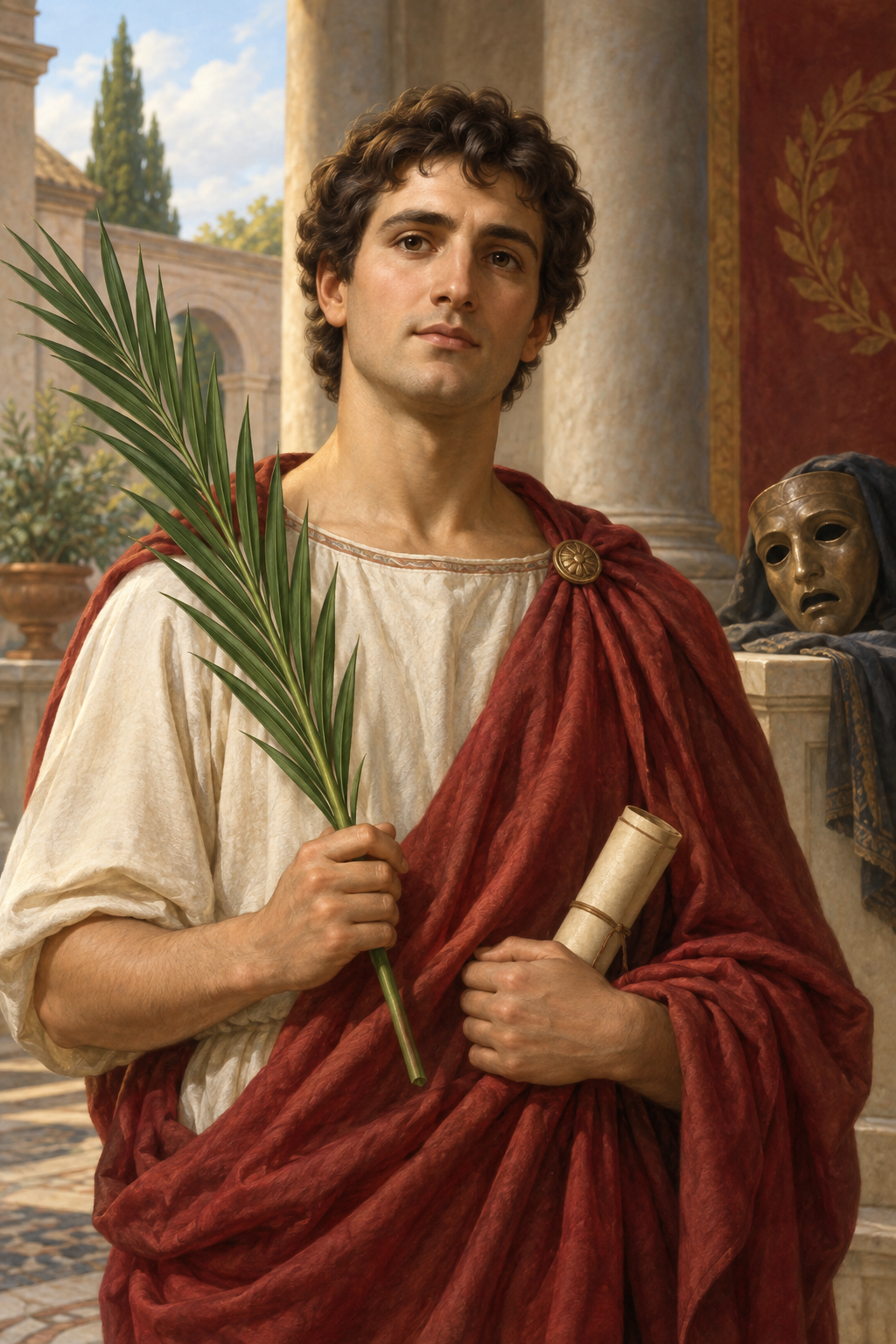
Artwork should follow that same editorial restraint. A simple Roman layman with a palm branch, scroll, and theatrical mask is suitable because it shows the traditional patronage and martyr identity. A literal baptism parody, torture scene, execution, emperor, or crowded stage would make the image more specific than the sources allow.
The final profile should therefore be candid and compact. Genesius of Rome is a traditional actor-martyr, patron of actors, honored on August 25. His famous conversion story belongs to later hagiography, and the sources themselves warn that its historical basis is doubtful. The safe record preserves devotion, labels uncertainty, and leaves unsupported life data blank.
Wondering how to weigh the stories and sources? Learn how to read a saint biography.