Biography
Gennadius of Novgorod
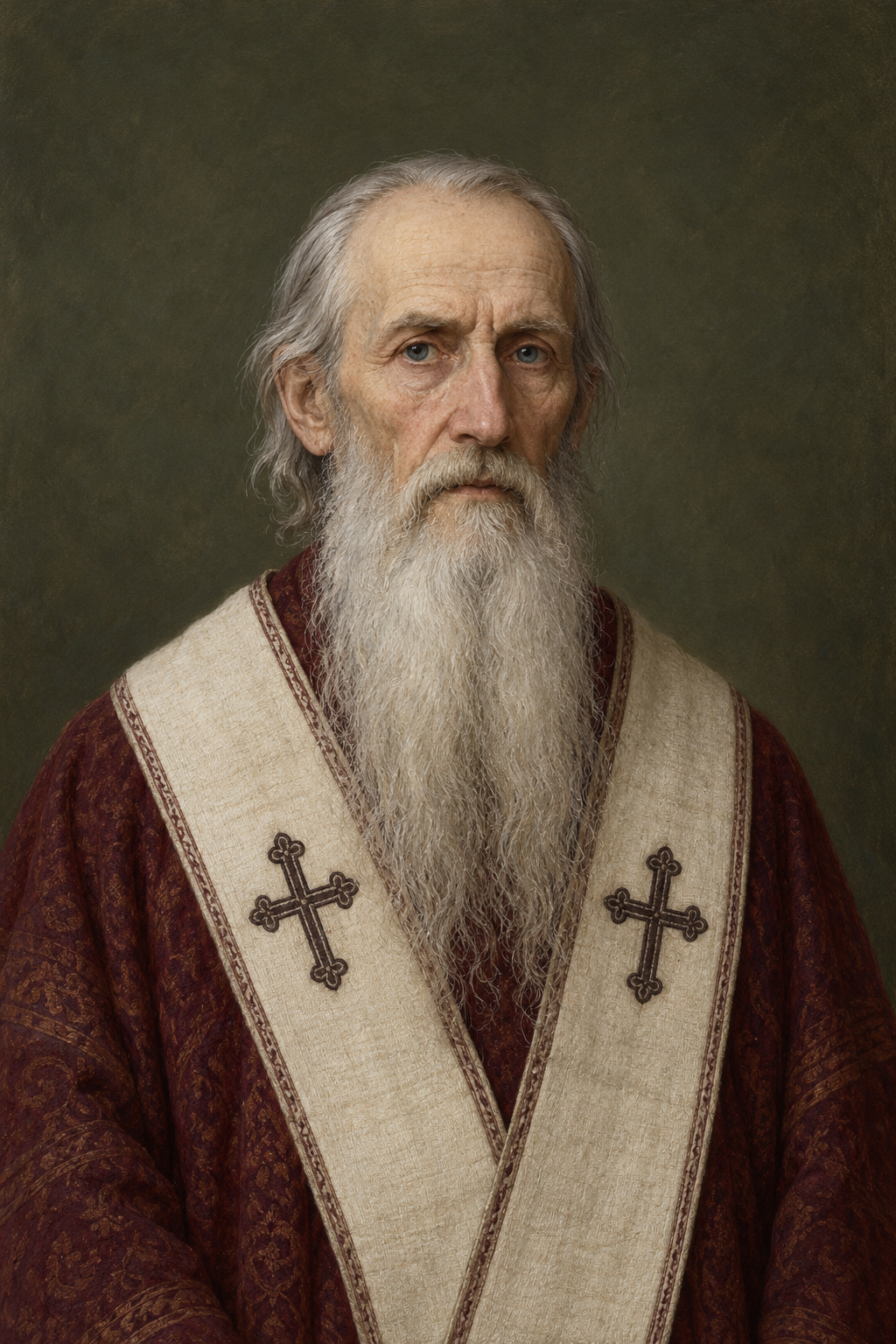
About Gennadius of Novgorod
Gennadius of Novgorod was a Russian monk and archbishop whose work joined the study of Scripture with the government of a large diocese. The Orthodox account places his monastic beginnings at Valaam under the guidance of Sabbatius. He later led Moscow’s Chudov monastery and was consecrated archbishop of Novgorod in December 1484.
His lasting scholarly achievement was the Bible assembled by the circle of translators and scribes working at his court. Completed in 1499, the collection brought the biblical books together in a full Slavonic manuscript. The scholars drew on existing Slavonic translations, arranging the books with reference to the Latin Vulgate. Books and passages missing from the available Slavonic material were translated from Latin. The result was a collective undertaking, rather than a translation made by Gennadius alone.
The surviving manuscript names three scribes: Vasily of Jerusalem, Gridya Ispovednitsky and Kliment Arkhangelsky. Gerasim Popovka directed its production, and the wider circle included Dmitry Gerasimov, Vlasy Ignatov and a Catholic monk named Benjamin. A later manuscript explicitly credits Benjamin with translating the books of Maccabees; attribution of the other Latin translations to him remains less certain. His precise background is also debated. The evidence establishes collaboration more securely than it establishes every participant’s origin or individual contribution.
The compilers worked across several layers of inherited translation. They removed much of the commentary that had accompanied biblical books in earlier Slavonic manuscripts, although some explanatory wording entered the resulting text. Other annotations drew on Latin commentaries and dictionaries. Benjamin’s translations followed Latin closely enough to produce unusual Slavonic grammar. These features make the Bible evidence of the practical difficulties faced by Gennadius’s scholars: finding missing texts, comparing differing versions and deciding how another language should be represented. The finished collection preserved traces of those decisions.
The distinction between manuscript and printed book matters here. The 1499 Bible was not printed at the time. Its textual tradition later contributed to the Ostrog Bible of 1580–1581, where the material underwent further revision.
The State Historical Museum in Moscow preserves the 1499 Gennadius Bible among its major manuscript holdings. The surviving volume gives his scholarly patronage a material presence beyond the later accounts of his life. He also worked on the calendar used to determine Easter. The Orthodox life connects that work with anxiety surrounding the year 1492, understood as the close of the seventh millennium from creation. His explanation rejected certainty about the world’s imminent end and defended the continued calculation of future feast dates.
Calendar work likewise involved consultation beyond his own household. Gennadius attended a Moscow council in 1492 concerned with extending Easter calculations into the next millennium. The encyclopedia cautions that its proceedings do not survive and that knowledge of the meeting depends on a chronicle. A later claim that this council established September as the beginning of the year lacks supporting evidence.
His circle also translated the eighth book of William Durandus’s Rationale in 1495. This brought a Latin discussion of calendar reckoning into the Slavonic scholarly environment. Extracts circulated on subjects including leap years, the solar year, months, seasons and hours. The undertaking shows that the circle’s use of Western books extended beyond filling gaps in the biblical text. The archbishop’s calendar concerns connected religious observance with the practical study of time.
His episcopate also involved the prosecution of people accused of heresy. Historian Yutaka Miyano shows that Gennadius’s accusations were contested and that church councils did not simply accept every allegation. Some of his opponents accused him in turn. The process of deciding who counted as orthodox was therefore itself part of the conflict.
David Goldfrank’s study urges caution about accepting the charge that these opponents were Judaizers. It also records Gennadius’s circulation of an account of the Spanish Inquisition before the council of 1490, including its executions and confiscations. His campaign cannot be described solely as a scholarly defense of belief.
The Orthodox Encyclopedia describes the public degradation of condemned opponents: they were paraded facing backward on horses, dressed in humiliating costumes and exposed to public abuse. It also reports executions in 1490. Goldfrank reaches a different conclusion about that episode, describing a humiliating public punishment without executions. The disagreement concerns the extent of the punishment, not whether Gennadius supported coercive action against the accused.
He was removed from his see in 1504. The Orthodox Encyclopedia reports that the official chronicle cited illness and the collection of ordination fees contrary to a council’s ruling; it also considers conflict over church property a possible explanation. These competing explanations should not be reduced to a simple story of voluntary retirement.
Gennadius returned to the Chudov monastery and died on December 4, 1505. The Orthodox Church commemorates him on December 4. His ecclesiastical remembrance and his role in transmitting Scripture belong to the same life as the contested accusations and punitive measures of his episcopate.
Wondering how to weigh the stories and sources? Learn how to read a saint biography.