Biography
Genoveva Torres Morales
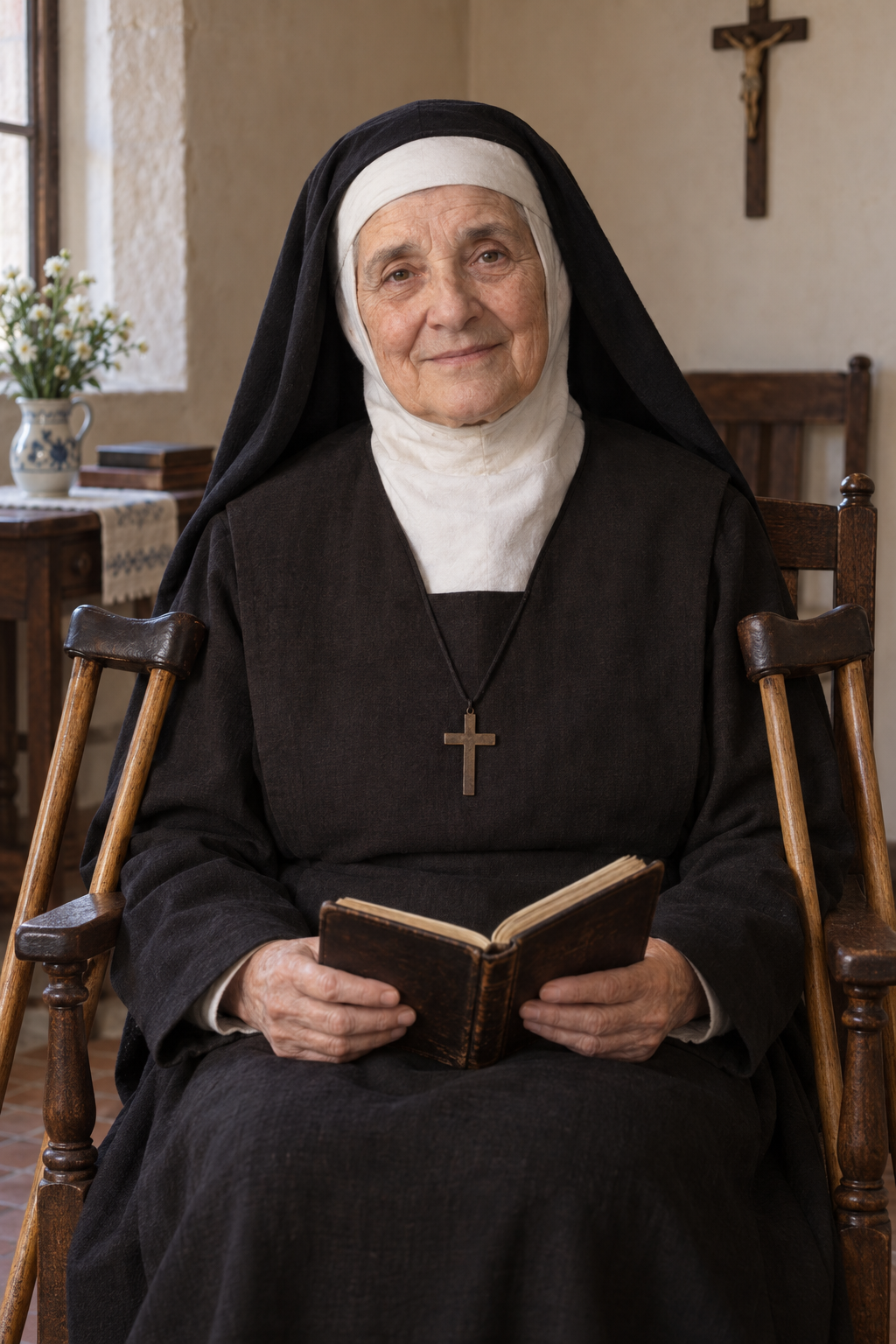
About Genoveva Torres Morales
Genoveva Torres Morales was born on 3 January 1870 in Almenara, a village of some 1,400 inhabitants in the province of Castellón, in the Valencian region of Spain. She was the youngest of six children of José Torres and Vicenta Morales, and she was baptized the day after her birth.
Her childhood was marked by loss. By the time she was eight, death had taken both her parents and four of her brothers and sisters, and the young girl was left to keep house for a surviving brother.
Around the age of ten she began to read spiritual books, and through them she came to a conviction that stayed with her for life: that real happiness lies in doing the will of God, the purpose for which each person is created. It became her rule of life.
In 1883, at thirteen, a disease of the left leg made amputation unavoidable, and the leg was removed at the thigh.
The operation was done at home without adequate anaesthesia. The leg caused her pain and illness for the rest of her life, and she depended on crutches.
Unable to support herself, she was taken in by the Casa de la Misericordia in Valencia, where she made up for the gaps in her schooling and grew in her spiritual life.
She lived in this home, run by the Carmelites of Charity, from 1885 to 1894.
Among the sisters and the other children she deepened her life of prayer and became a skilled seamstress. Her guide in these years was Fr Carlos Ferrís, a diocesan priest who later became a Jesuit and founded the leprosarium at Fontilles. She later recalled how much she had valued freedom of heart and worked to attain it.
She hoped to enter the Carmelites of Charity, but the congregation's own account says she was refused because of her disability.
Still wanting to give herself to God, in 1894 she left the home and went to live with two women who earned their living by their own work, sharing their poverty and solitude.
The Holy See's Spanish biography places at this point, when she was twenty-four, the beginning of what it calls the Angelic Society, formed with two companions to shelter women living alone and to keep nightly adoration of the Eucharist.
The decisive step came in 1911. Canon Barbarrós pointed out to her how many poor women could not afford to live on their own and suffered for it. Genoveva had long thought of a congregation devoted only to such women, since she knew of no one else doing this work. With the canon and the Jesuit Fr Martín Sánchez, she established the first community in Valencia.
According to the congregation, the first residence opened on 2 February 1911 with seven residents, and she served as its director. The institute took the name Sisters of the Sacred Heart of Jesus and of the Holy Angels, and its members became popularly known as the Angélicas.
Other women soon joined her, and despite many difficulties new houses followed in Barcelona, Bilbao, Madrid, Pamplona, Santander and Zaragoza.
She governed the growing work from the Mother House in Zaragoza. Her piety centred on the Heart of Jesus and the Eucharist, and she was deeply devoted to the Virgin Mary, especially through the Rosary.
Leadership cost her. Drawn to solitude with God, she found the business of new foundations a lasting burden, yet accepted it as God's will. She was remembered for kindness, openness and humour, even joking about her own ailments.
In 1953 the congregation received papal approval. Mother Genoveva died on 5 January 1956.
She died in Zaragoza, and people there began to invoke her as the Angel of Solitude.
John Paul II beatified her on 29 January 1995. In his homily he described a humble woman, by origin and by education, who knew the love of God through devotion to the Heart of Christ and liked to say that love conquers all. He spoke of her as a companion to women left alone, caring for them materially and spiritually in a true home. The Dicastery for the Causes of Saints lists her liturgical memorial on 5 January.
On 4 May 2003, in the Plaza de Colón in Madrid, the same pope canonized her with Pedro Poveda, José María Rubio, Ángela de la Cruz and Maravillas de Jesús. He called her an instrument of God's tenderness toward lonely people, and named reparatory adoration of the Eucharist as the driving note of her spirituality, the source of an apostolate of humility, simplicity and self-denial.
Her congregation continues her work today in Spain, Mexico, Venezuela and Colombia, running residences, dining halls and centres of spirituality. Its stated aim remains the one she set: to ease the loneliness of people who live alone and need affection and care in body and spirit.
Her particular legacy is that attention to loneliness itself as a form of poverty. A woman who had known early bereavement, disability and exclusion built a religious family to give others the home she had lacked.
Wondering how to weigh the stories and sources? Learn how to read a saint biography.