Biography
George
About George
George is one of Christianity's most widely honored martyrs, yet very little of his individual life can be recovered historically. Critical scholarship identifies a defensible core: a martyr named George was associated with Lydda, also called Diospolis, in Palestine, and probably suffered before Constantine. An ancient and geographically focused cult supports his existence more strongly than the surviving narrative passions do. No contemporary biography, military record, or trial transcript establishes his parents, birthplace, rank, age, speeches, or exact execution. This difference between an early cult and a late detailed story governs the whole account. George should first be presented as a real object of early martyr veneration whose personal history remains mostly unknown.
The catalog previously supplied a birth on January 1, 270, and an exact death on April 23, 303. Those entries claim more precision than the evidence supports. April 23 is a deeply established feast, but an observance does not prove the civil date of execution. The year 303 fits the traditional setting of Diocletian's persecution, yet it comes through received accounts rather than a contemporary notice naming George. Cappadocia as birthplace, Christian parentage, and a later home at Lydda also belong to tradition. The parent dates and birthplace are therefore cleared, while the probable pre-Constantinian martyrdom near Lydda remains explicit in prose.
Later Greek passions make George a soldier or officer who serves successfully in the Roman forces. When imperial policy turns against Christians, he distributes possessions, declares his faith publicly, and refuses to sacrifice. Officials imprison and torture him in an effort to force compliance. The stories multiply wheels, pits, poisons, heated footwear, and repeated deaths followed by restoration. They also describe conversions among witnesses, including an empress sometimes called Alexandra. This material profoundly shaped devotion, but its extravagant and varying forms do not yield an authentic sequence of proceedings. The violence should be named as coercion and execution without making legendary ingenuity the center of George's witness.
The OCA received life concludes that George prays for his persecutors and is beheaded on April 23, 303. It presents him as younger than thirty and interprets victory as faithful endurance rather than battlefield conquest. These details express the church's liturgical memory, not a court archive. The title Greatmartyr indicates the scale of honor given to his suffering; Victory-bearer communicates a theological interpretation of steadfastness. Neither title proves military rank or every torture. The tradition's moral center is refusal to cooperate with persecution and forgiveness toward those who inflicted harm. Those actions can be honored without treating a precise age, speech, or date as historically demonstrated.
Material and pilgrimage evidence describes the cult more securely. Sixth-century pilgrims identified Lydda with George's tomb and sanctuary. Archaeological and historical study of Lod notes Theodosius's association of the city with George around 530 and a later pilgrim's description of his church and miracles. Churches dedicated to George also appeared widely across the eastern Mediterranean. Such evidence documents what communities believed and where they gathered; it cannot independently recover the martyr's birthplace or trial. Lydda is therefore map-safe as the confirmed center of George's early cult and probable region of martyrdom, but no exact execution coordinate or transfer route is asserted.
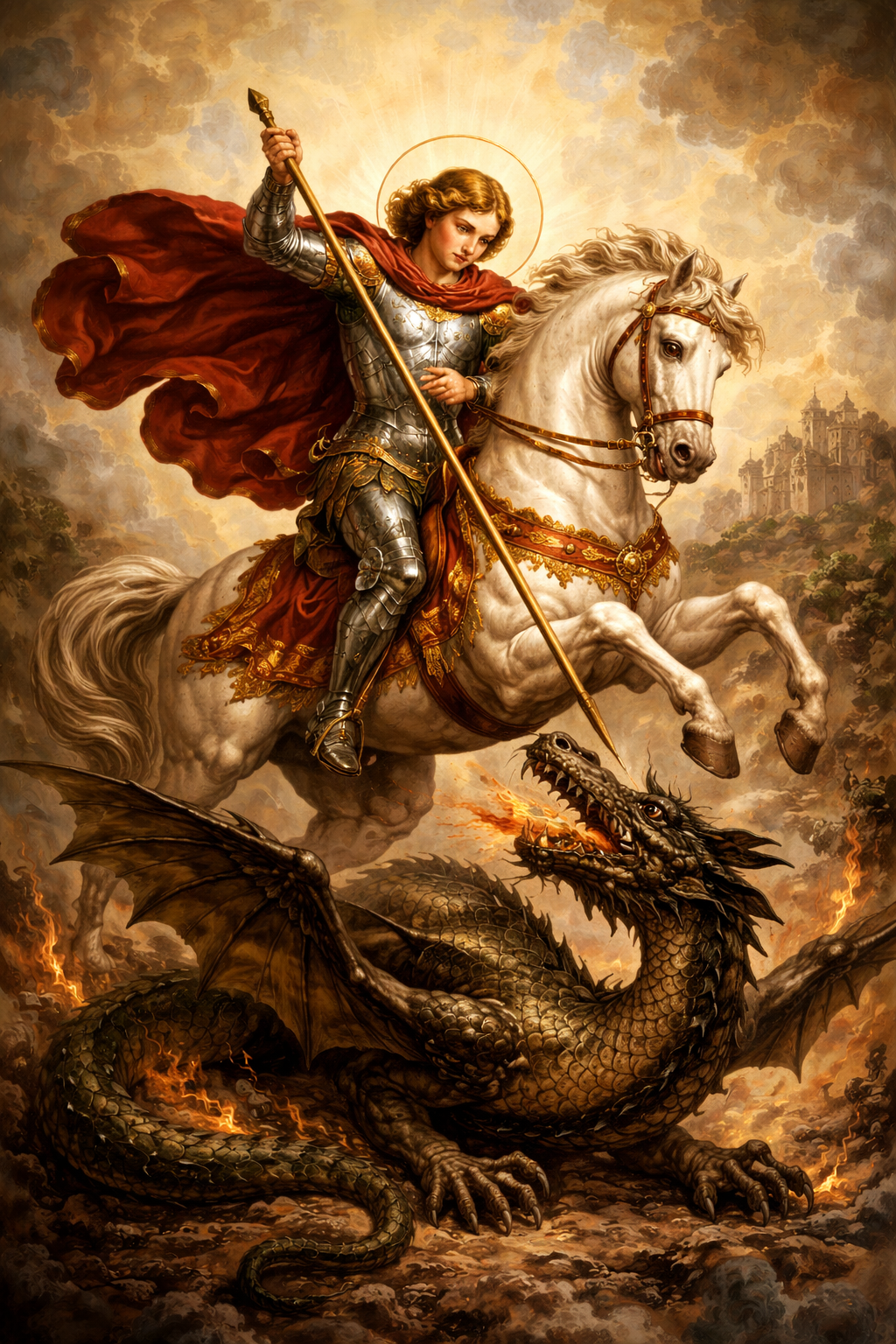
The dragon belongs to another layer of memory. Medieval legend tells of a city terrorized by a dragon or great serpent and compelled to surrender victims. When a ruler's daughter is selected, George confronts the creature, wounds or subdues it, and leads it into the city; the people then accept baptism and the dragon is killed. Versions differ over location, sequence, and emphasis. The episode is not part of the recoverable life of a late-antique martyr, and the princess is not a documented companion. It should remain visible because it transformed George's art and cultural meaning, while being labeled legendary and excluded from historical routes.
The image of a mounted saint defeating a dragon became a visual language for deliverance, courage, and the defeat of evil. It also risks simplifying George into a warrior who solves danger through force. The martyr tradition points in a different direction: his victory is endurance under state violence, not domination of human enemies. Later soldiers and nations adopted him as patron, including England, and his cross became a civic and military emblem. These are documented histories of reception. They should not be projected backward as proof that George fought for England, carried a medieval shield, or endorsed every campaign conducted under his name.
George's remembrance crosses ecclesial and cultural boundaries. Eastern Orthodox worship honors him as Greatmartyr and Victory-bearer on April 23, while the Roman calendar also keeps that date. The OCA records a separate November 3 commemoration for the consecration of his church at Lydda. Communities in the Middle East have long shared respect for the sanctuary and for the figure associated with it. Calendar and cult evidence demonstrate enduring veneration, not detailed biography. Each observance should retain its tradition and jurisdiction rather than being merged into a single supposedly universal practice or used to manufacture a death anniversary.
George remains significant where strong memory meets thin documentation. The early Lydda cult makes it reasonable to affirm an ancient martyr, while critical study refuses to borrow certainty from spectacular passions. The soldier's defiance, prayer for persecutors, and beheading are received tradition; the repeated resurrections and dragon rescue are legend; the shrine and later worldwide veneration are documented reception. Keeping these layers distinct does not empty the story. It directs attention toward moral courage under coercion, forgiveness without denial of harm, and protection that does not glorify violence. George's legacy is strongest when communities tell the beloved dragon story honestly and center the martyr's witness rather than conquest.
Wondering how to weigh the stories and sources? Learn how to read a saint biography.