Biography
George the Hagiorite
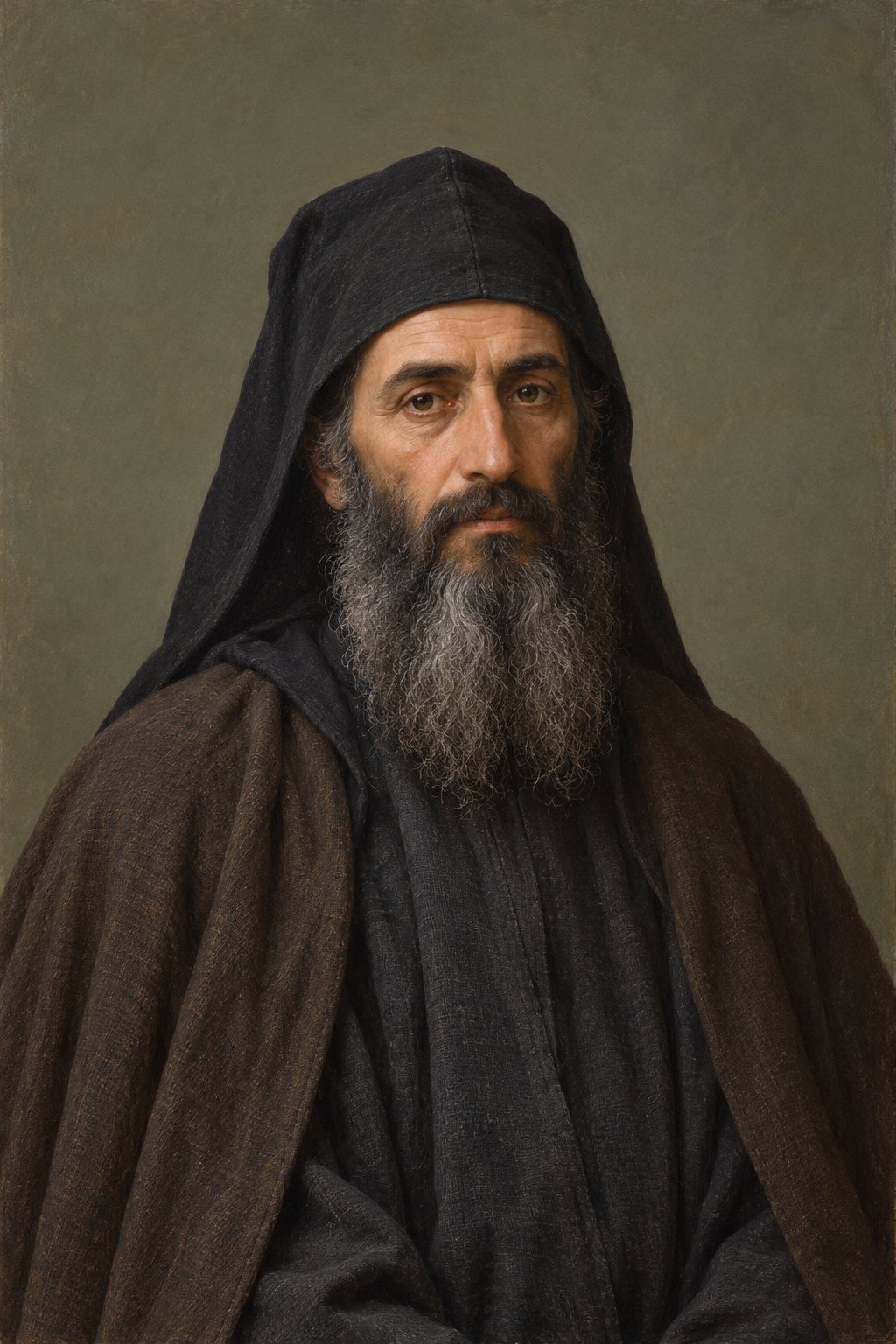
About George the Hagiorite
George the Hagiorite was a Georgian monk whose work brought Greek Christian writings into Georgian. The Orthodox Church in America remembers his education at Tadzrisi and Khakhuli, followed by study in Constantinople. His later teacher, George the Recluse, directed him toward the translation work of the Georgian community at Iviron on Mount Athos.
The received life describes a difficult beginning: George delayed the task until his teacher sent a disciple to remind him of it. As abbot, he gathered the lives of John and Euthymius and cared for the monastery. Administration competed with writing, and he sought release from leadership. He also returned to Georgia to help establish standards for clergy.
George’s writing also belonged to the effort of Georgian monks to maintain their place within the Byzantine world. Eka Tchkoidze studies his Life of John and Euthymius alongside other Georgian monastic lives. She argues that their religious language helped defend a community whose right to worship in Georgian had been questioned. In this reading, translation was connected with the preservation of a language and a people’s sense of belonging, as well as the transmission of particular books. Her analysis places these writings against the pressures on Iviron in the 1030s, when Georgian monks sought imperial support and defended their community’s religious standing.
Tchkoidze also examines the connection these texts make between Georgian speech and fidelity to Orthodox Christianity. Their claims of special divine protection form part of the writers’ understanding of their community. They should be read as religious and historical testimony, not as proof that one language or people enjoyed superior standing before God. This perspective helps explain why George’s literary work could matter so deeply to monks living away from Georgia.
A surviving part of his achievement is the Great Synaxarion, a guide to the church’s cycle of worship and commemoration. Editors Dali Chitunashvili and Manana Dolakidze date his Georgian translation to 1042–1044. They identify it as the surviving witness to a Greek original that has been lost. Translation preserved material that would otherwise be unavailable in that form.
The collection served as the Georgian Church’s principal liturgical guide until the fourteenth century and continued to be copied afterward. It included saints’ commemorations and practical monastic rules concerning meals, work and clothing. Its manuscripts also accumulated commemorative notices and colophons, preserving evidence of the communities that used them.
The editors distinguish its monthly calendar from its material for the movable seasons of worship. They identify John and Euthymius as the two Georgian figures George added to the monthly section. Other Georgian commemorations appear in later manuscript witnesses. This distinction separates his own contribution from additions made as communities continued using the book. The collection could preserve an earlier pattern while also acquiring new layers of remembrance.
Another major undertaking was his Lenten Triodion, a collection of hymns for the weeks leading to Easter. Lela Khachidze’s manuscript study shows George consulting earlier Georgian versions alongside Greek texts. Sometimes he retained an existing translation, sometimes corrected it, and sometimes translated anew. The work required decisions about what a community would sing and how its words would follow the forms of worship.
His treatment of Andrew of Crete’s Great Canon illustrates this care. The Paris manuscript studied by Khachidze preserves Euthymius’s earlier version together with George’s new translation. George supplied explanations rather than simply allowing the older version to disappear. Khachidze also emphasizes his attention to naming the authors of hymns, including contributions to composite works. Those identifications now assist scholars studying Byzantine poetry, especially where the Greek tradition leaves a hymn anonymous or does not preserve the same material. The translations therefore remain witnesses to the history of worship as well as works read in Georgian.
George’s dealings with other Christians have also drawn scholarly attention. David Tinikashvili reads his speech before Emperor Constantine Doukas in 1065 as a defense of Roman Christian practice. The scholar also points to George’s translation of a creed containing the disputed filioque clause. This is an argument about his attitude toward the Roman Church; it does not establish that he ceased to belong to the Georgian Orthodox tradition.
The devotional life ends with concern for children. Traveling with eighty orphans, George is said to have asked the emperor to provide for them shortly before his death. The account remembers a scholar whose responsibilities extended beyond his books.
The Georgian Orthodox Church commemorates him on June 27 in the Julian calendar. His name joins the memory of monastic service to the continued use and study of Georgian Christian literature. A church in Tsikhisdziri bears his name. Kobuleti Municipality’s guide identifies it specifically as the Church of Saint George the Hagiorite, distinguishes it from churches of other Georges, and records its feast on July 10. This dedication is a concrete expression of his local veneration.
Wondering how to weigh the stories and sources? Learn how to read a saint biography.