Biography
Germanos Maroules
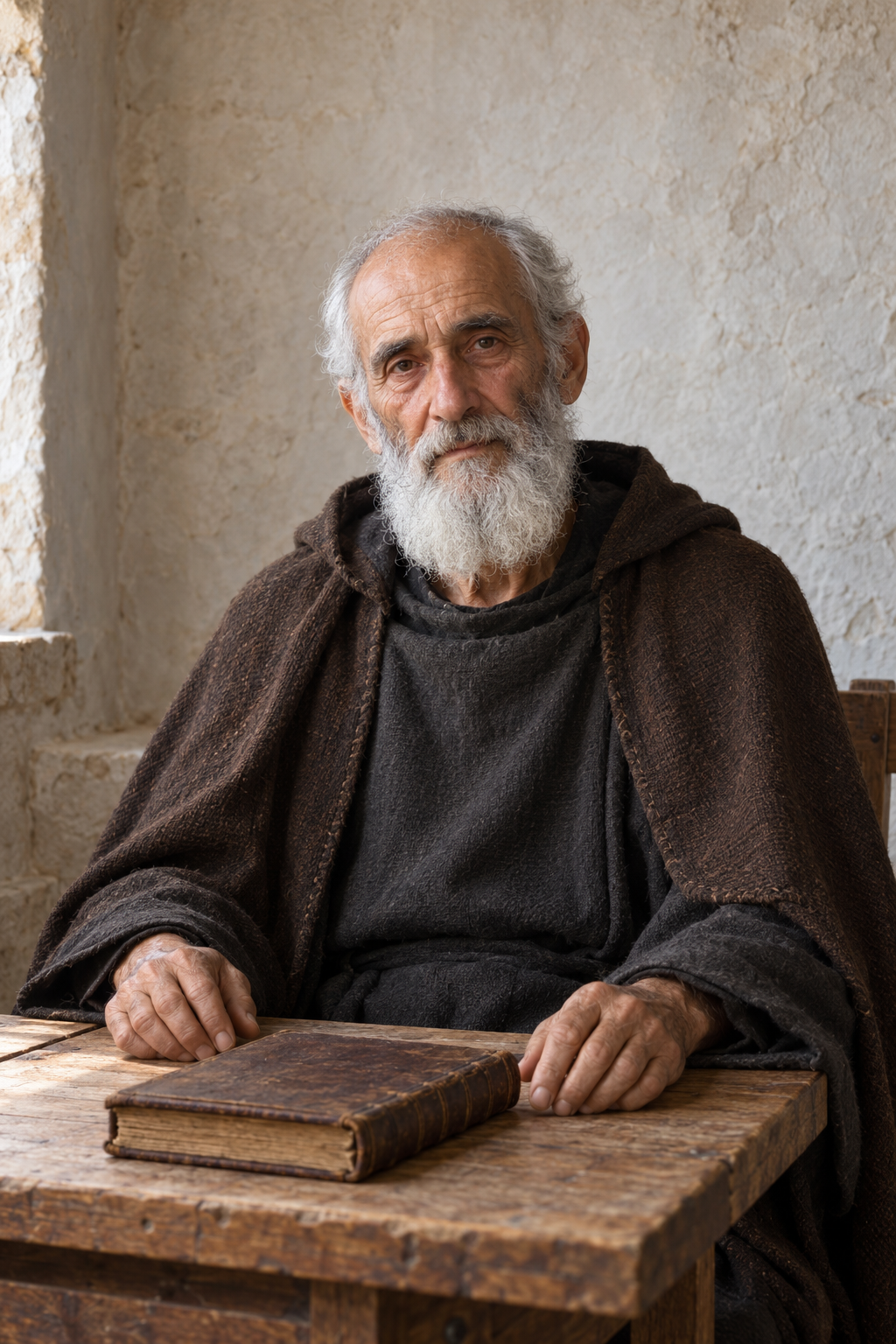
About Germanos Maroules
Germanos Maroules spent most of his life as a monk on Mount Athos. Born in Thessalonike around 1252, he belonged to the prosperous Maroules family and was baptized George. His spiritual formation began with an Athonite elder named John. Around the age of eighteen he entered monastic life, taking the name Germanos.
His family can be traced more carefully than those of many medieval monks. Vitalien Laurent identified the surname through a marginal annotation in a manuscript and the known name of Germanos’s nephew, Jakobos. The biography names two brothers, Demetrios and Andronikos, among eight children.
Laurent describes the family’s standing as rooted in wealth and public office. Germanos’s father exercised financial and judicial responsibilities in Thessalonike. His exact position is harder to establish: Laurent’s suggestion that he held unusually broad governing powers is an interpretation of the biographer’s language, rather than a securely preserved official title.
Philotheos Kokkinos’s biography presents Germanos’s childhood as preparation for religious life. Stephanie Novasio places this portrayal within Byzantine ideas about age and holiness. A saintly child could be depicted as unusually restrained, displaying the judgment expected of an older person. Such descriptions reveal the author’s religious ideals as well as his memories or sources.
One episode describes schoolmates striking Germanos’s hands with stones while he was writing. Philotheos praises his refusal to retaliate. Novasio reads the scene as an early setting for ascetic endurance: the future monk is made a stranger among his peers.
Family ties remained part of Germanos’s monastic world. Novasio notes that his nephew Jakobos came to him after completing his secular education. The relationship belongs to a wider pattern in which uncles became spiritual instructors for relatives.
On Athos, Germanos initially lived with John in a retreat associated with Docheiariou. Copying manuscripts and reading during worship formed part of his work. After John’s death, he came under the guidance of Job near Great Lavra. His life would be marked by successive teachers rather than one uninterrupted residence under a single elder.
Laurent emphasizes this unusually prolonged willingness to remain a disciple. Philotheos names John, Job, Myron, Malachias, Athanasios and Theodoretos as successive guides. Several were associated with the leadership of Great Lavra, making the biography valuable for its institutional history. Their precise sequence in office requires comparison with other documents and cannot simply be inferred from Germanos’s succession of teachers.
Laurent’s examination also shows the limits of the chronology. He disputes an earlier arrangement of the abbots and notes that uncertain intervals may separate Germanos’s periods of discipleship. Exact dates for these transitions remain difficult.
Violence eventually disturbed the quiet of his retreat. Mirjana Zivojinovic places Germanos among the Athonite ascetics who sought protection within fortified monasteries during Turkish raids. He moved into Great Lavra. Other monks left the peninsula, but Germanos’s response illustrates a different possibility: remaining on Athos while taking shelter within a larger community.
The raids affected more than individual decisions about where to live. Zivojinovic describes abandoned retreats and pressure on monastic resources. Fortified houses offered shelter, while more exposed cells could no longer provide the security needed for solitary life.
Zivojinovic also uses his biography to examine changes in monastic organization. While living outside the monastery, Germanos did not receive food and clothing from its abbot or hand over the products of his copying work. The historian connects this arrangement with a wider growth of individual economic responsibility among Athonite monks.
A disciple’s testimony preserved in the Life describes Germanos as a teacher who drew on the Old and New Testaments and the lives of holy people. He adapted his instruction to hearers of different education and social standing. The passage is also openly devotional, attributing his teaching to divine grace.
The same testimony recalls prolonged prayer during the night. Its account includes extraordinary light on Germanos’s face, presented as a sign of holiness.
The Orthodox Encyclopedia places his death around 1336. Philotheos later wrote the account that preserves his memory and the world of Athonite teachers around him.
Vatopedi continues to honor Germanos among the saints connected with its community. Its account remembers his visits for work and worship and records his commemoration on October 11. His lasting connection with the monastery rests on these relationships, even though his later life is particularly associated with Great Lavra.
Wondering how to weigh the stories and sources? Learn how to read a saint biography.