Biography
Giles
About Giles
Giles is remembered as a hermit and abbot whose name became attached to one of medieval western Europe's important pilgrimage shrines. The record of his life is much less secure than the history of that cult. The IRHT-CNRS catalogue dates the Latin Vita sancti Aegidii to about 891–915 and lists roughly ninety manuscripts. That work was composed perhaps two centuries after the period in which Giles is conventionally placed. No contemporary account securely establishes his birthplace, family, travels, office, birth year, or death year. The responsible starting point is therefore a late hagiographic portrait followed by the documented growth of devotion at Saint-Gilles-du-Gard.
The received Life makes Giles an Athenian of wealthy or noble parents. It says that he gives property to the poor, performs healings, and leaves his homeland because public admiration threatens his desire for obscurity. Later retellings send him across the sea to Gaul, first toward the Rhône and then into increasingly solitary country. These details create a spiritual movement from privilege toward voluntary poverty, but they are not a verifiable itinerary. The packet therefore records Athens only as a received origin and southern Gaul as a broad legendary setting. It does not assign dates, ports, roads, or coordinates to his migration.
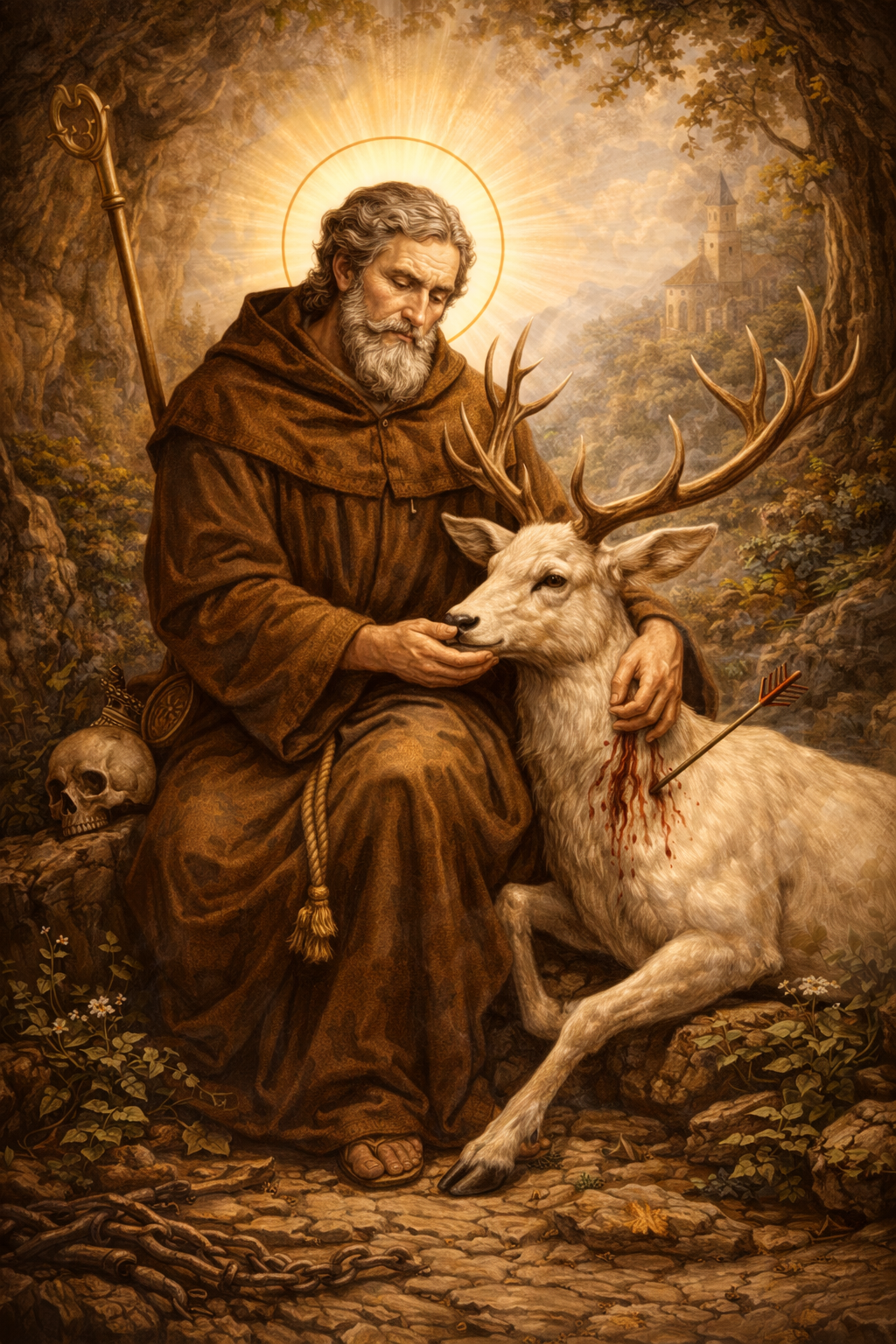
Giles's best-known legend places him in a forest near Nîmes with a hind as his companion. The animal supplies milk and shares the hermit's refuge. During a royal hunt, hounds pursue it toward Giles. A hunter shoots an arrow intended to drive out or strike the animal, but Giles is wounded while protecting it. Medieval versions disagree over the ruler's identity, and the Catholic reference observes that naming the Visigothic king Wamba conflicts with the political chronology of the region. The episode is therefore legendary in both its miracle and its royal setting, even though it became the defining image of Giles in European art.
The legend presents the wounded hermit as refusing honors and resisting the king's attempts to reward him. He asks instead for a religious house where a disciplined community can live. In the Golden Legend, he repeatedly refuses the crosier before accepting leadership after the king and others press him. This is the basis for calling him abbot, but it cannot establish the canonical form, date, or rule of an early medieval monastery. The story links humility with responsibility: Giles seeks neither fame nor office, yet accepts care for a community. That action can ground reflection without claiming that the surviving narrative is a foundation charter.
Another famous layer associates Giles with a ruler's concealed sin. The Golden Legend says that a king—later versions commonly make him Charlemagne—cannot bring himself to confess a grave offense. During Mass, an angel places a written account of the sin on the altar, and Giles's prayer obtains forgiveness once the ruler repents. The chronology makes a meeting with Charlemagne impossible for a hermit conventionally dated around 710. The tale nevertheless influenced Giles's later association with difficult confession. It must not be used to infer a historical audience with a named monarch, and forgiveness should not be presented as bypassing accountability or repair.
The narrative eventually returns Giles to his community, where he is said to die peacefully and be buried. The Catholic reference places his death in the early eighth century but gives no contemporary basis for an exact year. The Church of England now labels him 'Giles of Provence, Hermit, c.710,' appropriately signaling approximation within a calendar tradition. This packet does not convert that label into a historical death date or use September 1 as an anniversary. It also removes the inherited martyr classification: no received account makes Giles a martyr, and his wounded body in art belongs to the hunting legend rather than an execution.
The history of Giles's cult is far better documented than his biography. The settlement and abbey of Saint-Gilles-du-Gard became a major medieval destination. Pierre-Gilles Girault's research emphasizes that pilgrims traveled there as an end in itself, not merely as a stop on a route to Santiago de Compostela. Written itineraries, miracle collections, place-names, offices, relics, and images carried Giles's memory far beyond southern France. The Catholic reference likewise notes dedications across France, Germany, Poland, Hungary, and the British Isles. These records show the scale of reception without proving the details of the ninth-century Life.
The hind and arrow made that reception visually recognizable. The National Gallery describes a late-fifteenth-century painting in which Giles shelters the deer and receives the hunter's arrow in his hand. Such works are evidence for medieval and early modern imagination, not portraits from life. They also require careful language about disability. Giles later became associated with people living with disabilities and illnesses, but a wound in a legend should not reduce disabled people to symbols of suffering or dependence. The strongest virtue conveyed by the image is concrete protection: Giles places himself between a vulnerable creature and violence.
September 1 remains Giles's principal western observance. The Church of England marks him as a hermit in Provence, while older Roman Catholic reference works record the same feast and call him abbot. These labels belong to distinct calendars and should not be blended into proof of office or chronology. Giles's enduring significance rests on two different foundations: a legendary narrative of relinquished status, solitude, protection, injury, reluctant leadership, and intercession; and a documented medieval cult centered on pilgrimage, institutions, art, and care for vulnerable people. Keeping those foundations separate makes the account both more honest and more useful.
Wondering how to weigh the stories and sources? Learn how to read a saint biography.