Biography
Godfrey of Savigny
About Godfrey of Savigny
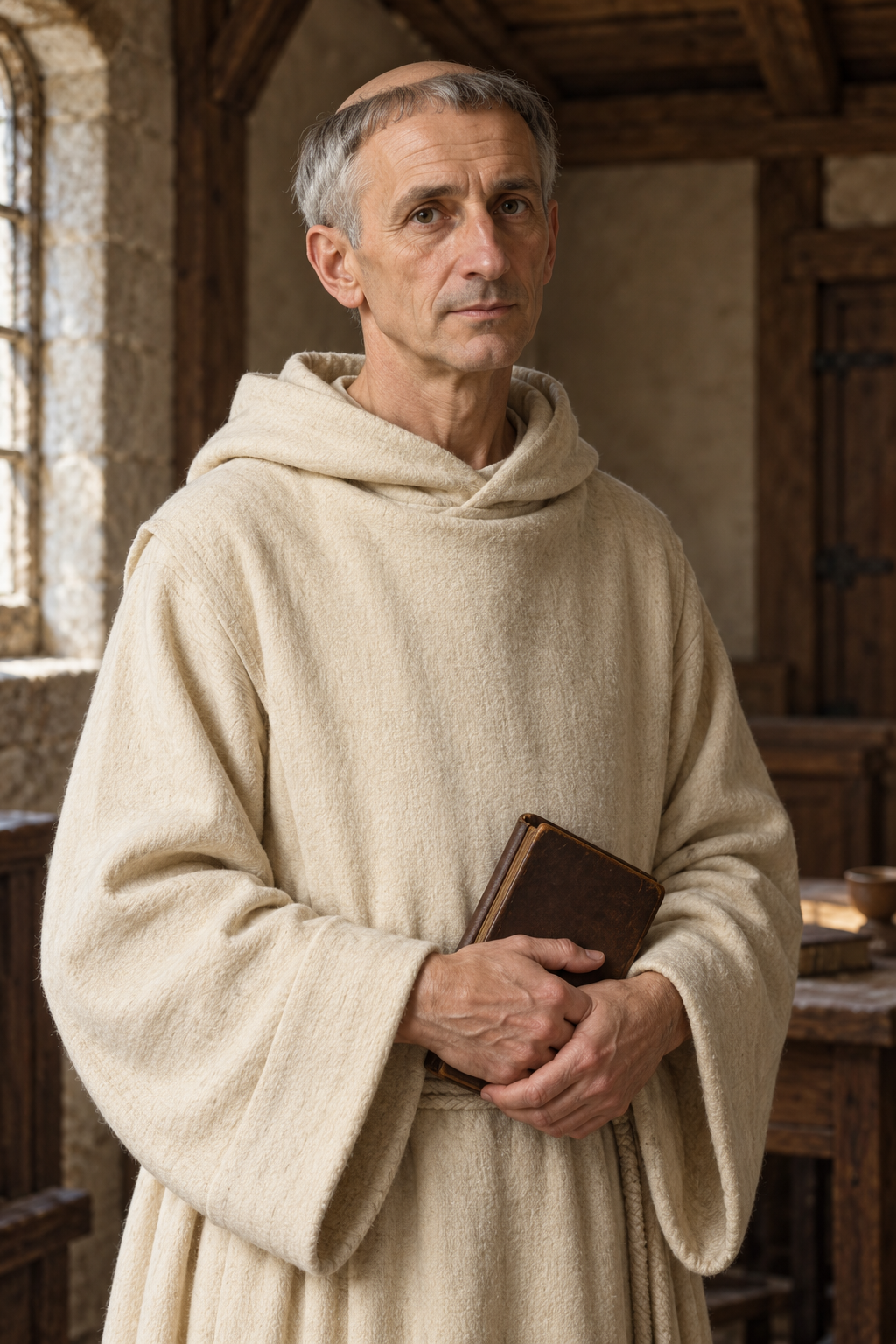
Godfrey of Savigny became the second abbot of a Benedictine monastery in Normandy that was growing into a much wider religious community. His earlier life is known chiefly through a biography written by a monk of Savigny after his death. That account describes study in Paris, entry into the monastery of Cerisy-le-Forêt and a later move to Savigny. When Vitalis died in 1122, the monks elected Godfrey as their abbot. The biography presents him as reluctant to accept the office, a detail that belongs to its portrayal of his humility. Hugh Feiss notes that the text may have been written much later, in connection with efforts to promote the saints of Savigny in 1243.
Godfrey continued building the community that Vitalis had founded. He completed its first abbey church, which was dedicated to the Trinity in 1124 in the presence of five bishops. The archaeological society of Avranches, Mortain and Granville identifies him as the principal promoter of the Savigny order. Its account places this growth within a broader pattern of donations and acquisitions in western France. The abbey attracted support from powerful aristocrats as well as smaller landowners and their families. The church Godfrey completed should not be confused with the much larger abbey church built later. According to the same society’s account, a replacement was undertaken in 1173 because the earlier building had become too small and worn.
The editors of The Lives of Monastic Reformers describe Godfrey as a leader who visited the houses associated with Savigny, although the precise form of those visits is uncertain. They also caution against treating rapid expansion as proof that every aspect of the congregation’s government worked smoothly. Expecting one abbot to visit all its monasteries placed a heavy burden on him. Requiring abbots from Britain to attend an annual meeting in Normandy also meant expensive, lengthy and sometimes dangerous journeys. The civil war in England made those connections harder to maintain. Houses belonging to the same congregation stood in territories controlled by rival claimants to the throne.
The new houses needed ways to remain connected. In her study of Savigny charters, Marguerite-Paule Guilbaud records that a general chapter met annually from 1132, gathering for three days at the feast of the Trinity. At Godfrey’s death, she counts eighteen daughter abbeys, without including the houses founded by those daughters. Savigny’s incorporation into the Cistercian order followed in 1147, after his lifetime.
His leadership also had an intellectual dimension. Richard Allen’s study of Norman monastic annals identifies a work on the calculation of time that Godfrey commissioned from John of Coutances around 1136. The text is now lost, although it was still known in the seventeenth century. Allen also proposes that Godfrey may have commissioned a set of annals alongside this work. That suggestion remains a historical reconstruction: the study does not establish that Godfrey personally wrote the annals. Allen considers the early annals tools for learning and for preserving institutional memory, including the remembrance of benefactors. This does not make every surviving entry Godfrey’s work: successive scribes added material over generations.
His death is dated to 1138 or 1139, and no single year can be chosen with confidence from these accounts. His fellow monks venerated him, and his relics remain associated with the parish church of Savigny-le-Vieux. This local recognition did not involve a formal canonization.
The diocesan calendar of Coutances and Avranches includes Saint Geoffrey, abbot, in the October 20 celebration of Adeline and the saints of Savigny.
Wondering how to weigh the stories and sources? Learn how to read a saint biography.