Biography
Gregorio Barbarigo
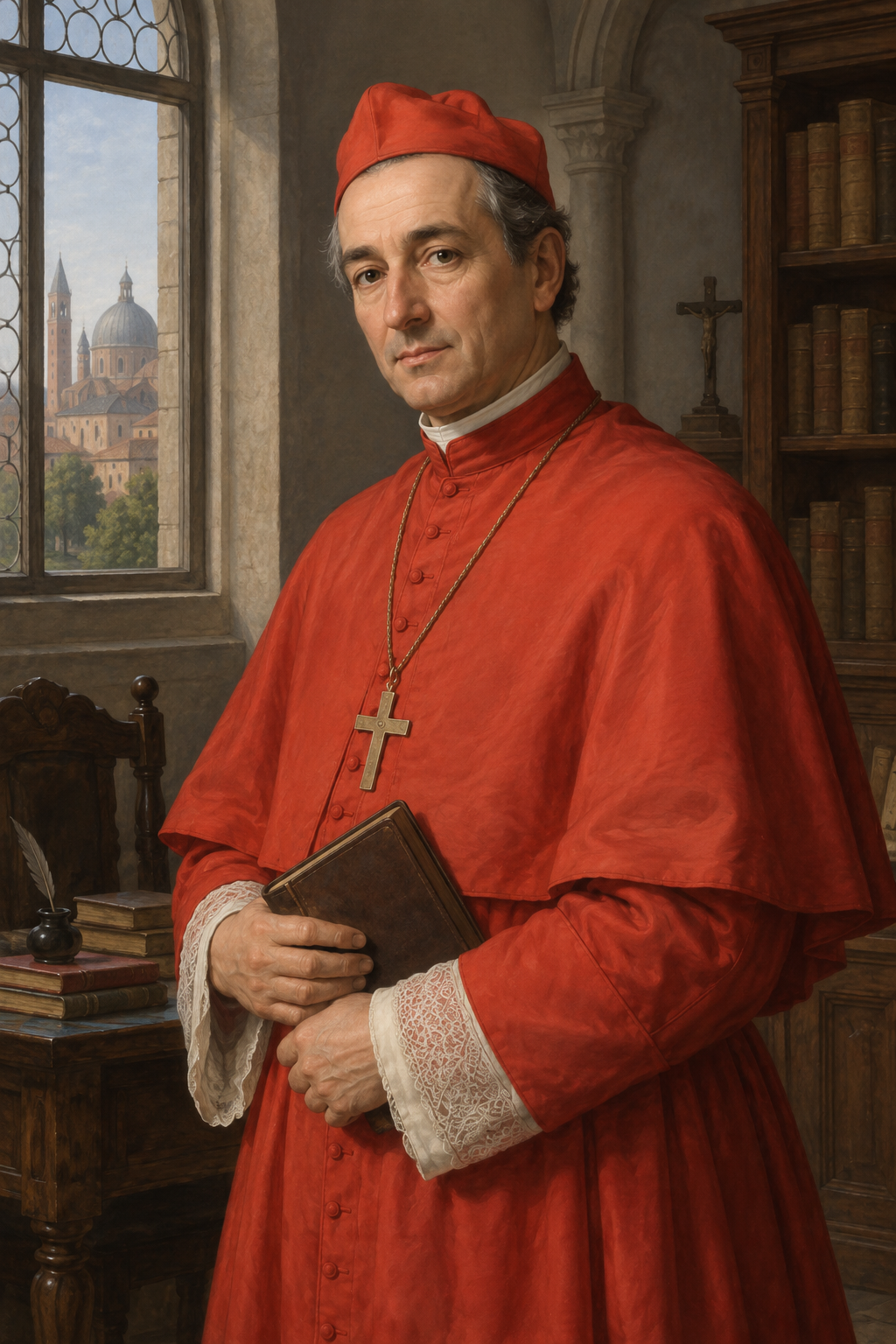
About Gregorio Barbarigo
Gregorio Barbarigo was born into a Venetian noble family in 1625. Sources disagree about the day of his birth, although the Padua seminary's own historical library and the Dicastery give 16 September. His mother died while he was young, and his father took a close role in his education. The boy studied languages, mathematics and the skills expected of someone who might serve the Republic of Venice.
In 1643 Barbarigo joined the Venetian ambassador Alvise Contarini's party in Münster. The journey placed him near negotiations that would help end the Thirty Years' War. He copied and translated correspondence and learned how political and religious disagreements shaped European affairs. He also met Fabio Chigi, then a papal diplomat and later Pope Alexander VII. Their continuing relationship influenced the direction of Barbarigo's life.
Back in Venice, he entered civic service, but eventually sought advice from Chigi about a different vocation. He studied law at Padua and received a degree in both civil and canon law. In December 1655 he was ordained a priest in Venice. This move from diplomatic and political training into ministry did not erase those earlier skills; they later shaped his work with both church and state authorities.
Alexander VII brought Barbarigo to Rome. During the plague of 1656–57, he supervised health work in the Trastevere district. The account is more specific than a general claim that he personally cared for every victim: he held an administrative responsibility in a district affected by the epidemic. The pope then appointed him bishop of Bergamo in 1657. Barbarigo was consecrated that July and arrived in his diocese the following year.
In Bergamo he visited parishes, strengthened clerical oversight and worked on the seminary. The reform model associated with Carlo Borromeo shaped his approach to bishops' responsibilities after the Council of Trent. Alexander VII made him a cardinal in 1660, though one later church summary mistakenly gives 1658. In 1664 he was transferred to Padua, where he would serve for the rest of his life.
Padua already had a seminary when Barbarigo arrived. He reorganized and enlarged it, regarding better education for priests as central to parish life. On 4 November 1670, students entered its new home. The program grew beyond the subjects usually expected in a diocesan school and drew on both the university city and the wider Catholic world. It was a long institutional project, not a single founding gesture.
His seminary taught Greek and Semitic languages as well as theology, philosophy and mathematics. A library and a press supported those studies. The seminary's historical library preserves his 1671 rules, which show how closely he connected learning with religious discipline. The curriculum also reflected plans to prepare clergy able to read and work across linguistic boundaries, particularly in the eastern Mediterranean.
In 1684 he established the seminary press. It could print materials needed in the classroom and books in several languages, making it more than a local parish printshop. Its work supported the educational program that he had developed over two decades. The press also belongs to a larger history of scholarly printing at Padua; its accomplishments should not be credited to the bishop alone, without the teachers, compositors and linguists who made the books.
Barbarigo also emphasized parish visits and the teaching of children. The Dicastery recounts his use of local speech in catechism and his attention to schools. These were practical ways to bring religious instruction to people beyond the seminary. They also took place within a tightly governed church system that expected conformity from clergy and laity. Remembering both the teaching and the authority behind it gives a fuller account of his pastoral work.
His commitment to education had clear limits. Elena Lucrezia Cornaro Piscopia, a learned Venetian woman, sought a doctorate in theology at Padua. Barbarigo, as bishop and university chancellor, opposed that degree; she received a doctorate in philosophy in 1678 instead. His objection is part of the record and should stand beside the account of his investment in schools. It illustrates the restrictions that women faced even in a city known for learning.
From 1676 to 1680 Barbarigo spent much time in Rome under Innocent XI. Letters from those years show how he tried to manage Padua's diocese at a distance with help from family members. He was also involved in the difficult relationship between Venice and the papacy, including an unsuccessful effort at mediation after formal relations broke down. The correspondence reveals a bishop balancing local responsibility with the demands of his rank as cardinal.
He returned to active oversight in Padua and continued working into his final year. The historical record places his death there on 18 June 1697. The exact day is better documented than the present catalog's year-only entry. His seminary, its books and its press endured after him, but their later development belonged to many people. A life of pastoral attention, institutional ambition and strict authority is more historically useful than an account that ignores either the achievements or the limits.
Clement XIII approved Barbarigo's beatification in 1761. John XXIII canonized him on 26 May 1960 by an equipollent process that recognized his established veneration. The pope's homily recalled his work as a bishop and his concern for the formation of clergy. His significance thus rests on documented pastoral and educational work, as well as the Church's later judgment of his life.
Wondering how to weigh the stories and sources? Learn how to read a saint biography.