Biography
Gregory of Decapolis
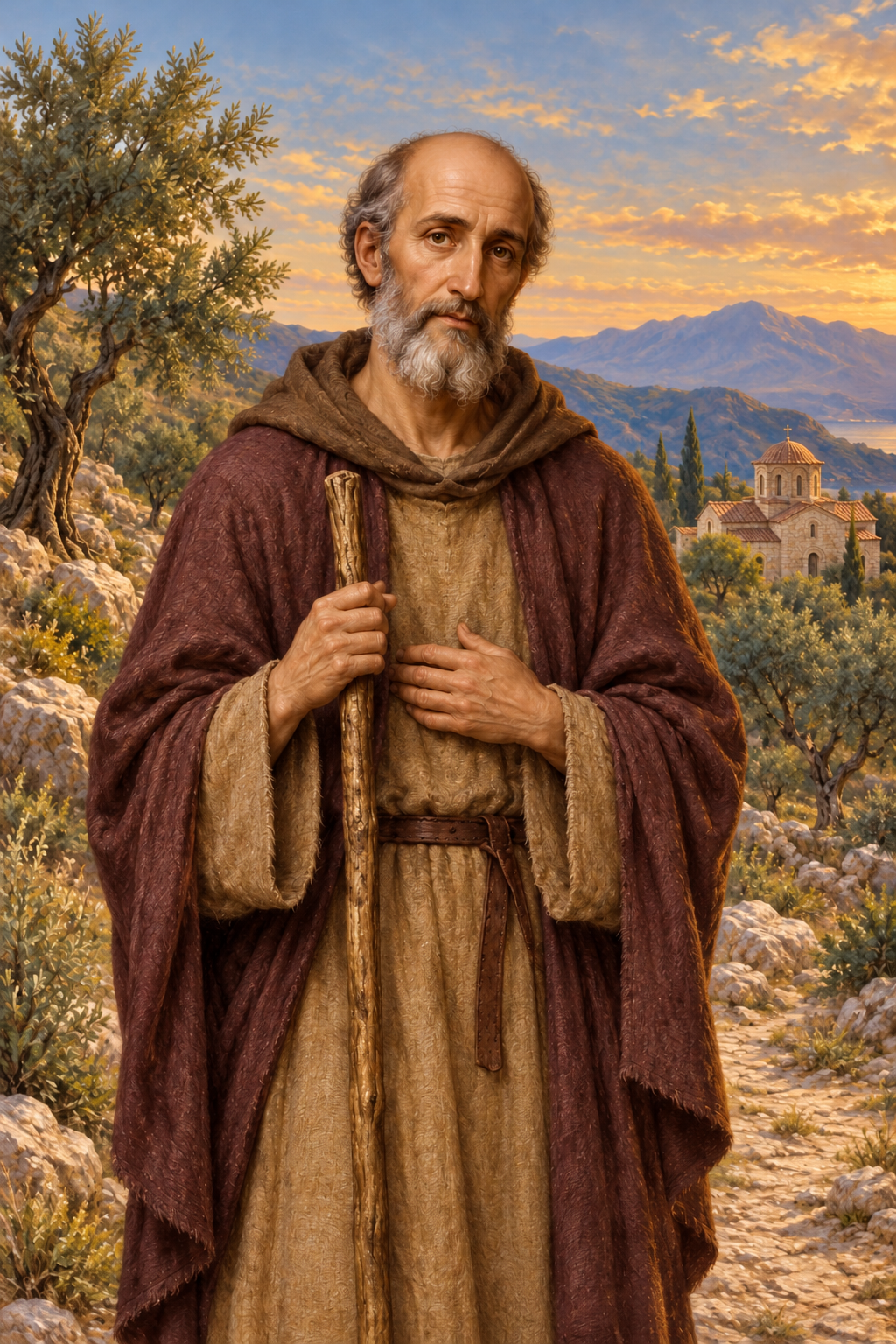
About Gregory of Decapolis
Gregory of Decapolis was a Byzantine monk remembered for his travels, spiritual guidance, and reputation as a wonderworker. He came from Eirenopolis in the Isaurian Decapolis, a region of Asia Minor. His parents were Sergios and Maria, and an uncle, Symeon, became an important guide in his monastic formation.
The account of his youth joins religious devotion to practical work. As summarized in the Prosopography of the Byzantine Empire, he learned manual skills and earned enough to support himself and his parents, sometimes helping people in need as well. The same narrative describes his eagerness to hear psalms in church and his preference for rough clothing. These are features of his hagiographic portrait, rather than an independently documented record of his childhood.
His life places his decision to become a monk amid family plans for his marriage. After leaving home and joining a monastery, he came into conflict with its abbot over icons. He then spent fourteen years in the community led by his uncle before withdrawing for a time into a cave.
Gregory’s travels took him through the eastern Mediterranean to southern Italy and Rome, and then back to Thessalonica. There he lived near the church of Saint Menas and gathered disciples. The narrative contains dangers as well as hospitality: at Otranto, people suspected him of being an Arab spy and mistreated him.
Travel also made him dependent on other people. The Life describes him accompanying another monk toward Corinth as a servant because he could not pay his own way. Later, near Saint Menas in Thessalonica, he struggled to obtain food and clothing and begged in the streets. According to the same account, regular support followed his intervention for a woman whose house had collapsed. His solitary vocation was therefore remembered alongside encounters with people who sustained him. Even his earlier withdrawal into a cave had involved another monk attending to his needs. At Rhegium, the narrative says, he refused a gift because he considered its source tainted.
These journeys were more than a sequence of destinations in the story told about him. Irene Jacobs’s study shows how the biography presents travel as part of his monastic formation and, later, as obedience to a divine call to benefit others. It also preserves movements prompted by friendship, family ties, and the search for solitude.
The story’s many miracles need to be read as part of that religious portrait. The Orthodox Church in America remembers Gregory as a man of prayer who received gifts of prophecy and healing. Its account also emphasizes his support for the veneration of icons.
The extent of his public role in the icon controversy is less clear. Jacobs notes that the subject is not prominent throughout his biography; passages stressing his orthodoxy may have helped establish his standing when the dispute remained unsettled. A conventional image of an active campaigner should therefore not replace the more complicated surviving account.
His biographical tradition connects him with Joseph the Hymnographer, who later established a monastery and placed Gregory’s remains there. The Orthodox Encyclopedia draws this connection from Joseph’s life. It also records the later preservation of Gregory’s relics at Bistrița Monastery in Romania.
That connection includes a journey Gregory did not make himself. According to Joseph’s Life, as discussed in the Orthodox Encyclopedia, Gregory sent Joseph to seek help from the pope in Rome. Pirates captured Joseph and carried him to Crete, preventing him from completing the mission. He returned only after Gregory’s death. The episode belongs to the tradition preserved about Joseph and should not be treated as an independently established itinerary for Gregory.
Gregory became seriously ill toward the end of his life. The critical prosopography describes his final journey to Constantinople, where he asked to be carried to a public hospital and died on November 20.
The year is uncertain. Jacobs summarizes the usual scholarly dating as 842 or one or two years earlier. The same study places his birth late in the eighth century without establishing an exact year.
The Orthodox Church in America gives the much earlier death year 816, illustrating a disagreement in the accounts rather than an additional secure date. Its liturgical commemoration falls on November 20.
Later generations encountered Gregory through accounts of his relics as well as through his life. The Orthodox Church in America describes their veneration at Bistrița and notes a booklet about miracles and healings attributed to him in Romania. That collection was written by Abbess Olga Gologan, who died in 1972. It records the continuation of devotional storytelling about Gregory long after his Byzantine lifetime.
Gregory’s remembrance remains part of the life of Bistrița Monastery in Vâlcea. Romanian Patriarchate reporting explicitly names him its patron and describes the vigil held for his feast in November 2025. His patronage here is attached to this particular monastery, where the community continues to honor him.
Wondering how to weigh the stories and sources? Learn how to read a saint biography.