Biography
Gregory of Sinai
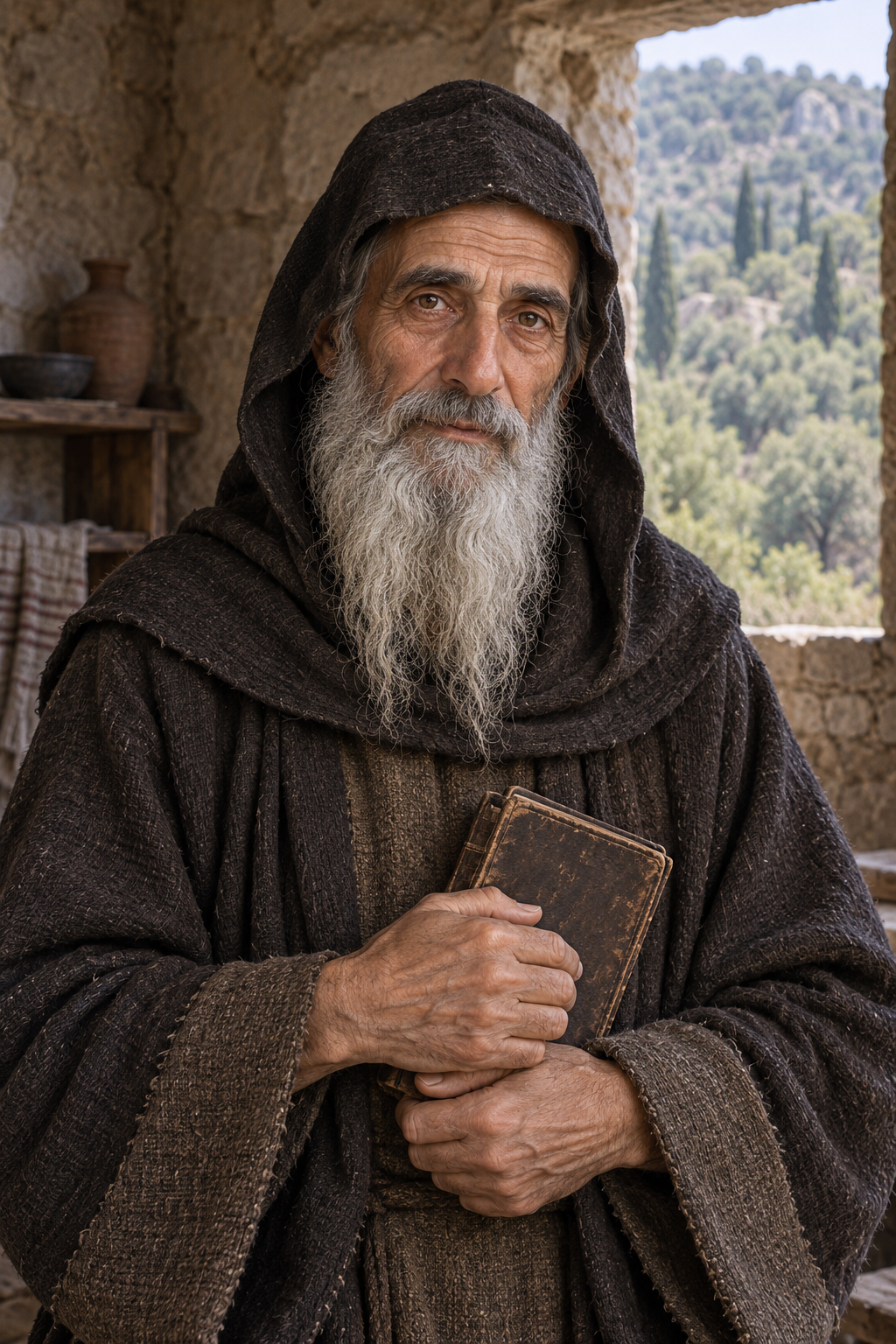
About Gregory of Sinai
Gregory of Sinai traveled between monasteries and remote settlements in search of a life centered on prayer. He became a teacher of hesychasm, the Christian tradition of inward stillness and watchfulness. His work reached both monks living in communities and those living alone. His disciple Kallistos, later patriarch of Constantinople, wrote the Life through which much of Gregory’s story is known.
Gregory came from Koukoulos near Klazomenai in Asia Minor. His birth year is uncertain. As a young man he was captured during a Turkish raid and taken with relatives to Laodikeia. According to Kallistos, local Christians paid for their freedom after hearing them sing in church. Gregory subsequently reached Cyprus, where a solitary monk introduced him to monastic life. He later traveled to Saint Catherine’s monastery on Mount Sinai and made his profession there.
At Sinai, the received account remembers him working as a cook, baker and copyist. Reading Scripture and earlier Christian writers accompanied those ordinary duties. His demanding religious practice drew admiration, but the story also describes tensions with other monks. He left, visited Jerusalem, and spent time on Crete before going to Mount Athos. These journeys connected his later teaching with several different monastic settings.
The accounts of his austerity need care. David Balfour points out that a literal reading would require Gregory to spend entire nights both praying and reading while also working, copying books and repeatedly climbing Sinai. The accumulation belongs to the language of hagiographic praise. It conveys the biographer’s admiration without providing a credible timetable for every day.
On Crete, a monk named Arsenius taught Gregory about contemplative prayer. Gregory later gathered disciples on Athos, but attacks forced him to leave. His travels brought him toward the Black Sea and eventually to Paroria, where a monastery became an influential center of spiritual teaching. His writings helped carry that influence beyond the community itself.
His settlement at Paroria was not a simple withdrawal from other people. After an earlier attempt there had failed amid threats and violence, he returned and gathered another community. Banditry remained a danger. He asked the Bulgarian ruler John Alexander for protection, and royal support supplied buildings, a church, a defensive tower and property. Gregory also maintained a separate cell where he could spend time away from the larger community.
His surviving Instructions to Hesychasts show a teacher attentive to differences among monks. He discusses prayer spoken aloud and prayer held inwardly, allowing for the weariness that can accompany either practice. He does not present attention as an achievement produced by willpower alone. Repentance, humility and divine help belong to his account of a mind repeatedly drawn away from prayer.
The same work distinguishes the life of a solitary contemplative from the duties of a monk in community. It recognizes more than one faithful course: some combine psalm singing with inward prayer, while others continue a more active life. Gregory also stresses the need for an experienced instructor. His advice belongs to a relationship of spiritual guidance, in which a practice is considered alongside the person undertaking it.
His best-known collection contains 137 chapters, bringing together reflections on Christian teaching, conduct, passions and prayer. Shorter works address particular aspects of spiritual life. F. de Sa’s account in the New Catholic Encyclopedia notes that published editions do not contain all the writings attributed to Gregory and that manuscripts preserve variant forms. The transmission of his work therefore requires attention as well as its interpretation.
A passage preserved in the Slavonic version of his Life describes his final withdrawal to a solitary cell with a disciple. It portrays him struggling against demonic attacks before receiving consolation and preparing for death. The disciple grieves at losing his teacher. This is a religious account of Gregory’s last days, shaped by its understanding of spiritual struggle; the supernatural events belong to the narrator’s testimony.
Gregory died at Paroria, but the year is less secure than many short biographies suggest. Antonio Rigo’s chronological discussion places the death after 1341 and before 1347, probably toward the end of that interval. The often repeated year 1346 began as a later scholarly hypothesis. The uncertainty does not erase his historical setting, but it prevents treating a reconstructed year as an exact recorded date.
Later devotion also requires distinctions between people with similar names. Relics at the Serbian monastery of Gornjak were once assigned to Gregory of Sinai, but the Orthodox Encyclopedia identifies them with his disciple Gregory the Younger. They cannot establish the location of this Gregory’s remains.
The Orthodox Church in America commemorates Gregory on August 8 and also lists other observances. Its account remembers a teacher whose instruction joined inner prayer with work. His texts remain a substantial part of that remembrance: they preserve practical questions about attention, persistence and the different demands of monastic life, alongside the story of the monk who taught them.
Wondering how to weigh the stories and sources? Learn how to read a saint biography.