Biography
Isaac of the Dalmatian Monastery
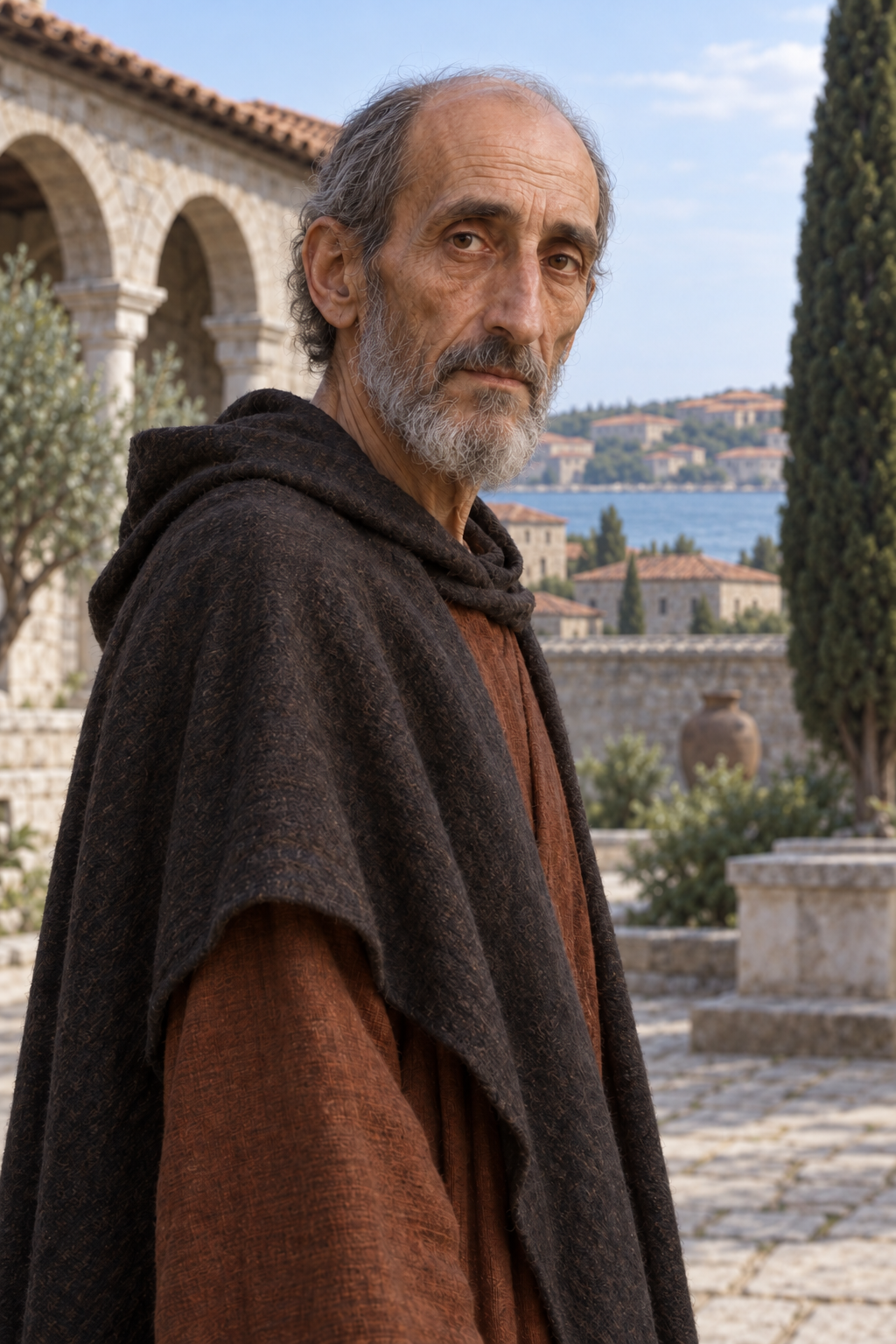
About Isaac of the Dalmatian Monastery
Isaac is honored in Orthodox tradition as the founder of the Constantinopolitan monastery later named for his successor, Dalmatus. The Orthodox Church in America remembers him as an ascetic who opposed the emperor Valens’s support for Arian teaching and later led a community in the capital. Its account describes practical care for people in need and a final entrusting of the monastery to Dalmatus. The title “of Dalmatia” refers to this monastic association; the notice does not establish a birthplace in Dalmatia.
A fifth-century church history preserves his confrontation with Valens. Theodoret introduces it as something related about Isaac, a solitary living at Constantinople. When the emperor marched out with his troops, Isaac urged him to restore the expelled church leaders and warned that otherwise he would not return. Valens threatened to kill him after the campaign, and Isaac accepted that consequence if his warning proved false. The episode is transmitted as a story of a monk challenging imperial religious policy.
Other early sources place Isaac within a difficult conflict among Christians. Palladius, an advocate for John Chrysostom, names Isaac and the priest Eugenius as the men who delivered a summons to John during the proceedings against him. This evidence belongs to Isaac’s opposition to the bishop, rather than to his confrontation with an Arian emperor.
Sozomen reports that John disputed with monks, especially Isaac. The disagreement concerned monastic conduct: John praised quiet life within monasteries and rebuked monks who appeared in the city. Sozomen later places Isaac on a voyage with Theophilus of Alexandria after the conflict over John.
The historian J. H.W. G.Liebeschuetz treats Isaac as a significant figure in the monastic opposition to John. He also traces Isaac’s connections with influential laymen: Saturninus provided land and a cell, while Aurelian arranged his burial in a shrine of Saint Stephen. The historian stresses the limits and partisanship of the surviving accounts; no satisfactory narrative explains the conflict from the monks’ own perspective.
The death year remains problematic. The OCA’s received account gives 383, while the historical evidence also associates Isaac with John Chrysostom’s opponents at the beginning of the fifth century. Those strands cannot be combined into an exact chronology. The OCA commemorates him on May 30.
Wondering how to weigh the stories and sources? Learn how to read a saint biography.