Biography
Isaac of Stella
About Isaac of Stella
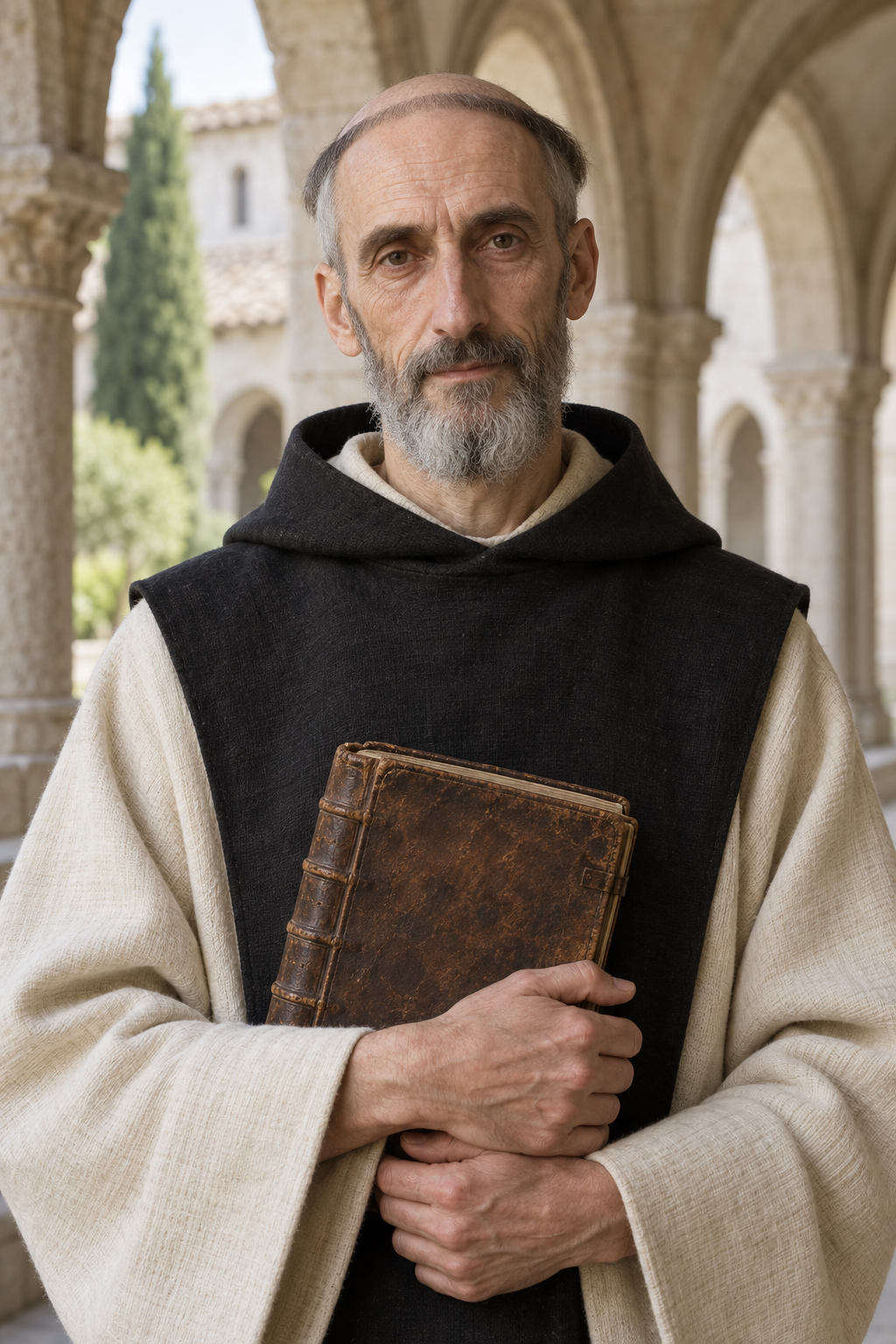
Isaac of Stella was an English monk who made his home in France and led the Cistercian community of Stella, near Poitiers. Born around 1100, he brought a scholarly education to the work of an abbot, although the precise schools he attended are uncertain. His surviving writings grew out of that vocation: sermons for a religious community and letters answering questions about the human soul and the celebration of Mass.
By 1147 Isaac was abbot of Stella, a house connected with Pontigny in the diocese of Poitiers. The community had adopted Cistercian observance in the middle of the 1140s. He also spent time on the island of Ré helping a monastic foundation, probably during the 1150s, before returning to Stella. This was not necessarily a permanent banishment: the familiar picture of an abbot ending his life in punitive island exile is not established.
Isaac's preaching could be demanding rather than comforting. In a sermon before Lent, he described monastic discipline through labor, silence, poverty and submission to another's authority. He used harsh images of crucifying the old self to explain the renunciation of entrenched desires and habits. Yet the next sermon begins by admitting his own uncertainty about the meaning and final outcome of his observances. The teacher appears within the struggle he describes, not simply above the people he instructs.
An exchange with Alcher, a monk of Clairvaux, brought a different side of Isaac's teaching into view. Alcher wanted more than an account of sin and salvation: he asked how the soul works, inhabits the body and leaves it. Isaac answered while acknowledging the limits of his knowledge, and asked Alcher in turn for a letter about the human body. To explain why damage to the body need not destroy the soul, he compared bodily organs to a musical instrument: when its strings break, the musician's art is not itself broken. His conclusion says he wrote amid severe famine and pestilence. The usual dating to about 1162 comes from comparing that report with contemporary chronicles, rather than from a date written into the letter.
Isaac also remained connected to church affairs beyond his monastery. In a letter of 1164, John, bishop of Poitiers, told Thomas Becket that he and Isaac had arranged for the monks of Pontigny to remember the archbishop continually in prayer. John called Isaac their mutual friend and encouraged Becket to develop closer relations with the abbey, in person or through letters. The bishop also said that the house was prepared to offer practical help if it became necessary. The episode places Isaac within a network of monastic support, without establishing that he personally received Becket as a guest.
John was also the recipient of Isaac's letter on the Mass. Isaac explained how familiar worship could acquire renewed meaning when the restless mind attended to its spiritual significance. He read the progress of the service as an inward journey through penitence, righteousness and contemplation, relating the worshipper's movement toward the altar to a deeper approach to God rather than merely a change of physical position. His letter closes abruptly with a complaint that Hugh of Chauvigny had seized oxen and taken property while Isaac was absent. An abbot absorbed in contemplation still had to answer injuries affecting his community's material life.
His approach belonged to a wider medieval practice of explaining worship through symbols, alongside historical explanations and practical instructions. A priest's gestures, the objects used in a service and the movement of the ceremony could be read as signs of spiritual realities. Such interpretation did more than supply a dictionary of meanings: it offered a way to sustain attention when repeated services had become familiar. Seen in this setting, Isaac's writing joins the intellectual work of interpretation to the lived difficulty of remaining attentive in prayer.
Isaac probably died at Stella around 1169; neither an exact death date nor the later year 1178 should be treated as certain. His work on the soul reached later readers partly through a compilation called De spiritu et anima, which circulated under Augustine's name. Passages from Isaac consequently entered debates in which their original author was not always visible. Thomas Aquinas, for example, considered a passage transmitted through that compilation while discussing which powers remain in the soul after death. He did not simply accept its authority: his reply distinguished powers that remain actually from those remaining only in principle.
Isaac's voice has also remained part of Catholic reflection on Mary and the Church. In 2013 Pope Francis called him Blessed and cited his fifty-first sermon in Evangelii gaudium. The passage connects Mary, the Church and individual believers through their relationship to Christ. This later use gives a specific example of his enduring significance: an abbot's teaching, formed for monastic listeners, continued to help Christians describe faith beyond the walls of his own community.
Wondering how to weigh the stories and sources? Learn how to read a saint biography.
Explore similar vocations
Prayers for Isaac of Stella
Isaac petition
Quod in nobis adimplere dignetur gloriosa trinitas. Amen.