Biography
Isidore Bakanja
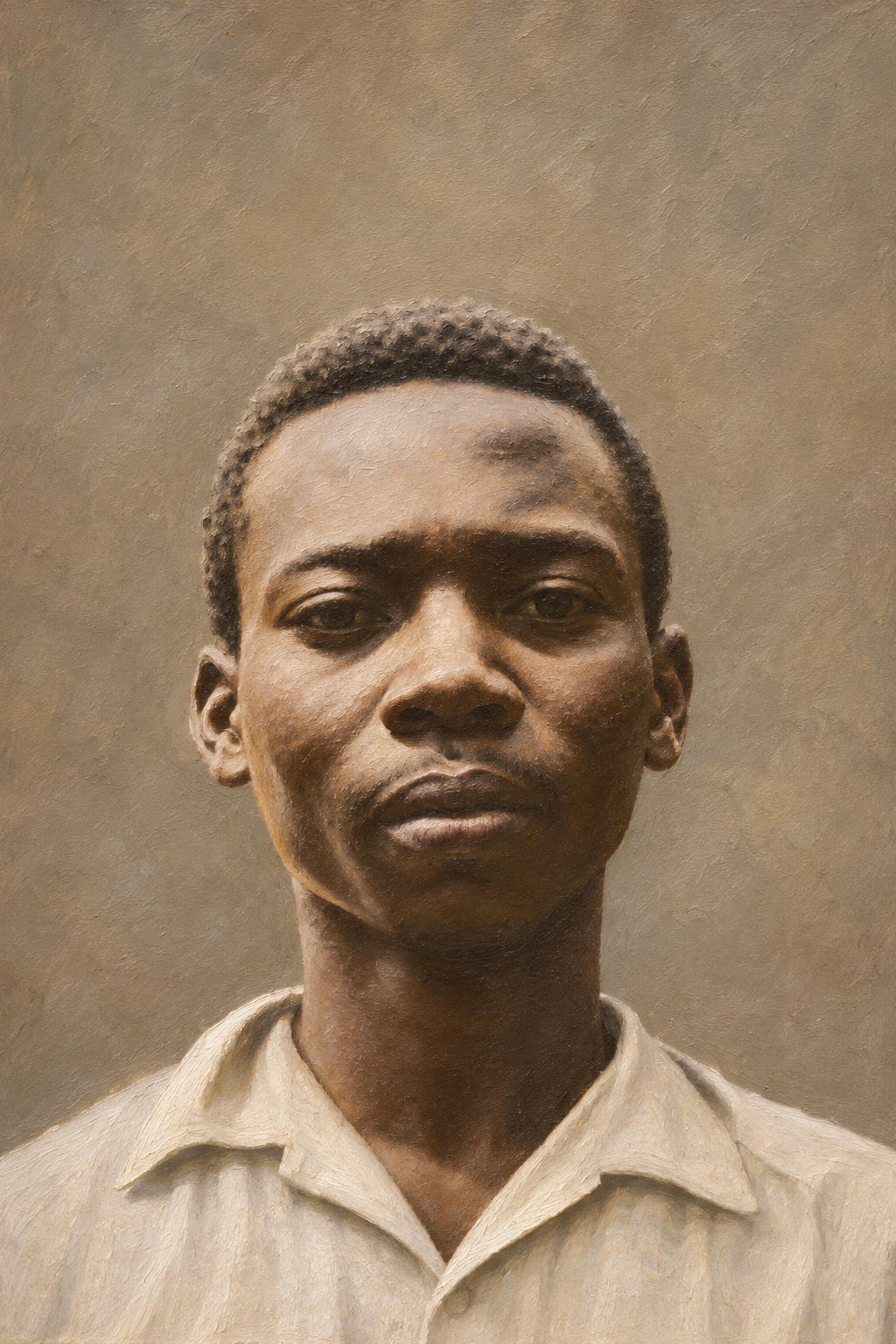
About Isidore Bakanja
Isidore Bakanja was born at Bokendela, in what is now the Democratic Republic of Congo. The Carmelite cause’s account places his birth around 1885, though the precise year is uncertain. He left his village for Mbandaka, where he encountered Trappist missionaries and became a Catholic. He was baptized on 6 May 1906 and confirmed later that year. Prayer and devotion to Mary became prominent in a faith he had adopted as a young working man.
He found work as a mason in Mbandaka. Shorter describes his religious practice as simple and consistent, marked by the rosary and the scapular he wore. He spoke about Christianity with friends and acquaintances, and his example attracted others to the faith. This was a layman’s activity within his existing relationships. He did not need to leave his employment or enter a religious community to share what he had learned.
Bakanja later became a domestic worker for Reynders, a European plantation supervisor at Busira. When his employer was transferred to Ikili, he accompanied him. His relations with Reynders were initially cordial. The plantation manager, Van Cauter, however, was hostile to Christian practice and to missionaries. Reynders warned the young servant to conceal his faith. Bakanja continued to wear the scapular and to pray. That visible religious commitment brought him into conflict with a manager who held coercive power over the workforce.
The biography reproduced by the Dicastery connects the hostility with a plantation system in which employers feared any allegiance that might limit their control over workers. Bakanja wanted to leave and return home, but permission was refused. He was ordered to throw away the scapular of Our Lady of Mount Carmel. His refusal led to repeated flogging. These were attacks upon an employee who could not freely withdraw from the situation, and whose profession of faith was treated as an obstacle to the manager’s authority.
An inspector eventually found him suffering from the injuries and arranged to take him away for treatment. The damage was already severe, and his condition did not recover. The Catholic account describes a prolonged illness in which he continued to identify himself openly as a Christian. When missionaries reached him, he told them what had happened. They encouraged him to forgive the man responsible, and he said that he would pray for him. The account remembers forgiveness alongside the reality of the violence inflicted upon him.
The vice-postulator’s account records his anointing on 24 July 1909 and his death on 15 August, the feast of the Assumption. He had remained alive for months after the beating. His remains were later moved to Bokote in 1917. The same account presents the scapular as a sign of the Christian identity for which he had suffered. Catholic devotion to him therefore centres upon fidelity and forgiveness, rather than upon any power attributed to the cloth itself.
The violence also left a documentary record outside the later cause for beatification. Historian Mathieu Zana Etambala reproduces a 1910 court judgment that linked the punishment explicitly to Bakanja’s refusal to remove the scapular. The judgment described deep injuries, detention without care and an inability to walk without help. It treated the motive as an attack upon his moral personality and freedom of worship. This evidence gives historical substance to the religious conflict remembered by the Church, while locating it within the practices of a colonial commercial enterprise.
Etambala places the case after Belgium’s takeover of the Congo Free State in 1908. He shows that coercion by concession-company agents continued despite the political change. Dörpinghaus, the inspector who intervened for Bakanja, also reported other abuses and pressed complaints that reached officials in Congo and Europe. Bakanja’s suffering was thus part of a wider system of forced labour and violence. His case entered debates about that system as well as the later history of Christian martyrdom.
John Paul II beatified Bakanja in Rome on 24 April 1994, during the special assembly of the Synod of Bishops for Africa. In his homily, the pope presented him as a lay witness whose sharing of faith resembled the work of catechists. He connected that witness with the many African laypeople who sustained Christian communities alongside priests. He also emphasized forgiveness across racial and social divisions. The recognition gave public honour to a worker whose short Christian life had been lived far from ecclesiastical office.
The following day, the pope addressed pilgrims who had come for the beatification, including people from Bakanja’s country. He drew attention to prayer and to the unity of faith with daily work and social responsibilities. He asked them to become people of dialogue, reconciliation and peace. In that Catholic remembrance, Bakanja’s life remains connected to the ordinary places where conscience is exercised: employment, friendship, worship and the treatment of people who depend upon those with power.
Wondering how to weigh the stories and sources? Learn how to read a saint biography.