Biography
Ivo of Chartres
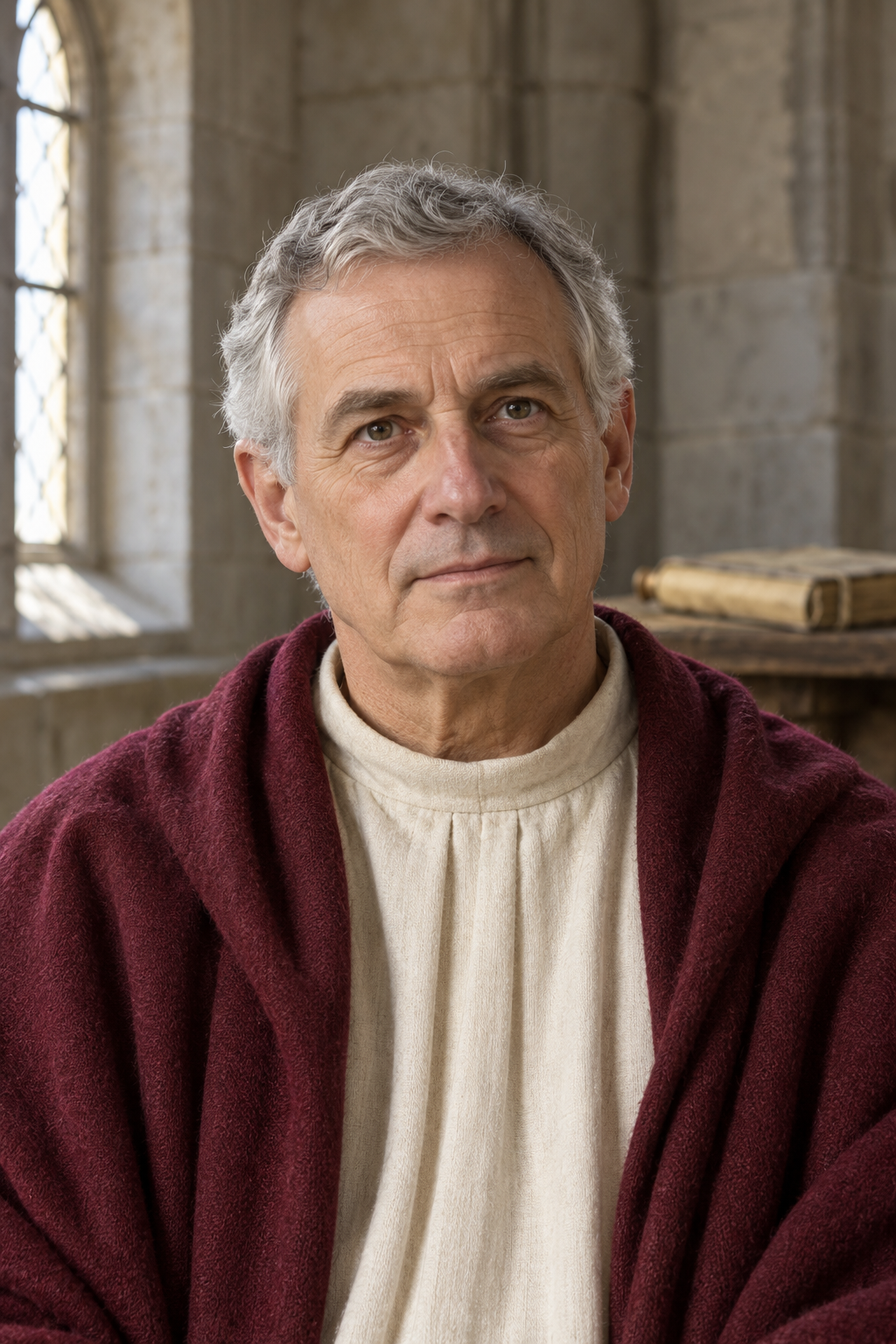
About Ivo of Chartres
Ivo of Chartres worked as a bishop, judge and writer at a time when church law was developing into a distinct field of study. His surviving correspondence shows him dealing with questions that reached from worship and penance to marriage and legal procedure. For him, the difficult task was not simply finding a rule: it was deciding how inherited rules should be applied to a particular person and circumstance.
Born around 1040 in the Beauvais region, he studied under Lanfranc at Bec and later became a canon at Nesle. He then led the community at Saint-Quentin in Beauvais before becoming bishop of Chartres in 1090. His election was disputed because his predecessor, removed for simony, still had supporters. Pope Urban II supported Ivo and consecrated him.
The new bishop soon faced a conflict involving King Philip I of France. He opposed the king’s rejection of Queen Bertha and relationship with Bertrada of Anjou. His opposition brought imprisonment, while Urban II continued to defend him. The episode placed the bishop’s judgment about marriage directly against royal power.
Ivo’s own words reveal a similar difficulty in his dealings with Countess Adela. In a letter preserved in Columbia University’s Epistolae collection, he challenges her efforts to defend or conceal the relationship of her cousin Adelaide with William. He begins by acknowledging Adela’s generosity, but refuses to let that respect settle the case. He argues that tolerating misconduct among people close to him would undermine his authority to correct it elsewhere. He also insists that his position comes from his understanding of justice, rather than personal hostility.
That letter is firm without simply closing discussion. Ivo allows a conditional concession to Adela’s request if the couple agrees to abstain from sexual relations until the case is resolved. The document therefore preserves both an objection and a proposed interim arrangement. It is evidence of what he asked and argued; it does not, by itself, establish how the couple subsequently behaved.
His approach to law was grounded in extensive reading. The Decretum brings together roughly 3760 passages in seventeen books, grouping material by subject. Its range includes the sacraments, church offices, marriage, the responsibilities of laypeople and theology. Augustine’s writings have an especially large place in the collection. The arrangement makes clear that Ivo’s legal work cannot be separated neatly from his theological interests.
The collection grew from earlier authorities rather than from a wholly new set of rules. Much of Burchard of Worms’s compilation appears within it, alongside other material. Ivo had begun gathering texts while still at Saint-Quentin, and a developed version was available to him by 1095. His prologue later circulated with other collections as well as with his own. Modern scholarship distinguishes this securely attributed Decretum from the Tripartita and Panormia, which were long associated with him but cannot be assigned to him with the same certainty.
Treccani’s account likewise warns that the legal collections connected with Ivo are not always uniform or final texts. They gather papal decisions, council rulings and writings of earlier Christian teachers, and their relationships are complicated. That caution changes how his achievement should be described: his importance does not require treating every book transmitted under his name as a work entirely written by his own hand. The same account places him within church reform and describes his conciliatory participation in the disputes over investiture.
The surviving manuscripts also show the breadth of his writing. The University of Missouri records a twelfth-century fragment containing part of a sermon on church dedication and another fragment of the Decretum. Its account identifies about 300 letters on theology and church law, alongside surviving sermons. These witnesses preserve more than the outline of a public career: they make it possible to study the arguments and teaching through which he carried out his office. The sermon fragment is catalogued as English and dated 1140–1160, while the Decretum fragment is assigned to central France in the second half of the twelfth century. Both belong to the library’s Fragmenta Manuscripta collection.
Ivo died on December 23, 1115. Some older references give 1116 or 1117, but a study in the English Historical Review explained why those dates are untenable: a papal letter announcing his successor’s consecration must belong to April 1116. The modern chapter by Christof Rolker also uses 1115. His Catholic remembrance is retained in the French Nominis calendar as a local feast on December 23.
His lasting contribution lies partly in the responsibility he placed on the judge. As Rolker explains, inherited church tradition could support either severity or leniency. Ivo held that a decision must take account of the circumstances and be guided by charity. His work therefore preserves a demanding question within the history of Christian law: how to remain faithful to an authoritative tradition while responding carefully to the person and case before the court.
Wondering how to weigh the stories and sources? Learn how to read a saint biography.