Biography
James Theodore Holly
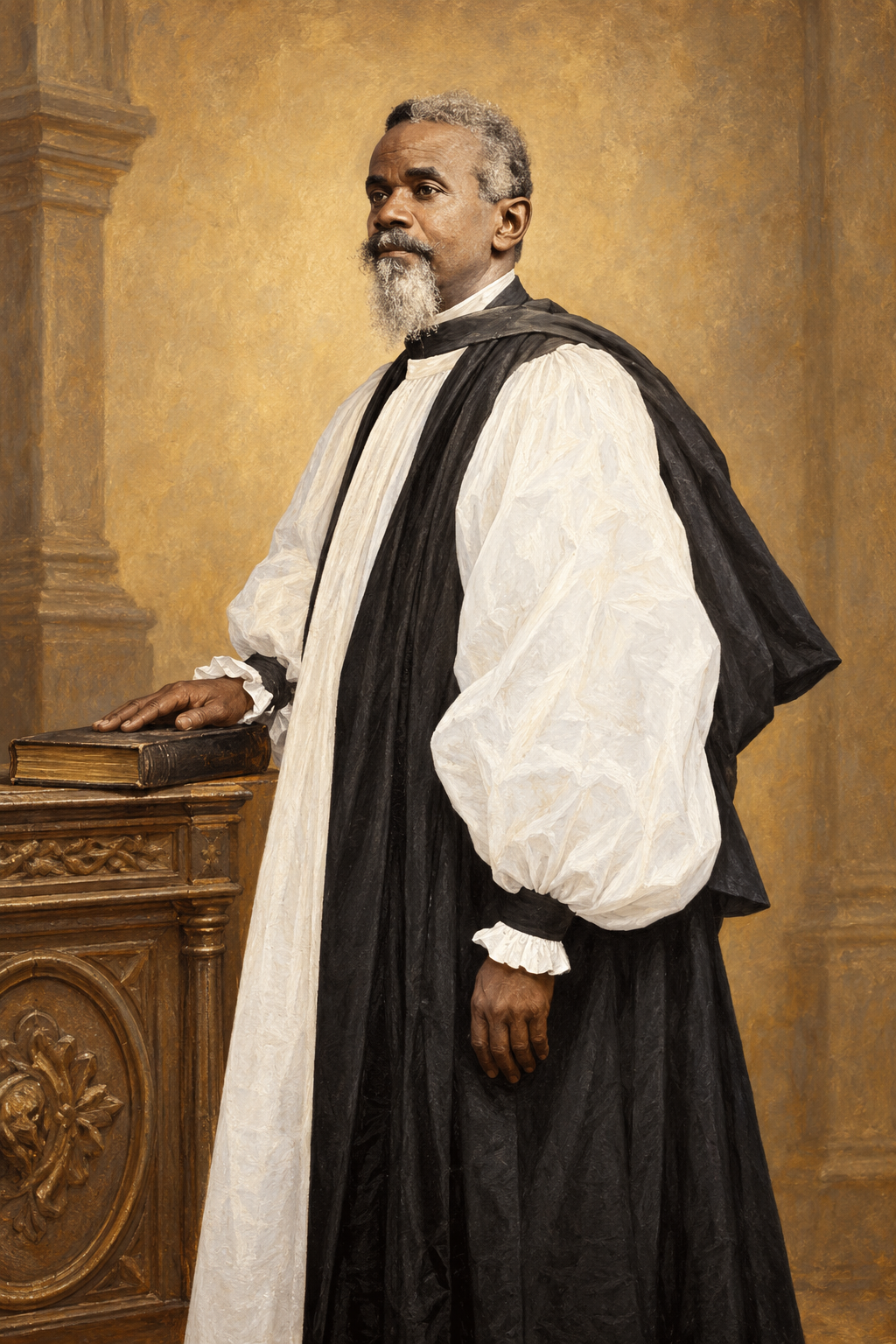
About James Theodore Holly
James Theodore Holly connected the struggle against racial exclusion in the United States with a lifelong commitment to Haiti. As rector of St. Luke’s Church in New Haven, he encouraged Black Americans to consider emigrating to a country where enslaved people had won independence. He hoped that Anglican church life could contribute to the country’s development. His plans met resistance from the Episcopal Church’s missionary authorities, but he continued seeking support.
Holly recorded his birth in Washington on October 3, 1829. Raised Catholic, he later left that church and joined the Episcopal Church in Detroit. His own account distinguishes those two decisions rather than treating them as a single conversion. He was ordained deacon in 1855 and priest the following year.
His public case for Haiti appeared in a lecture published in 1857. Holly explained that he had first delivered it to a literary society of Black young men in New Haven after returning from Haiti, then repeated it in Ohio, Michigan, and Canada West. He dedicated the publication to William C. Munroe, acknowledging a teacher whose religious guidance he connected with human liberty. The argument challenged claims that Black people lacked the capacity to govern themselves. Holly also challenged professed friends of racial equality whose support weakened when equality had to be recognized in practice. He wanted his listeners to recover self-respect from a history too often told by their oppressors. The Haitian Revolution supplied his central example: people held in slavery had fought for personal freedom and control of their country together. He contrasted that struggle with the American Revolution, whose participants already possessed liberties denied to the enslaved. These were Holly’s political and religious arguments, shaped to persuade an audience, rather than a detached account of every aspect of Haitian history.
His New Haven years also involved work close to home. Historian Randall Burkett describes Holly’s advocacy for better schooling for Black children and his service as an elementary-school principal from 1857 to 1859. In 1858 he opened a select school whose program joined academic preparation with Episcopal worship and racial pride. His educational work accompanied the campaign for emigration; the two interests coexisted during his parish ministry. Burkett’s research also identifies the people who helped secure his position. Thomas Prime introduced him to Harry Croswell, and parish officers supported his preparation for priestly ordination. Richard Green, Frederick Benjamin, and members of the Merriman family wrote testimonials on his behalf, alongside clergy who knew him. This local support matters because Holly’s later prominence can obscure the congregation that helped sustain his early career. Burkett distinguishes the surviving record from speculation: Croswell’s diary contains little about his personal reaction to Holly’s ideas. The absence of such comments does not establish agreement with every aspect of Holly’s politics, even where practical assistance is documented.
In 1856 he also helped establish a society promoting the Episcopal Church among Black people. It pressed the wider church to address slavery. When he eventually sailed for Haiti in 1861, members of his New Haven congregation were among the emigrants. Disease and difficult conditions soon undermined the settlement, and many survivors returned to the United States. Holly remained, building a mission with those who stayed.
The losses reached into his own household: his mother, wife, daughter, and a son died. Over the decades that followed, he supported his ministry and family through such work as shoemaking, teaching, and secretarial employment. His pastoral responsibilities included teaching, evangelism, and counseling, alongside the practical task of finding enough money to continue.
Holly’s 1897 account makes clear that this was not the work of one man alone. Haitian clergy combined ministry with paid employment, while rural lay readers visited households and led worship. Parishioners contributed land, materials, and labor to build their chapels. Schools helped prepare readers and teachers for communities where literacy was essential to using the Bible and Prayer Book. Holly also appealed for a dispensary and hospital, linking bodily care with Christian ministry. His disparaging description of rural Haitian religion also reveals the limits of his missionary perspective.
He was consecrated bishop for Haiti in 1874, becoming the first Black bishop consecrated in the Episcopal Church. He attended the Lambeth Conference and continued living and working in Haiti until his death in 1911.
Rooy records that, by the end of Holly’s life, the church included fifteen parishes, seven missions, fifteen Haitian clergy, and more than two thousand members. Rooy’s account of his work emphasizes Holly’s conviction that the incarnation required care for both body and soul. Schools, medical work, and mutual assistance belonged within that understanding of the church’s responsibility.
Rooy also describes a largely self-directed intellectual life. Holly acquired knowledge of several languages, including French and Creole as well as biblical languages, and published books and articles on varied subjects. His ministry required study alongside preaching and teaching, and the paid employment that helped sustain his household.
Wondering how to weigh the stories and sources? Learn how to read a saint biography.