Biography
Jane Frances de Chantal
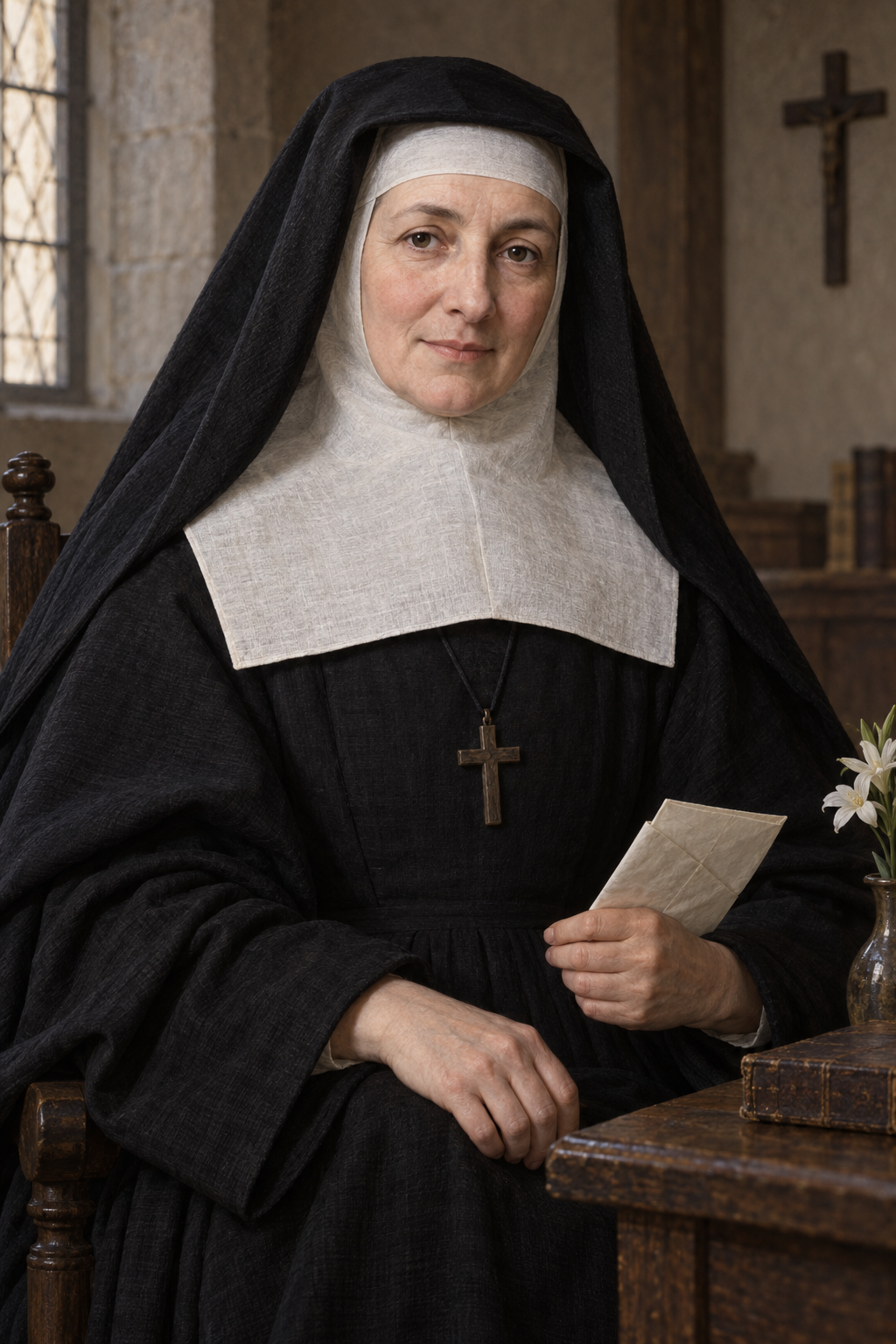
About Jane Frances de Chantal
Jane Frances de Chantal, born Jeanne-Françoise Frémyot, came from a prominent family in Dijon. Vatican City State and the Diocese of Dijon give her birth as 23 January 1572 and name her father, Bénigne Frémyot, a magistrate and president of the Parliament of Burgundy. Her mother, Marguerite Berbisey, died when Jane was about fifteen months old. The Catholic Encyclopedia instead prints 28 January; because the Vatican and local diocesan accounts agree on 23 January, this profile uses that date and records the discrepancy rather than implying unanimity. The sources describe her as a member of the Burgundian legal nobility, but offer little dependable detail about her schooling, so no curriculum or childhood anecdote is asserted as fact.At age twenty Jane married Christophe de Rabutin, Baron de Chantal. They had six children, four of whom survived. The family lived at Bourbilly, where Jane took responsibility for household and estate management while her husband was away. This work placed her in charge of practical decisions and the welfare of dependents; the sources support a capable household manager, not the later idealized picture of a woman untouched by ordinary obligations. The marriage ended when Christophe was accidentally killed in a hunting incident, leaving Jane widowed at about twenty-eight. Accounts differ slightly on whether the accident occurred in 1600 or 1601, so the biography does not attach a precise year to it.After Christophe's death, Jane returned to Dijon and later lived at Monthelon with her father-in-law. The move protected the inheritance and future of her children, but placed her in a difficult household for several years. She remained responsible for the children and resisted pressure to remarry. These years matter to the later history of the Visitation because her religious vocation developed while she was still a mother with material and family duties. The record does not need the dramatic visions described in later devotional biographies to explain this transition: her correspondence and the later foundation give documentary evidence of her spiritual direction and decisions. The number of years spent at Monthelon is usually reported as seven; this figure belongs to the historical biographies and is not used to infer any missing life date.During Lent in 1604, while Francis de Sales was preaching in Dijon, Jane met him and sought his spiritual guidance. The encounter began a sustained relationship of direction and correspondence. Their surviving letters concern prayer and religious discernment, but also the practical work of governing communities: travel, foundations, staffing, health, money, and relations with church authorities. The Visitation's correspondence survives in a six-volume critical edition prepared by Patricia Burns; a scholarly review reports that roughly 2,600 letters are extant. A separate 1918 English selection, translated from the Annecy sisters' 1877 edition based on manuscripts, preserves Jane's own voice while making clear that it is a selection and not the complete critical corpus. Some letters reveal painful family concerns as well as convent administration, including grief over a daughter's death and anxiety about her son. These are first-person documents, whereas the account of a vision that foretold her director is a later religious narrative and is not stated here as established history.With de Sales and three companions, Jane founded the Order of the Visitation of Holy Mary at Annecy on 6 June 1610. The first plan differed from strict cloistered orders: the women were to follow a moderated rule and visit the sick and poor outside the convent. This made the new community accessible to women who could not manage harsher physical austerities. The arrangement later changed under ecclesiastical direction, and the order adopted strict enclosure. The contrast between the original aim and the later cloister is important: the order's development was not simply the execution of one fixed plan, but a negotiation between the founders' pastoral vision and the church's rules for women's religious communities. Jane left her children only after arranging for their care and future, a choice remembered in later accounts as emotionally difficult. The evidence supports both her role in founding the order and the practical cost of that decision; it does not justify reducing her family life to a single legendary departure scene.After Francis de Sales died in 1622, Jane carried much of the work of directing and extending the Visitation. The order had thirteen monasteries at his death and eighty-seven when she died. She traveled to support new houses, advised superiors, and maintained common rules and practice through letters and constitutions. Her own letters show that administration was not abstract: she discussed the condition of individual sisters, the recruitment and formation of members, the needs of new foundations, and the pressure of keeping communities united across distance. The IEP's scholarly account notes that surviving letters and conferences form a substantial body of religious writing and that modern scholars rely on the critical correspondence and manuscript-based collected works. These sources support describing Jane as a founder and governing superior, not merely as a collaborator remembered through Francis de Sales.Jane's family continued to shape her life after she entered the Visitation. Her son Celse-Bénigne died in military service in 1627, and her letters record the anguish this caused her. The published selection also preserves her response to grief and fear through language of trust in divine providence; this is evidence of her own religious reflection, not proof that she felt no sorrow. She continued leading the order for almost two decades after de Sales's death, until her own death at the Visitation house in Moulins on 13 December 1641. She was beatified in 1751 and canonized by Pope Clement XIII on 16 July 1767. The current Roman Catholic memorial is 12 August. The biographical record is therefore unusually well documented for a seventeenth-century religious foundress: official church histories supply life dates and institutional milestones, while her letters and their critical editions preserve details of her own work and thought.
Wondering how to weigh the stories and sources? Learn how to read a saint biography.