Biography
Jeanne de Lestonnac
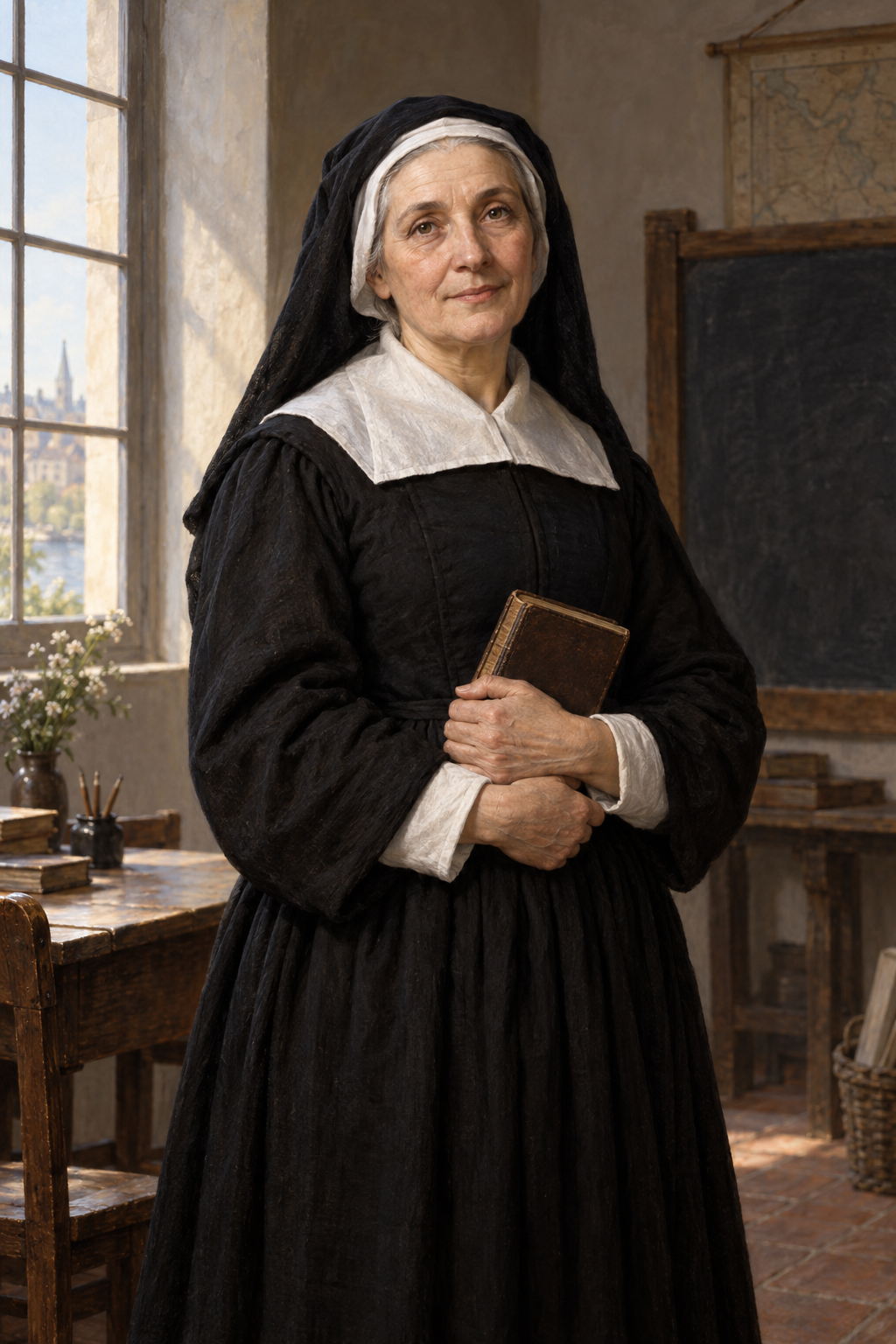
About Jeanne de Lestonnac
Jeanne de Lestonnac was born in Bordeaux on 27 December 1556, into a household divided by religious conflicts of her century. Her father, Richard de Lestonnac, was Catholic; her mother, Jeanne Eyquem, had embraced Calvinism. Michel de Montaigne was her mother's brother. These relationships help explain the intellectual and confessional world in which Jeanne grew up, though surviving retrospective accounts do not give a diary of her childhood.
Her family life formed an important part of her vocation. She married Gaston de Montferrand and they had seven children, three of whom died young. After Gaston's death, she continued to care for the surviving children and manage household responsibilities. A library authority record preserves the outline of marriage, motherhood, bereavement and her later religious life. That sequence should not erase the years she spent as a mother and administrator. It also keeps the founding of the Company from being mistaken for her first experience of education.
The religious divide within her family mattered. Philippe Loupès describes Richard as a Catholic official of the Bordeaux parlement and Jeanne's mother as drawn to Protestantism. Her later Catholic commitments were made in a city where both confessions had a public presence. Older biographies turn this into scenes of childhood argument; those conversations cannot be checked here. What can be said is that education and religious belonging were closely linked in the setting that shaped her.
In 1603 she went to a reformed Cistercian community in Toulouse. Its austere life damaged her health, and she left after a short stay. The Company's account gives this period a spiritual interpretation, calling it a decisive night of prayer and a new call to reach out to girls. Such language conveys how the institute remembers its founder. It is not a verbatim record of an inward voice. The practical consequence was a move toward a community devoted to teaching.
On returning to Bordeaux, Lestonnac found work among women and girls. Pius XII's later canonization homily remembers her care for sick people during an epidemic, placing service to those in need beside the education of youth. That is the pope's interpretation of her charity, not a register of everyone she helped. It also reminds us that the new school was not simply a change of building. Her experience as a mother and a widow contributed to a religious mission that joined action to prayer.
The project gave girls sustained Christian education. The Diocese of Bordeaux says she founded an institute in 1605 with help from Jesuit Jean de Bordes. Archbishop François d'Escoubleau de Sourdis approved it on 25 March 1606, and Paul V gave papal approval on 7 April 1607. These were stages of one foundation, from which the Company of Mary Our Lady grew.
Loupès explains why this project was unusual. The women lived under enclosure, as religious communities of the period generally did, while teaching girls as a central apostolic purpose. The constitutions adapted elements of Jesuit educational practice: French-language instruction, personal guidance, repetition, testing and devotional formation. The blend did not discard contemplative life; it rearranged time and space so that study and teaching could take place within it. Its innovation belongs to its own seventeenth-century conditions rather than a modern school model.
The first community took visible form in Bordeaux. Marshman dates Archbishop Sourdis's veiling of the postulants to 1 May 1608, in the presence of family, Jesuits and city leaders. The new company bought a former priory, then moved in 1610 to larger premises on the rue du Hâ as enrollment grew. These details come from a study attentive to contracts and local records. Its author also notes that many original documents were lost in a nineteenth-century archival fire, an important limit on reconstructing every early decision.
Early success had social boundaries. Marshman finds that women from parliamentary and bourgeois families entered the Bordeaux house, and that classrooms filled with daughters of local elites. Boarding spaces could be separated by social class. Gifts and family ties paid for buildings and helped bring requests from other towns. A responsible account of Jeanne's educational work should name this patronage and its inequalities. It should also recognize the real learning offered to girls within a society that often restricted their access to formal education.
The company spread beyond Bordeaux. A review of the annotated 1697 order history lists Béziers by 1616, Périgueux and Agen by 1621, and later houses in towns including Pau and Toulouse. Those establishments depended on other women who taught, governed and sustained them. A list of places alone would obscure their labor. By Lestonnac's death, roughly thirty educational houses had been founded in France. The surviving account of expansion therefore records an institution and its collaborators, not one woman personally running thirty schools.
Jeanne died on 2 February 1640. A modern library authority record corroborates the date and notes that the Company had about thirty houses in France. The institution thus outlived the woman whose name later came to stand for its beginnings. The same record identifies her as both a mother and a religious founder, two roles that should be read together. It is a cataloging synthesis, not a surviving birth, marriage or death register, and cannot by itself authenticate the later devotional scenes associated with her.
Beatified in 1900, Lestonnac was canonized in 1949. The Dicastery and Bordeaux diocese disagree on the beatification day, so this record gives only the year.
Pius XII's canonization formula names 2 February, the day of her death, for remembrance.
The Bordeaux diocesan calendar places her on 3 February.
The Company's own educational project says its schools and communities celebrate her on 15 May, the canonization anniversary. These are observances of named communities, not disagreements about when she died.
Her legacy is an educational community that endured far beyond the household, widowhood and early Bordeaux classroom from which it grew. Jeanne's Catholic faith, the help of other women, the negotiations with clerics and the patronage of local families all shaped that work. It offered girls instruction within constraints of class and enclosure that should remain visible. Her life is best told as both personal resolve and a collective institution, with devotional memory distinguished from the narrower historical record.
Wondering how to weigh the stories and sources? Learn how to read a saint biography.