Biography
Jeanne Jugan
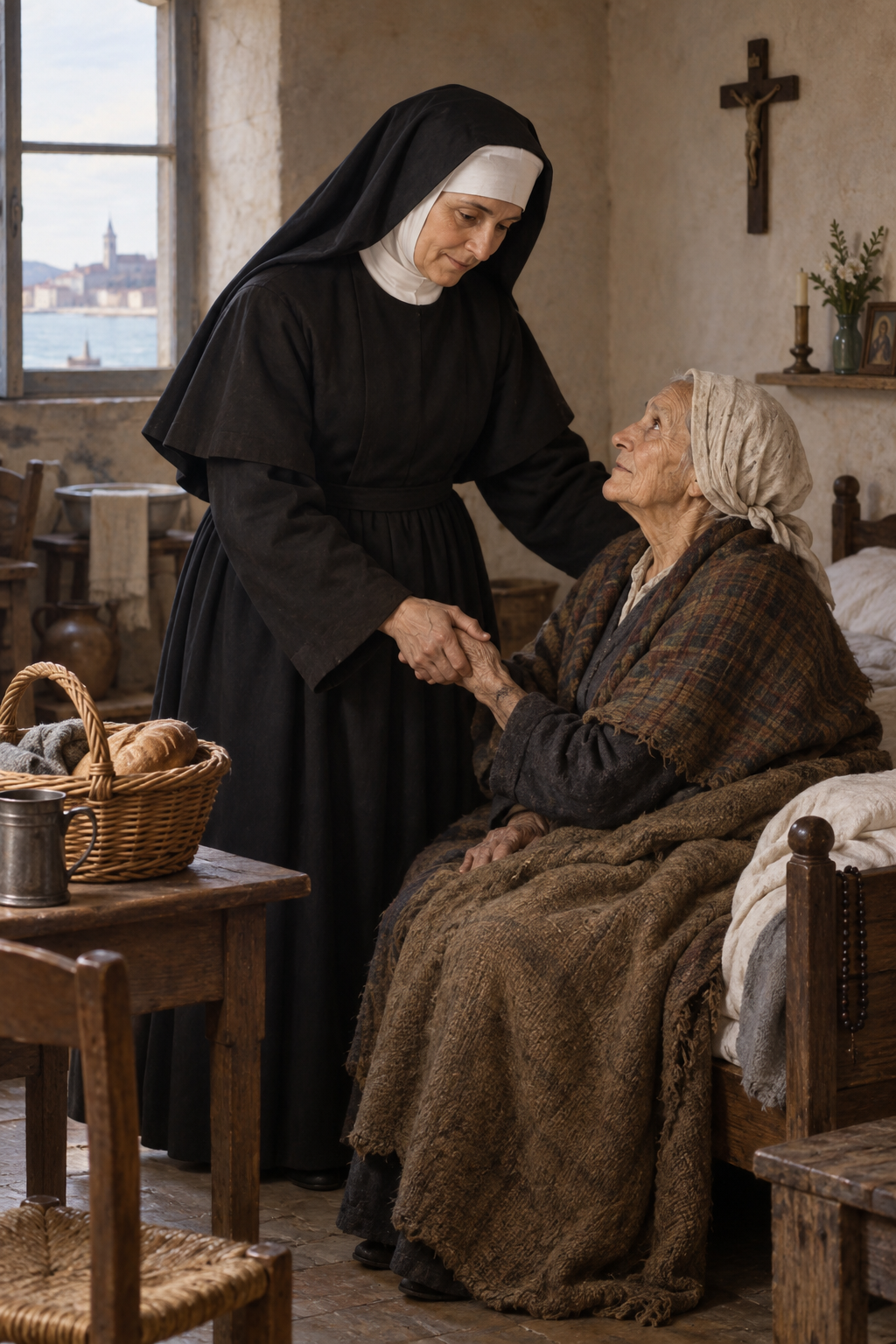
About Jeanne Jugan
Jeanne Jugan, later known in religion as Marie de la Croix or Sister Mary of the Cross, was born at Cancale in Brittany on October 25, 1792. The Dicastery for the Causes of Saints places her birth in the turmoil of the French Revolution and says she was the sixth of eight children.
Four of the children died young. Jeanne's father, a sailor and fisherman, disappeared at sea when she was only four, and her mother raised the four surviving children alone. The final page should let that poverty and insecurity stand plainly, without making it picturesque.
Because of political and economic conditions, Jeanne could not attend school in the ordinary way. The official profile says she learned to read and write while learning the catechism through Eudist tertiaries active in the region.
As a child she knew work early, tending animals while praying the rosary and helping her mother with household tasks. At fifteen she began work in a nearby bourgeois household, where she and the mistress of the house served people in need.
That early service put Jeanne in contact with social worlds beyond her own and with the humiliation experienced by people who depended on assistance. The page should present this as formation in practical charity, not as a modern social program.
In the religious revival after the Concordat, Jeanne sensed a call from God. The Dicastery profile says that when a young man proposed marriage, she answered that God wanted her for an unknown work not yet founded. This can be paraphrased briefly without leaning on the quotation.
Jeanne went to Saint-Servan, where for six years she worked as an assistant nurse and encountered physical and moral misery. She also asked to belong to the Eudist Third Order, where she received a spirituality centered on union with Jesus and humility.
After a trial of health, Jeanne left the hospital and was received by an Eudist tertiary friend, Mlle Lecoq. She served that friend for twelve years, until Lecoq's death in 1835. This long hidden period matters because her later work did not begin from institutional power.
In 1839 Jeanne was forty-seven and shared two small rooms in Saint-Servan with two companions: Fanchon, who was seventy-five, and Virginie Tredaniel, a young orphan. The Dicastery profile describes severe poverty in Saint-Servan, with many residents living by begging.
One winter evening in 1839, Jeanne encountered an elderly woman who was poor, blind, infirm, and newly bereft of her only support. Jeanne brought her in, gave the woman her own bed, and slept in the attic. The source calls this the first spark of a great fire of charity.
The work grew quickly. In 1841 Jeanne rented a larger room where she sheltered twelve elderly people. In 1842, though she had no money, she acquired a ruined old convent where forty elderly people were soon housed.
To support the work, encouraged by a Brother of Saint John of God, Jeanne went out with a basket to seek alms. The public page should describe her begging as a chosen service for the poor, not as a degrading spectacle or sentimental image.
Foundations followed at Rennes and Dinan in 1846, Tours in 1847, and Angers in 1850. This was the congregation known in English as the Little Sisters of the Poor. The official profile notes that it quickly extended beyond these places, but the final page should avoid current institutional statistics unless freshly sourced.
The growth came through painful dispossession. In 1843, after Jeanne had just been reelected superior, the adviser Abbe Le Pailleur annulled the election on his own authority and appointed Marie Jamet in her place. The Dicastery profile says Jeanne saw God's will in this and submitted.
From then until 1852, Jeanne supported the work especially through begging and encouraging younger sisters by example. In 1852 the Bishop of Rennes officially recognized the congregation and named Le Pailleur superior general.
Le Pailleur then recalled Jeanne permanently to the motherhouse. The Dicastery profile calls the following period a hiddenness that lasted twenty-seven years. Young sisters no longer even knew she was the foundress, but she transmitted the charism through serenity, wisdom, counsel, praise, and humble presence.
Jeanne died on August 29, 1879. The official profile records her beatification by John Paul II on October 3, 1982, and canonization by Benedict XVI in Saint Peter's Square on October 11, 2009. It also gives August 29 as her liturgical memorial.
The page should not hide the injustice of her removal, but it should avoid turning the profile into a grievance narrative. Jeanne Jugan's witness is the combination of concrete elder care, poverty, alms-seeking, dispossession, humility, and long fidelity.
Artwork should show a Breton/French religious foundress in a simple black habit and white coif, assisting an elderly poor woman in a humble room, with an alms basket or simple bed. Avoid institutional grandeur, pity imagery, rendered words, logos, and exact-likeness claims.
Wondering how to weigh the stories and sources? Learn how to read a saint biography.