Biography
Joan Elizabeth Bichier des Âges
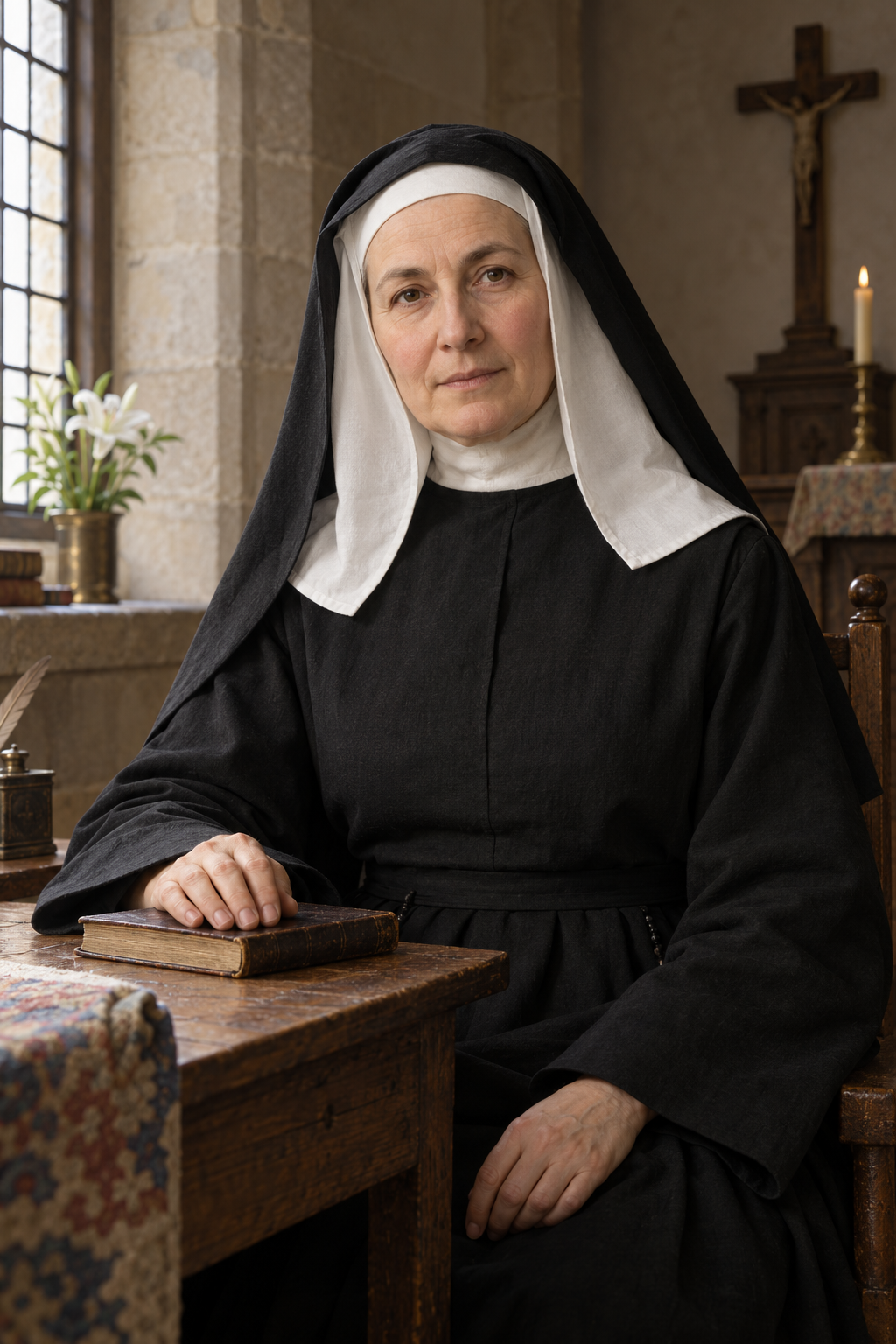
About Joan Elizabeth Bichier des Âges
Joan Elizabeth Bichier des Âges, usually known by her French name Jeanne-Élisabeth, was born on July 5, 1773, at her family’s home of des Ages. She received part of her education with the Hospitalières at Poitiers. Returning home after four years, she helped care for her youngest brother. Her upbringing gave her experience of both family responsibility and religious life before she began the work for which she is remembered.
The French Revolution disrupted that life. In his address after her canonization, Pius XII recalled her efforts to protect her family’s property and her imprisonment, during which she repaired the clothing of other prisoners. He also noted the practical education she received from her uncle, a canon named de Moussac, including training in accounts. These skills later proved useful in managing a growing congregation. Her early service at La Guimetière combined teaching children with caring for sick people, bringing different needs into the same household.
In 1797 she met André-Hubert Fournet at a clandestine Mass near Saint-Pierre-de-Maillé. His guidance helped direct her religious aspirations toward poor people in the surrounding countryside. She considered joining existing congregations, including the Daughters of Wisdom and the Sisters of the Incarnate Word, before establishing a new community with four companions. Fournet remained closely involved in its formation. In preparing the first constitutions, completed in 1811, he asked Elisabeth to set down her own ideas. Her surviving manuscript records her contribution to the community’s beginnings.
The first companions included Marianne, who had accompanied Elisabeth to learn about religious life at Poitiers, and Madeleine, Véronique and Anne, who joined them at Béthines. The congregation’s account thus places its beginnings in a small circle of women before its later expansion into numerous houses.
The La Puye history also recalls her 1829letter to Pius VIII, in which she dated the congregation’s beginnings to 1804 at Béthines, before the first vows and later move to La Puye.
The sisters became known as the Daughters of the Cross, Sisters of Saint Andrew. The congregation’s spiritual centre at La Puye records their profession of vows at the château of Molante in February 1807. Their work brought them into neighbouring parishes as teachers and carers. Some communities began with travelling sisters rather than a permanent house: at La Puye they stayed for two days at a time, lodging with Marie Pichot, a former Fontevrist novice. In 1820 the sisters settled in the remains of the old Fontevrist priory there. The abandoned buildings became the congregation’s motherhouse.
Expansion required Elisabeth to negotiate with people far beyond the original community. Pius XII’s account describes her visits to other religious houses to learn about their ways of life. It also recalls her search for suitable premises at La Puye and her close involvement with the work needed to make them usable. Finding a building was only one part of establishing a home for the sisters: she also had to oversee its repair and adaptation. Travel, accounts and building work became recurring parts of her responsibilities.
Her journey to Paris for surgery in 1815 opened further opportunities for foundations. The congregation received diocesan recognition in 1816 and state recognition in 1826. Elisabeth preferred to be addressed as Sister rather than Mother. By her death, 117 houses had been opened, although some had closed; the congregation counted 633 sisters in 99 establishments across 23 dioceses. Those figures distinguish the total number of foundations from the houses still operating.
The growth also brought disagreement. In a study of the founders’ human relationships, Sister Marie de Magdala describes Elisabeth’s friendship with the teacher Henriette Servières. Elisabeth hoped she could help train sisters for free schools; Servières joined the congregation but later left. In 1818, after an extended stay establishing houses around Paris, Elisabeth returned to Maillé to find Sister Anne installed as superior, although she had left Sister Véronique in charge. The study presents these changes as part of a difficult evolution in her partnership with Fournet, rather than a history without tension.
The same study draws attention to her letters encouraging Sister Marthe, who had hoped to teach but found herself burdened with administration and building work at Igon. It also describes Elisabeth continuing to support the sisters amid difficulties in the congregation’s government after Fournet’s death. In June 1838 she made a final journey to Béthines, close to the home where her work had begun.
Elisabeth died at La Puye on August 26, 1838. She was beatified on May 13, 1934.
The official record of her cause describes a lengthy process of recognition after her death. The cause was introduced in 1891, and in 1928 Pius XI recognized her heroic virtues. The decree also records the examination of reported miracles, followed by authorization to proceed toward canonization.
Pius XII canonized her on July 6, 1947, together with Michel Garicoits. The canonization formula named August 26 as her annual commemoration.
Wondering how to weigh the stories and sources? Learn how to read a saint biography.