Biography
Joaquina Vedruna de Mas
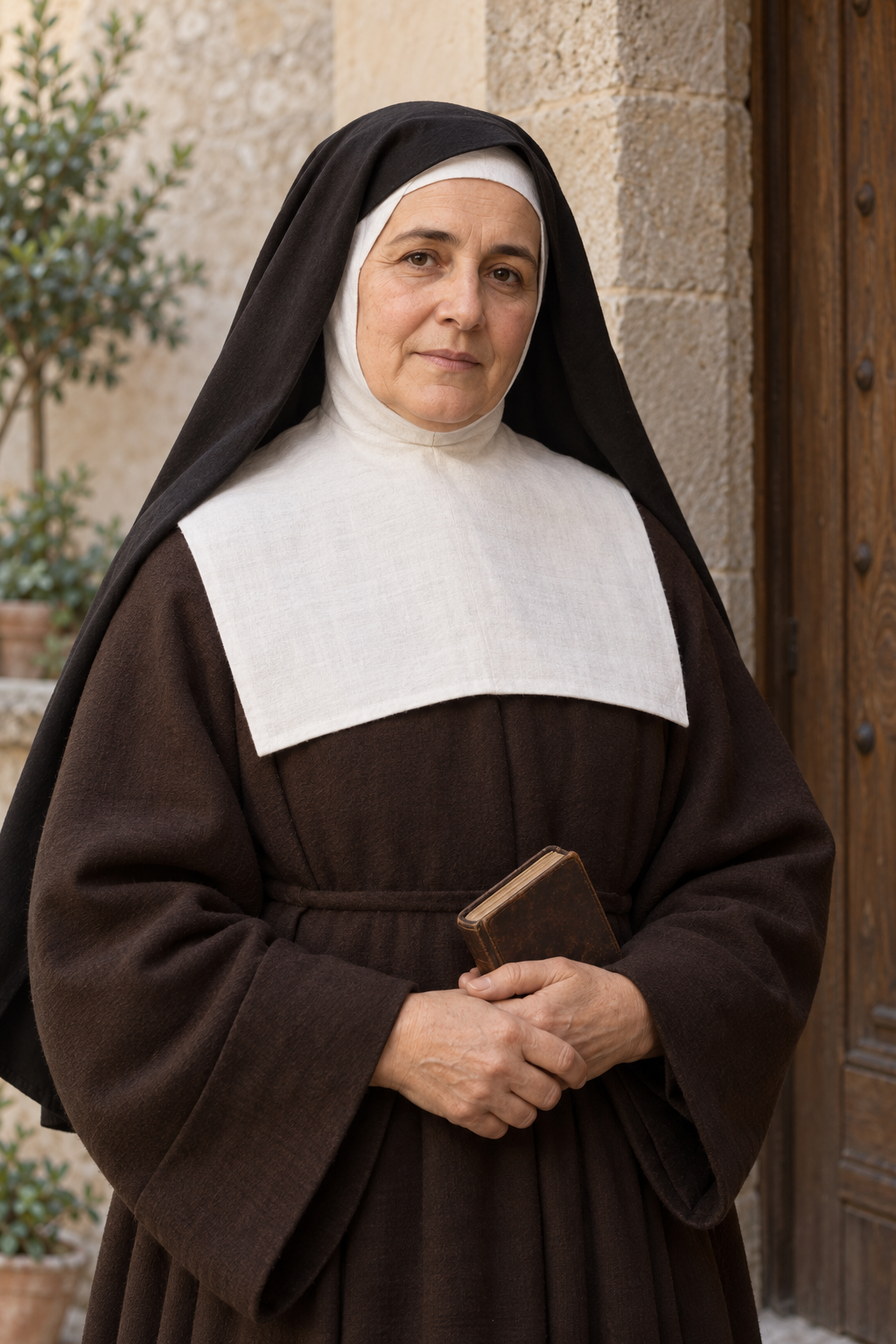
About Joaquina Vedruna de Mas
Joaquina Vedruna de Mas was born in Barcelona on April 16, 1783. She was baptized that day at Santa Maria del Pi, the parish with which her family remained closely connected. On March 24, 1799, she married Teodoro de Mas. Her husband’s parents opposed the match and did not attend the wedding. The parish later became the setting for painful family farewells: their daughter Joaquina was buried there in 1815, and Teodoro’s funeral took place there after his death on March 4, 1816.
The later papal account recalls an early wish to enter a Carmelite community at twelve. John XXIII explained that she instead married in accordance with her father’s wishes and with her spiritual adviser’s consent. Her religious aspirations thus preceded her eventual experience of widowhood.
The couple had nine children. Six survived when Joaquina became a widow. The congregation’s chronology records a further disruption in 1822, when war drove her and her family into exile at Prades in France for eight months. Her later foundation grew out of this experience of family life, bereavement and displacement.
Her responsibilities had already brought her to Vic during the Napoleonic wars. In a study of her relationship with the city, María Teresa Llach describes the family’s move to the Manso Escorial in 1808, Teodoro’s military service and the loss of two young children the following year. After his death, Joaquina returned to the estate with her surviving children. She had to manage the land, livestock and household while protecting the children’s inheritance against financial claims.
Joaquina considered entering a contemplative community when her children were settled. Her meeting with the Capuchin Esteve d’Olot redirected that intention toward a community serving girls who lacked education and people needing care. Llach also records her visits to the Hospital de la Santa Creu, sometimes accompanied by her daughters. Her religious vocation developed alongside family obligations and practical service, rather than beginning only when she became a founder.
The foundation depended on several collaborators. Mabel Burgell’s history of Vedruna education describes the support of Esteve d’Olot, the businessman and hospital administrator Josep Estrada, and Bishop Pablo de Jesús Corcuera. Initial plans to establish the sisters at hospitals in Vic and Igualada did not succeed. Joaquina therefore began in her own home. On February 26, 1826, the first community gathered at the Manso Escorial after prayer at the church of the Divina Pastora. They opened a small school for nearby girls and went out at night to care for sick people in their homes.
Expansion was uneven. Burgell explains that the sisters’ first outside foundation, at Tàrrega in 1827, was intended to combine hospital work with a future school. The school never opened, and the foundation failed three years later. Other early arrangements also proved difficult. At Cardona in 1831, however, the sisters took responsibility for a hospital and opened a school. This history makes clear that new foundations required negotiation and resources, and that the educational work did not simply grow without setbacks.
War interrupted the congregation again. In 1840 Joaquina went to Perpignan with fifteen sisters, remaining in exile for three years. The congregation remembers these journeys as part of its beginnings, alongside her religious profession in January 1826 and the foundation the following month.
Her final years brought declining health and changes in leadership. In their biographical study, Mabel Burgell and Ramon Rial describe the bishop’s decision to introduce a director general to assist in governing the congregation and provide continuity after the founder. The sisters did not welcome the change, and Joaquina sought to calm their concerns. In the winter of 1852 she left Vic and retired to the Casa de Caritat in Barcelona, where an early companion, Veneranda Font, led the community.
There her mobility progressively diminished. During the cholera epidemic of 1854 she became ill and died on August 28, surrounded by the sisters. The biography places her death at the Casa de Caritat in Barcelona, the city where she had been born. Her work continued through the communities she had founded and the women who had shared its beginnings.
She was beatified in 1940.
John XXIII canonized her on April 12, 1959. In his homily he presented her as an example for mothers, widows and religious women, emphasizing the care and education at the heart of her foundation.
The ceremony also honored Charles of Sezze, whose background was very different from hers. Drawing on Francis de Sales, the pope used their contrasting lives to emphasize that Christian holiness could develop in different social circumstances and occupations.
Her congregation celebrates her feast on May 22.
Among the communities that honor her as patron is Santa Úrsula school in Sullana, Peru. The sisters’ account of its celebration explicitly identifies that local patronage, linking her memory with the school’s continuing educational work.
Wondering how to weigh the stories and sources? Learn how to read a saint biography.