Biography
Joasaph of Meteora
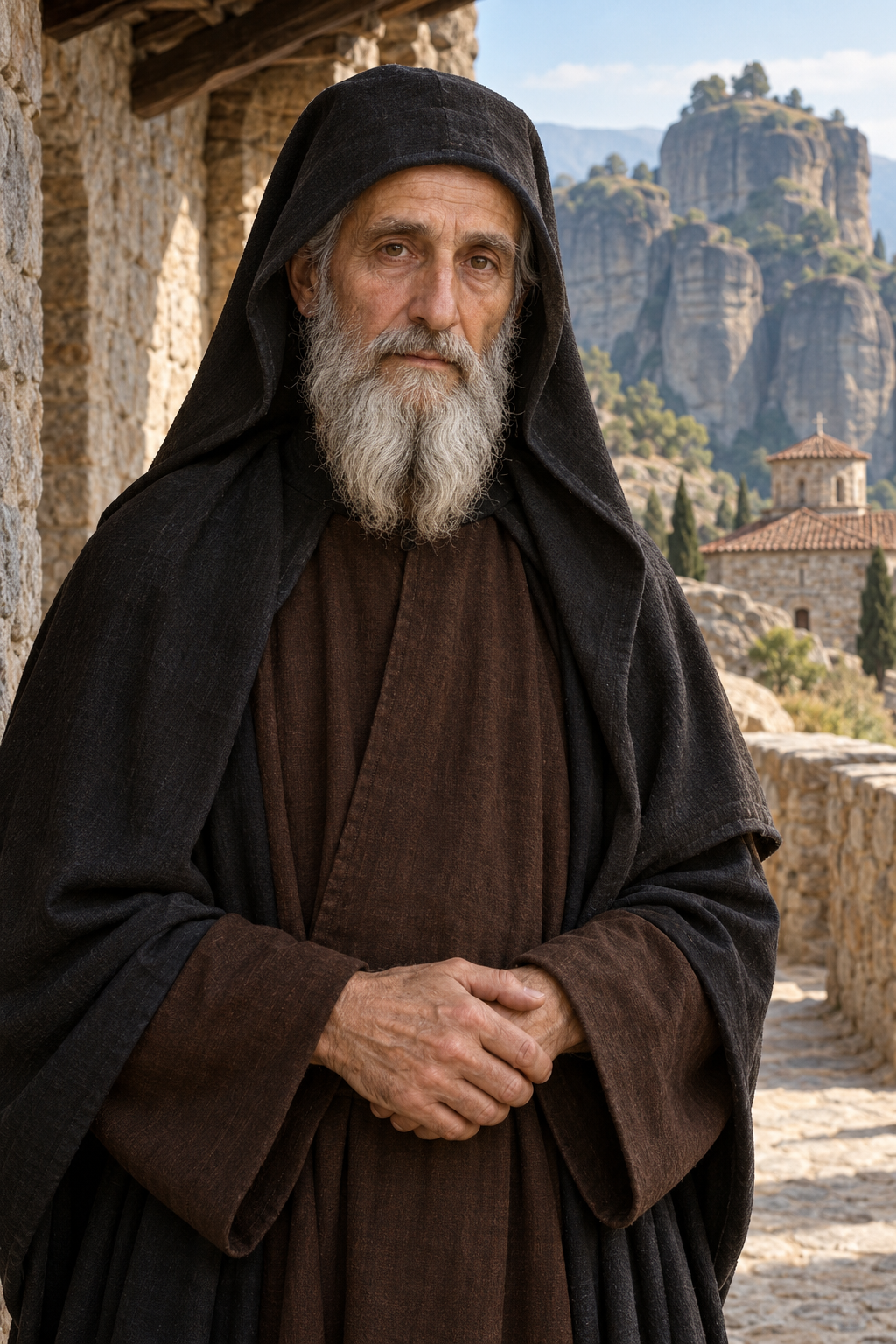
About Joasaph of Meteora
Joasaph of Meteora was born John Uroš, a Thessalian ruler who became a monk and developed Great Meteoron. His father was Simeon Uroš and his mother Thomais Orsini. He inherited authority after his father’s death, but his reign was brief. Documents place the transfer of secular power to Alexios Angelos Philanthropenos in the early 1370s, when John began the transition toward monastic life.
The chronology of that transition needs care. Historian Radivoj Radić distinguishes the usual date for relinquishing power, 1373, from the firm documentary appearance of John as the monk Joasaph in November 1381. He therefore gives a wider interval for his profession than accounts that date both decisions to the same year. A change of political role and a formal commitment to monastic life need not have been a single recorded event.
At Great Meteoron, Joasaph became a disciple of Athanasius and eventually took responsibility for the community. He enlarged the church of the Transfiguration and is remembered as the monastery’s second founder. His life also included periods away from Meteora. The Orthodox Encyclopedia records him at Vatopedi on Mount Athos in 1394, probably because of the Ottoman conquest of Thessaly, and places his return in 1396. He also participated in the foundation of Hypsilotera, known as the monastery of the Calligraphers, on a neighboring rock in 1389/90.
Becoming a monk did not end every connection with political affairs. Michael Lascaris’s reading of the Chronicle of Ioannina describes Joasaph being brought to the city after the assassination of Thomas Preljubović, the husband of his sister Maria, in December 1384. Lascaris concludes that he briefly governed until Esau Buondelmonti arrived at the end of January 1385 and married Maria. This episode makes his withdrawal from kingship more complicated than a story of permanent separation from public responsibility.
Lascaris also notes the chronicle’s attribution of measures of clemency to Joasaph’s advice. The evidence is a historical narrative interpreted by a modern scholar, rather than a surviving personal explanation by Joasaph. It nevertheless places him within the family and civic crisis at Ioannina, where his monastic standing coexisted with the authority attached to his former royal position.
A manuscript provides a more specific witness to his support for religious books. The colophon of Meteoron Codex 555, dated 1385/86, names Joasaph as the person who funded its production and Thomas Xeros as the priest who wrote it. Xeros held the office of chartophylax at Trikala. The notice distinguishes the sponsor from the scribe: it supports Joasaph’s role in commissioning the volume, without making him its copyist.
That distinction matters because a much broader story later circulated about him as a pioneering librarian. Radić examined this claim and rejected it, identifying untraceable publications, inaccurate manuscript references and chronological contradictions in the argument. His critique does not erase the evidence that Joasaph supported books. It warns against extending that evidence into an elaborate professional career which the cited documents do not establish. Radić dates his death shortly before February 24, 1423. This places the event within an approximate chronology, without establishing that he died on the day later writers sometimes repeat.
The rebuilding of the monastery’s church has another material witness. An inscription on a capital in the sanctuary’s apse records the year 6896, interpreted by the monastery as 1387/88. The survival of a dated architectural element helps distinguish this phase of construction from the larger building campaigns of subsequent centuries. The inscription itself supplies a date; identifying the patron depends on the accompanying historical evidence.
His death is generally placed around 1423. The Hilandar account remembers his final years in a small cell at Meteora after decades as a monk. His relics remained at Great Meteoron, where his memory was associated with that of Athanasius. His continued veneration connects the monastery he helped build with other Orthodox communities, including those on Mount Athos where he had spent part of his life.
In 2024 representatives of Great Meteoron brought a fragment of his relics to Hilandar as a permanent gift. The monastery’s supporting foundation reported the reception by Abbot Methodius and the brotherhood, with the metropolitan of Stagoi and Meteora and Great Meteoron’s abbot visiting. This is evidence of present-day church commemoration, rather than independent proof of every detail in the medieval biographies. The transfer followed an agreement reached during the preceding year’s anniversary gathering, linking the commemoration with this later gift.
The Diocesan Academy of Meteora also marked the six-hundredth anniversary by announcing a 2023 scholarly symposium devoted to Joasaph. Its program description brought together the religious setting, family history and surviving objects associated with him. Those different kinds of evidence help explain his lasting significance: he was both a royal figure who entered monastic life and a benefactor whose work left traces in the community’s buildings, manuscripts and memory.
Wondering how to weigh the stories and sources? Learn how to read a saint biography.