Biography
John Macías
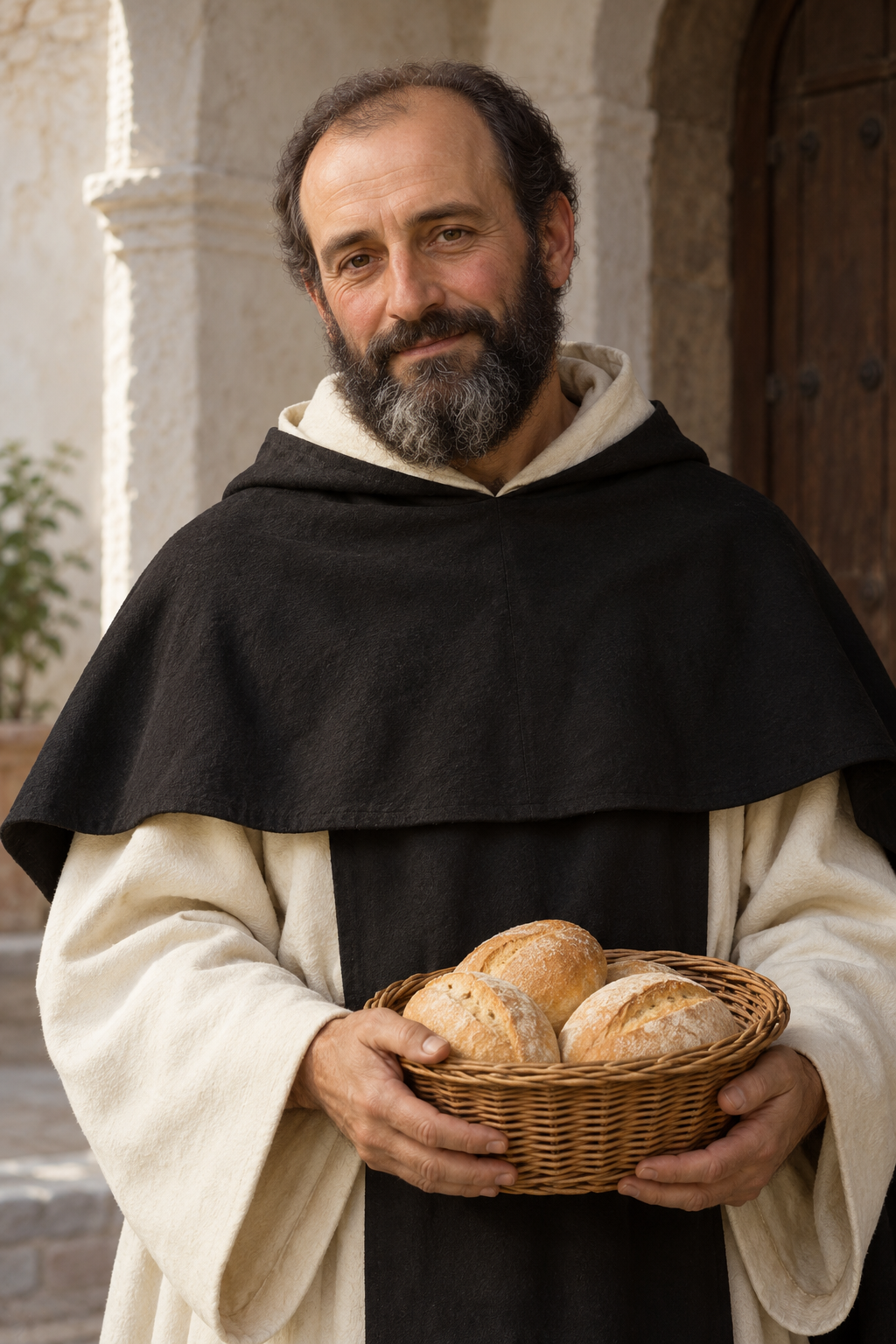
About John Macías
John Macías made a convent doorway a place of welcome. A Spanish emigrant who became a Dominican lay brother in Lima, he spent more than twenty years receiving people who needed food, help or counsel. Paul VI’s canonization homily presents his work as a union of prayer and practical charity: the brother who sought God in silence also recognized Christ in those who came hungry to the door.
He was born on March 2, 1585, at Ribera del Fresno in Extremadura.
Orphaned while young, he grew up with relatives and worked as a shepherd. Xabier Gómez García’s Dominican account describes the long hours in the countryside and the religious formation he received at home, especially devotion to the rosary. The same account remembers his departure from his village and his gradual journey south, earning his living along the way. Exact ages and travel dates vary in later biographies, so they are not used here to reconstruct a precise itinerary.
The Dominican province’s biography traces his passage through Cartagena and onward to Lima. In 1622 he entered the convent of Santa María Magdalena as a lay brother, making his profession the following year. His vocation was expressed in the community’s practical work and care for others. At the gate, he distributed assistance, prayed with visitors and offered religious instruction. The portería became a meeting place for people whose needs were material and spiritual.
The surviving traditions place him close to Martín de Porres. A conservation report from Chile’s National Center for Conservation and Restoration records this friendship and describes Macías’s distribution of food, clothing and alms. It also explains the attributes by which later artists distinguished him: the black scapular and shoulder cape of a Dominican lay brother, a staff and a basket of bread. These images preserve a devotional memory of his service, rather than a photographic record of his appearance.
Prayer was not a separate refuge from the people around him. In the canonization homily, Paul VI recalled his devotion to the Eucharist and rosary, and the way his contemplation led him back to his neighbors with renewed concern. The pope also distinguished his chosen religious poverty from deprivation that leaves people helpless: Macías worked for his own support and shared the fruits of that work. His generosity was active, sustained by ordinary duties faithfully performed.
Later Dominicans have reflected on the importance of his experience as an emigrant. In a text associated with the 1975 canonization, Vincent de Couesnongle placed Macías among people who crossed the ocean because of need. He read the saint’s life as a call to welcome displaced people with dignity. His argument went beyond praising individual acts of kindness: charity should also seek fair participation in society for those who remain excluded. This is Couesnongle’s interpretation for his own time, not a social program written by Macías.
Macías died in Lima in September 1645. The Dicastery for the Causes of Saints gives September 16, although some Dominican biographies give September 15.
Gregory XVI beatified him on October 22, 1837, and Paul VI canonized him on September 28, 1975.
At the Angelus on the day of canonization, Paul VI returned to the meaning of the convent gate. He presented Macías’s generosity as a challenge to make possessions serve others, with bread shared in Christ’s name creating a bond between giver and recipient. The humble task of receiving visitors could still teach a society preoccupied with acquiring more.
A Dominican jubilee resource names him patron of emigrants and marks his feast on September 18. It encourages welcome for those living far from home and service to people in need.
The Dicastery lists September 16 as his liturgical memorial. These different observances recall the same lay brother, whose ministry took shape in the repeated work of feeding and welcoming others.
Wondering how to weigh the stories and sources? Learn how to read a saint biography.