Biography
John Neumann
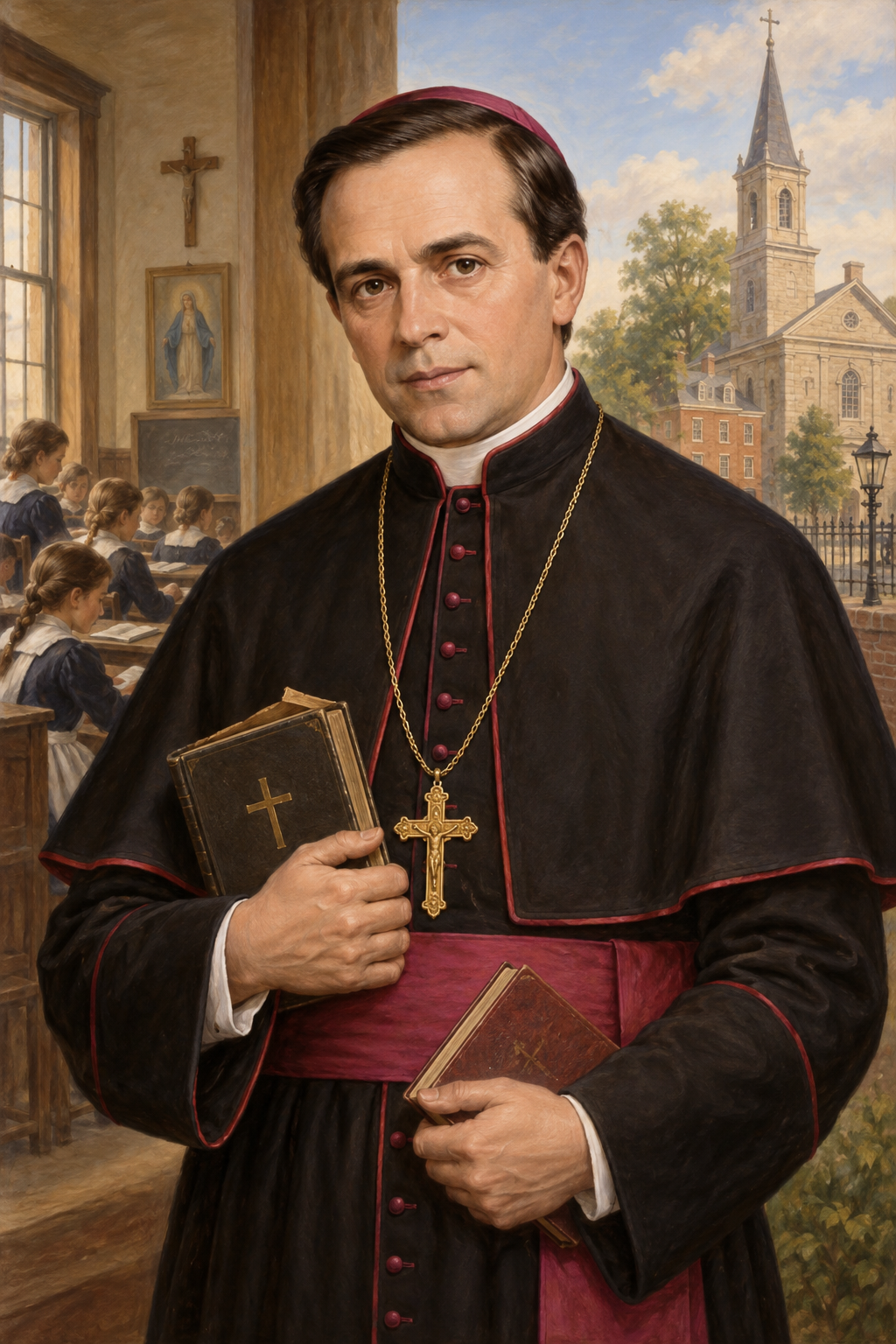
About John Neumann
(draft)
John Nepomucene Neumann was born on 28 March 1811 at Prachatitz, then in the Austro-Hungarian world. He received his early formation at the seminary in Budějovice and completed theological studies in Prague. Paul VI's canonization homily presents him as a European immigrant whose formation prepared him for a ministry that would be shaped by the movement of people between continents. [N1]
Neumann's ordination was delayed because the number of candidates exceeded the available places. Rather than abandon the priesthood, he joined a project for missions in America, traveled through Paris to Le Havre, and crossed the Atlantic to New York. Bishop John Dubois ordained him there on 25 June 1836. His first American ministry took place around Niagara Falls, including Williamsville and North Bush, where he served workers and settlers for four years. The Vatican account emphasizes the ordinary demands of that work: a missionary priest traveled, taught, visited, and celebrated the sacraments for communities spread across a developing region. [N1]
Neumann desired a more communal religious life and entered the Redemptorists. He first served in Baltimore, where he made his religious profession, and then in Pittsburgh, where he was asked to lead the Redemptorist house. After three years in Pittsburgh he returned to Baltimore and became the first Redemptorist pastor of Saint Alphonsus Church in America. The homily describes him as constant in work, sacrifice, and religious observance, while noting that he continued to give particular attention to German-speaking immigrants. [N1]
In 1852 Neumann accepted appointment as bishop of Philadelphia. The new office expanded rather than displaced his missionary concerns. He visited the diocese, worked among poor and laboring people, and founded about one hundred Catholic schools. He also founded Philadelphia's first Italian parish, dedicated to Saint Mary Magdalene de' Pazzi, and began the construction of the cathedral. These projects show why the record should not reduce him to an administrator: education, ethnic-language pastoral care, parish organization, and large building projects were all responses to the needs of a rapidly growing church. [N1]
Neumann traveled to Italy in 1854 for the proclamation of the dogma of the Immaculate Conception and visited his country of origin. He wrote several works, including a catechism that was republished many times. The surviving account does not by itself establish the complete publication history of those works, so the importer should cite only the catechism and authorship claims that can be tied to a specific edition or official record. [N1]
His ministry also included pastoral visitation, care for the sick, and close attention to reconciliation. Paul VI recalls Neumann's love for the sacrament of penance, his friendship with poor people and sinners, and his promotion of the Forty Hours Devotion as a way of making parish communities centers of faith and service. The homily interprets these actions as expressions of pastoral charity, but the factual record should keep the actions distinct: schools, visits, confession, Eucharistic devotion, and immigrant ministry are separate events with separate evidence links. [N1]
Neumann died suddenly from an illness while walking in Philadelphia on 5 January 1860. He was not yet forty-nine. He was buried at Saint Peter's Church in Philadelphia. He had been beatified by Paul VI on 13 October 1963 and was canonized in Rome on 19 June 1977. The canonization homily calls him the first canonized saint of the Catholic Church in the United States and connects his legacy to Catholic schooling, catechesis, sacramental reconciliation, care for immigrants, and service to the poor. Those are well-supported themes for the profile, while broader claims about universal patronage should remain omitted unless an additional official source supports them. [N1]
Neumann's immigrant experience shaped the way he approached pastoral work. He had arrived in the United States without wealth or institutional security, and his earliest assignments placed him among people whose work and homes were scattered across a large territory. The homily's account of his ministry around Niagara therefore belongs alongside the later diocesan projects: both involved bringing sacramental and educational care to communities that could not be served by a single urban parish model. [N1]
His attention to language communities was also practical. Serving German-speaking immigrants required preaching, catechesis, confession, and parish organization that people could understand and trust. Later, the Italian parish in Philadelphia showed that the same concern extended beyond the community with which he was personally most familiar. These should be recorded as distinct pastoral events, not collapsed into a generic claim that he welcomed immigrants. [N1]
The schools Neumann founded were part of the same pastoral strategy. The Vatican homily describes about one hundred Catholic schools and connects them with the need of children for truth, doctrine, and Christian formation. The number is an official retrospective estimate, not an independently audited school census; the importer should preserve that qualification and avoid attributing every later school in the diocese to Neumann personally. The supported claim is that he promoted and founded a large Catholic school system during his episcopate. [N1]
Neumann's pastoral activity was not limited to institutions. Paul VI recalls his visits among the people, care for the sick, closeness to the poor, and work in the sacrament of reconciliation. He also promoted the Forty Hours Devotion, which the homily presents as a means of helping parishes become communities of faith and service. These details make the biography more than an administrative record: the schools, cathedral, parish, and devotional practices were connected to regular contact with the people he served. [N1]
The official source presents Neumann's canonization as a celebration of pastoral charity, but the catalog should separate the Church's theological interpretation from the historical chronology. His immigrant origin, ordination, Redemptorist profession, Philadelphia appointment, school foundations, pastoral visits, and death are historical claims. The language that describes him as an image of Christ or a symbol of Christian success belongs to the homily's religious interpretation and should be cited as such rather than rewritten as neutral historical fact. [N1]
Wondering how to weigh the stories and sources? Learn how to read a saint biography.