Biography
John of Lodi
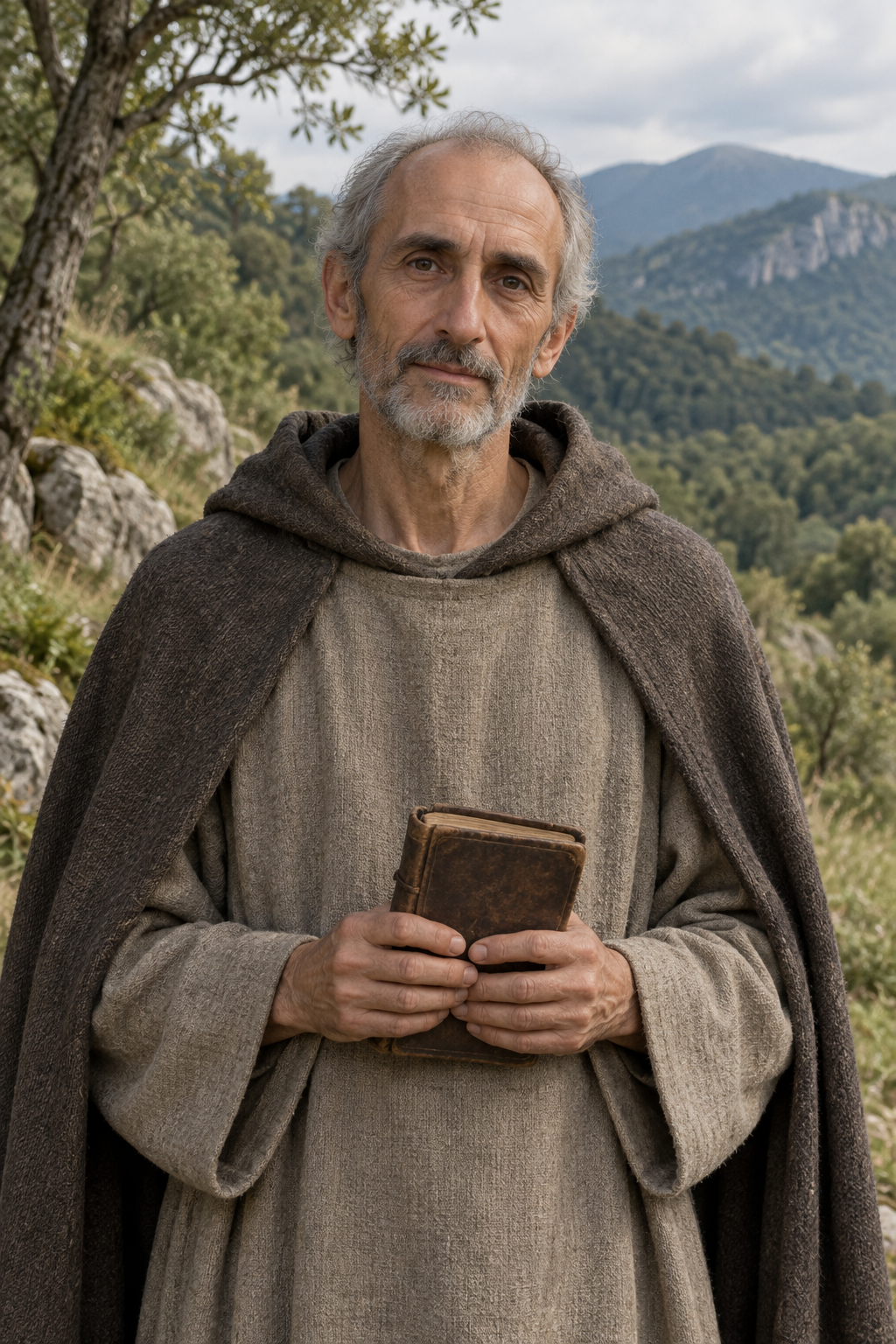
About John of Lodi
John came from Lodi and joined the hermitage of Fonte Avellana while still young. He became a close companion of Peter Damian and traveled with him.
His birth year is uncertain: Freund proposes about 1040, while the Lodi diocesan homily gives about 1025.
An early biography by an unnamed disciple describes John’s care for sick people before he became a monk. It says that he visited them and stayed to help when they needed attention. The same account presents a young man trained in the liberal arts who tried to separate useful learning from material he considered morally harmful. These recollections belong to a life written to edify its readers, rather than a complete record of his childhood.
At Fonte Avellana, the disciple describes John copying books, correcting other scribes’ work, and composing letters between church services. His portrayal joins study to the demands of communal prayer and fasting.
A surviving letter shows the trust Damian placed in John’s judgment. Addressing John together with Gebizo and Theobald, Damian acknowledged an error in his discussion of John the Baptist’s conception. In the letter, Damian described recognizing his mistake after a troubling dream. He asked them to correct the passage and examine his other writings for mistakes. They could remove faulty material or rewrite it: sound understanding mattered more than preserving the author’s polished language. The request placed John among readers whose scrutiny Damian wanted before his work circulated.
After Damian’s death, John wrote his biography at the request of Prior Aliprando. He also collected biblical quotations from Damian’s works and helped preserve his writings.
John explained his own approach in the introduction to Damian’s biography. Writing to the prior and elders of Fonte Avellana, he feared that delay would allow memories of his teacher to disappear. He distinguished what Damian had told him, what earlier companions remembered, what a relative reported about Damian’s youth, and what he had witnessed himself. The introduction presents the book as an act of obedience and preservation, while making its different kinds of testimony visible.
The collection of extracts, known as the Collectanea, gave Damian’s biblical interpretation a different arrangement. The Bavarian Academy’s catalogue describes 294 passages drawn from his writings and organized according to the books of the Old and New Testaments. It identifies the Vatican manuscript numbered Latin 4930 as John’s autograph and names Damian’s nephew as the recipient of the dedication. The catalogue dates the compilation probably before 1078. This work preserved selected passages in a form ordered by Scripture, alongside John’s separate effort to record the life of their author.
Freund places John’s election as prior in 1082 or 1084.
The anonymous disciple presents his leadership as service: John wanted to be loved rather than feared, and to help the brothers rather than simply exercise authority over them.
As prior, John used the hermitage’s supplies to support people during the famine of 1084–85. When the provisions were exhausted, he sold property to buy grain.
Elected bishop of Gubbio late in 1104, he worked to reform its cathedral clergy.
The early biography says that John came to Gubbio to help choose a bishop, only to be chosen himself. It describes his reluctance because of age and illness, followed by active service after his consecration: dedicating churches, confirming children, and preaching. The author praises his pastoral energy while acknowledging that his episcopate lasted less than a year.
At Gubbio, John brought the young Ubaldo into his work of reform. Ubaldo had withdrawn from San Mariano because the clergy’s conduct troubled him. According to the diocesan account, John called him back from San Secondo so that his example could help change their way of life. The two shared a household for barely a year, but the diocese remembers their collaboration as an important influence on Ubaldo’s later work among the clergy.
Stephan Freund’s scholarly account dates his death to September 7, 1105; Nominis instead gives about 1106.
John’s biography of Damian had a different history of transmission. The Bavarian Academy describes three surviving late-sixteenth-century copies associated with the editor Costantino Gaetani. They derive from a version prepared at the monastery of San Giovanni Battista in Valle Acerreta, where an account of a miracle after Damian’s death had been appended. The catalogue also records a later reworking by Giovanni Boccaccio. These copies and revisions show how John’s account continued to reach readers beyond the community for which he first wrote it.
His memory also remains visible in the place of his birth. In September 2017, the bishop of Lodi blessed a new statue of John by the sculptor Rudelli in the Basilica of the Twelve Apostles at Lodi Vecchio. The accompanying homily recalled his work as a copyist, his service to the poor, and his brief episcopate. It also noted the veneration of his remains in Gubbio’s cathedral.
Wondering how to weigh the stories and sources? Learn how to read a saint biography.