Biography
Jón Ögmundsson
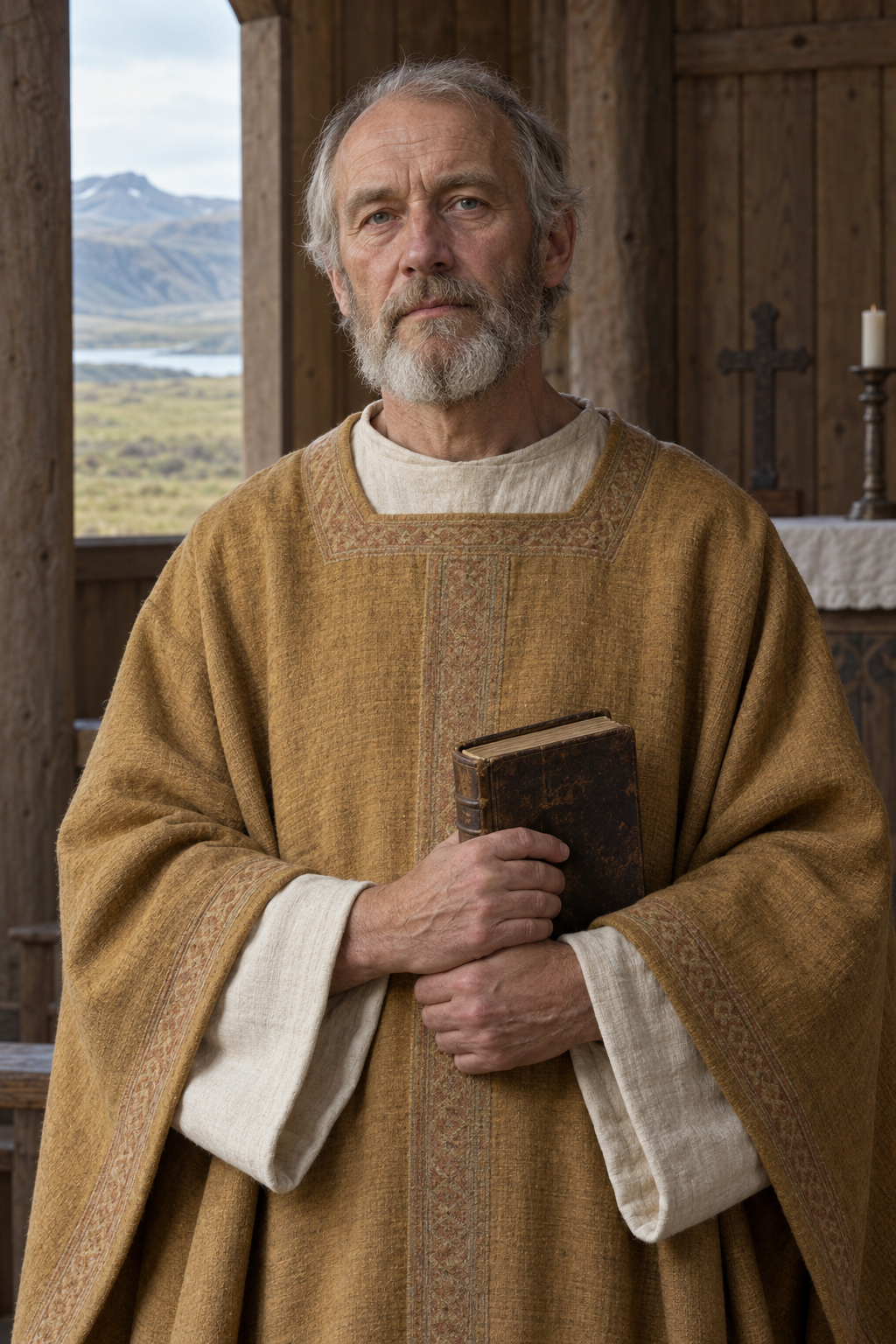
About Jón Ögmundsson
Jón Ögmundsson, also called John of Hólar, became the first bishop of Hólar in northern Iceland in 1106. He came from Breiðabólstaður in Fljótshlíð, in the south of the island, and trained for the priesthood at Skálholt. His episcopate helped establish Hólar as a center of religious life and learning.
The surviving accounts of Jón require care. His life was written long after his death, and its medieval authors sought to present a saint as well as to preserve a life story. Peter Foote’s critical edition identifies three surviving recensions of the saga, with differences in wording and content. The university’s description of that edition notes that some versions contain additional miracle stories whose relationship to the original text remains uncertain.
One difficult episode concerns Jón’s two successive marriages. Later biography described a journey to Rome for a papal dispensation before he became bishop. In her review of Joel Anderson’s research, Margaret Cormack explains that this supposed dispensation is incompatible with the canon law of the time. The story reflects the concerns of later writers and cannot establish that the second journey to Rome took place. His married life should therefore be acknowledged without treating the proposed papal solution as documented history.
Jón’s school at Hólar was an important part of his work. Árnason’s account describes teaching in Latin, rhetoric and logic, together with music and astronomy. The school helped develop a center where future clergy could study. Jón also contributed to plans for a monastery at Þingeyrar, although it was not inaugurated until 1133, after his death. His work belongs to the growth of Christian institutions in Iceland during the generations following its conversion.
The saga also presents a demanding reformer. Bernadine McCreesh describes its account of his efforts to replace weekday names associated with pagan gods, discourage sexually explicit poetry and improve the learning of clergy. Her analysis distinguishes these remembered activities from stories fashioned around biblical patterns. Childhood prophecies and miraculous episodes tell us about the way his sanctity was portrayed; they cannot all be read as straightforward records of events.
Jón died on April 23, 1121, at Hólar. His remains were later enshrined, and he received local recognition as a saint in 1200. The distinction between local recognition and papal canonization matters here: the Norwegian Catholic account records no papal confirmation. Cormack also cautions that the national assembly added saints’ feasts to the calendar; it did not itself perform their canonizations.
His memory remains connected with education. Tryggvi Gíslason, a former headmaster of Menntaskólinn á Akureyri, identifies Jón as the school’s patron and traces its educational roots to Hólar. His account also recalls Ingunn, a woman whose command of Latin enabled her to help others learn. This is one glimpse, preserved in the school’s remembered history, of the people around the bishop and the learning they shared.
The Catholic Diocese of Reykjavík names Jón among the protectors of its Cathedral of Christ the King, together with Mary, Joseph and Thorlac. The church was consecrated in 1929, centuries after Jón’s lifetime. The Norwegian Catholic biography lists his commemoration on April 23 and notes the Icelandic observance of March 3, associated with the translation of his relics. These local forms of remembrance preserve his place in Iceland’s Christian history without erasing the limits of what can be known about his life.
Wondering how to weigh the stories and sources? Learn how to read a saint biography.