Biography
Joseph the Hymnographer
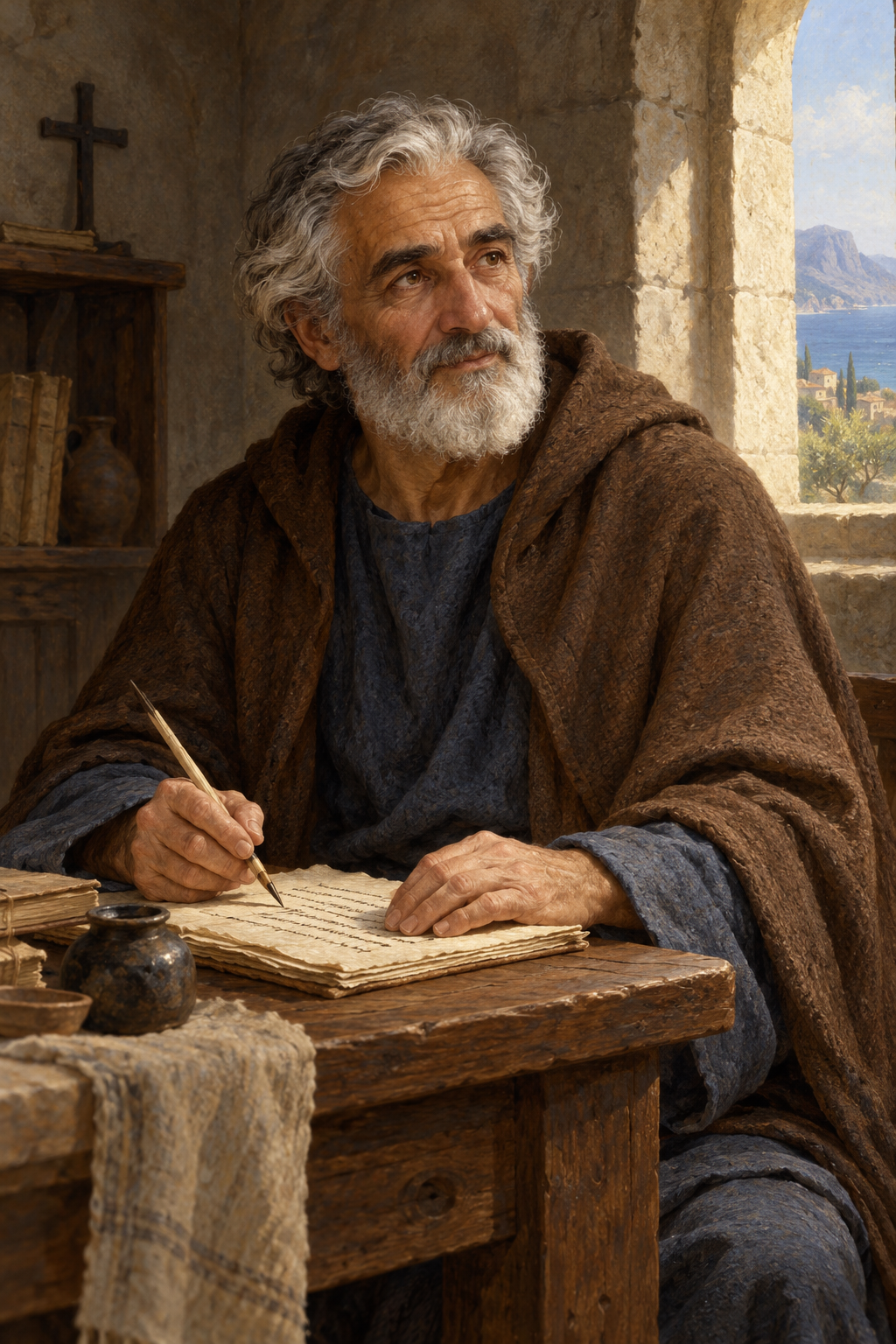
About Joseph the Hymnographer
Joseph the Hymnographer was a ninth-century monk and priest whose life carried him from Sicily to the churches and monasteries of Constantinople. His family fled an Arab attack and settled in the Peloponnese. He entered monastic life in Thessalonica and became a disciple of Gregory of Decapolis, accompanying him to the capital.
His parents were Plotinos and Agatha, and he grew up with siblings whose names are not preserved here. The account of his upbringing describes both religious and secular education. As summarized in the Prosopography of the Byzantine Empire, his later companionship with Gregory included biblical study as well as prayer and a demanding ascetic life.
His early life survives in accounts that do not always agree. The earlier biography, written by his disciple Theophanes, does not name his first monastery; the later account by John the Deacon identifies it as Latomos. Joseph’s birth year is uncertain, and the dates proposed for his youth do not fit comfortably with the usual minimum age for priestly ordination.
Sent toward Rome on Gregory’s behalf, Joseph was captured and taken to Crete. The critical prosopography places this journey in 841 and his release around 843. Returning to Constantinople after Gregory’s death, he lived with another disciple, John. Later he founded a monastery and brought the remains of both companions there.
The captivity story grew in the telling. In Theophanes’s account, Saint Nicholas appears to promise freedom, and Joseph is subsequently ransomed. John the Deacon instead describes Nicholas carrying him miraculously to the vicinity of Constantinople. These are different versions of the tradition, not two separately documented escapes.
The new monastery developed from a growing community. After John’s death, Joseph had spent five years near the tomb of John Chrysostom. More monks gathered around him, and the existing site became too small. His biographical tradition describes a move to an unused site, where a church honored Bartholomew and Gregory. Joseph’s disciple Theophanes, later his biographer, was among those he admitted to monastic life.
Joseph was also remembered as a man who hesitated before undertaking sacred poetry. The Orthodox Church in America recounts his prolonged prayer for help in honoring the apostle Bartholomew and a vision in which the apostle blessed his work. The story presents his writing as a gift received through prayer.
His hymns became part of the Church’s worship. The same church account describes his canons in the Menaion and the appearance of his name as an acrostic in the ninth ode.
A canon is a long hymn sung at Orthros, the early morning service. It uses one of the eight modes of Byzantine church music. This form is central to Joseph’s reputation, although his poetry also belongs to other liturgical genres. Paraskevi Toma’s critical edition examines groups of eight canons dedicated to particular saints, with one composition in each mode. These organized groups show a specific way in which his poetry served worship: the same saint could be celebrated through the full sequence of modes.
That signature does not settle every attribution. Joseph of Thessalonica, Theodore the Studite’s brother, also composed hymns. Daniel Stiernon’s review of the scholarship cautions that the name Joseph alone is insufficient to distinguish the two writers; manuscript evidence and the character of each work must also be considered. Some canons remain disputed.
Joseph supported Patriarch Ignatios and was exiled to Cherson, conventionally in 858. Recalled in 867, he became keeper of Hagia Sophia’s sacred vessels. His biographies also describe respectful relations with Photius after Ignatios’s death.
His biographical tradition portrays acceptance of public responsibility as reluctant. After returning from exile, he declined greater honors, preferring quiet. He nevertheless accepted responsibility for Hagia Sophia’s precious sacred vessels. This account places practical care for the church’s possessions alongside the prayer and poetry for which he became better known.
The later Life by John the Deacon also remembers Joseph as a confessor. In that account, Photius entrusted clergy to his guidance. Rather than exposing what penitents concealed, he patiently encouraged them to speak. This is a devotional description of his pastoral manner, preserved in a later source rather than an independently verified record of individual confessions.
The chronology of Joseph’s final illness is disputed. Stiernon discusses the competing reconstructions that produce death years of 883 and 886, showing why a precise year should be treated cautiously. The Orthodox Encyclopedia likewise places his death around 886.
His disciple’s account remembers Joseph returning the inventory of the church treasury before his last illness. The Orthodox Encyclopedia records April 3 as his death day without an explicit year in that account.
The Orthodox Church in America celebrates his memory on April 4.
The church account preserves praise for the way his hymns accompanied night worship, helping singers remain attentive through long vigils. Its remembrance of Joseph joins the words he wrote to the people who continued to sing them.
Wondering how to weigh the stories and sources? Learn how to read a saint biography.