Biography
Józef Sebastian Pelczar
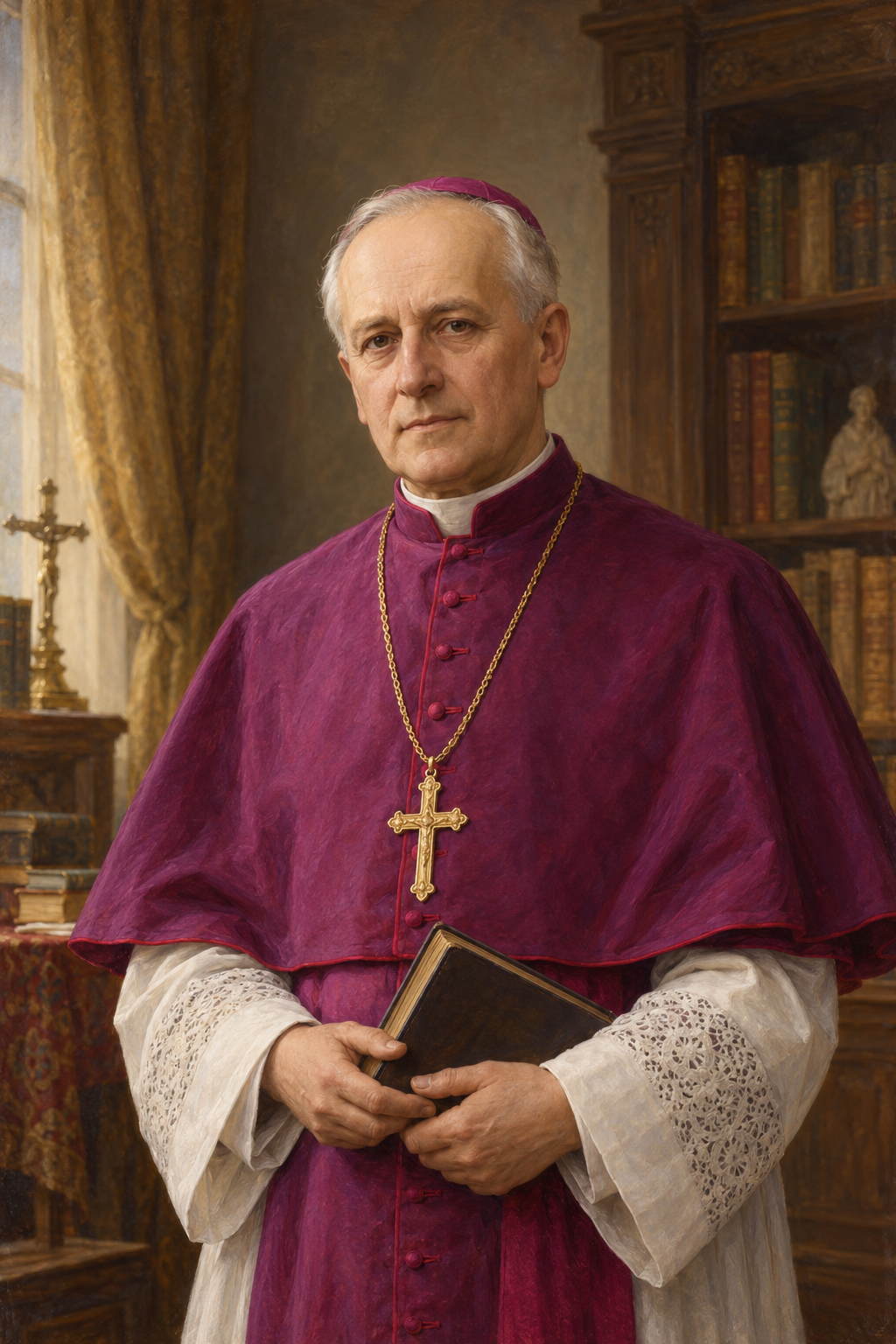
About Józef Sebastian Pelczar
Józef Sebastian Pelczar was a Polish bishop, teacher and writer who joined education with organized care for people in need. Born in Korczyna on January 17, 1842, he entered the seminary in Przemyśl in 1860 and was ordained a priest on July 17, 1864. After parish work in Sambor, he studied in Rome before returning to teach.
His education began in Korczyna and continued in Rzeszów. The cathedral biography describes a household supported by farming, with religious practice closely woven into family life. In Rome he gained doctorates in theology and canon law. On his return he taught pastoral theology and church law in the Przemyśl seminary. These subjects would remain relevant to his later responsibilities: preparing clergy for parish work, shaping diocesan rules and connecting intellectual formation with the daily demands of pastoral service. He also preached and wrote.
His academic career took him to the Jagiellonian University in Kraków, where he spent twenty-two years as a professor and served as rector in 1882–1883. Alongside teaching, he supported libraries, courses and books through a society for popular education. His work reached beyond university classrooms to people with fewer opportunities to study.
The needs of young women arriving in Kraków for work helped shape his most enduring foundation. In 1891 a confraternity he established opened a shelter for unemployed domestic workers, providing accommodation and training. Ludwika Szczęsna came to help direct this work after Pelczar sought assistance from Honorat Koźmiński.
On April 15, 1894, Pelczar and Szczęsna formally established the Sister Servants of the Most Sacred Heart of Jesus. Their tasks included supporting domestic and factory workers and nursing sick people in their homes. The sisters soon extended their work to Lviv and Zakopane. The congregation grew from practical needs already being addressed, rather than from an abstract plan alone.
The foundation also required rules and practical support. Pelczar submitted provisional statutes based on the Franciscan Third Order to Cardinal Albin Dunajewski. The early community soon outgrew its accommodation. Donors helped provide a larger home, including land given by Wanda Jabłonowska at Pelczar’s request. This institutional history preserves the contributions of women whose resources helped the congregation take root.
Pelczar became auxiliary bishop of Przemyśl in 1899 and its diocesan bishop in 1900. He held three diocesan synods and supported shelters, kitchens, vocational training and assistance for poor seminarians. He also addressed the difficulties faced by workers and emigrants.
His educational interests continued in Przemyśl. Historian Tomasz Pudłocki describes his founding of a diocesan museum, library and periodical, as well as his support for local cultural associations. He took part in public celebrations and gave Lenten talks for educated townspeople. Restoring churches and protecting old church bells were also part of this concern for cultural inheritance.
Pudłocki’s study shows the practical detail behind these projects. Pelczar asked clergy to send neglected church objects to the diocesan museum, both to preserve them and to provide examples for future building and restoration. The response was slow enough that appeals had to be repeated. He also funded the Collegium Marianum, where boys considering priesthood combined secondary schooling with religious preparation and practical skills such as carpentry. Within the seminary he encouraged additional study, languages, preaching exercises and written work. Talented students were sent abroad, especially to Rome, Vienna and Innsbruck, and some later became teachers themselves. His support for learning therefore involved buildings, collections, curricula and people. The same study records his intervention in Vienna in 1917 to prevent requisition of the cathedral’s great bell during the war. He encouraged clergy to contribute scholarly writing to the new diocesan periodical.
His public life also included opposition to reforms intended to protect minority representation. In 1913 he joined four other bishops in a letter against a proposed electoral settlement in Galicia. Historian Maciej Janowski argues that their position favored Polish political dominance and weakened a proposed Polish-Ukrainian compromise. The bishops also objected to arrangements concerning non-Christian representation. This political exclusion belongs alongside his charitable achievements in an account of his life.
For Pelczar, devotion to the Eucharist and the Sacred Heart was central to religious life. At his canonization, John Paul II emphasized his conviction that holiness was open to people of every age and condition, and his desire to lead others toward it through teaching and pastoral work.
He died in Przemyśl on March 28, 1924.
John Paul II canonized him on May 18, 2003.
His January 19 commemoration is observed in Przemyśl, whose cathedral identifies him as one of the archdiocese’s patrons.
An apostolic letter of October 7, 1993 confirmed him as principal patron of Rzeszów diocese.
Krosno County also adopted him as patron, celebrating the designation in Korczyna on May 9, 2010.
The Z otwartym sercem foundation in Kamesznica names him as its patron, linking his memory with its charitable identity.
Wondering how to weigh the stories and sources? Learn how to read a saint biography.