Biography
Juan de Palafox y Mendoza
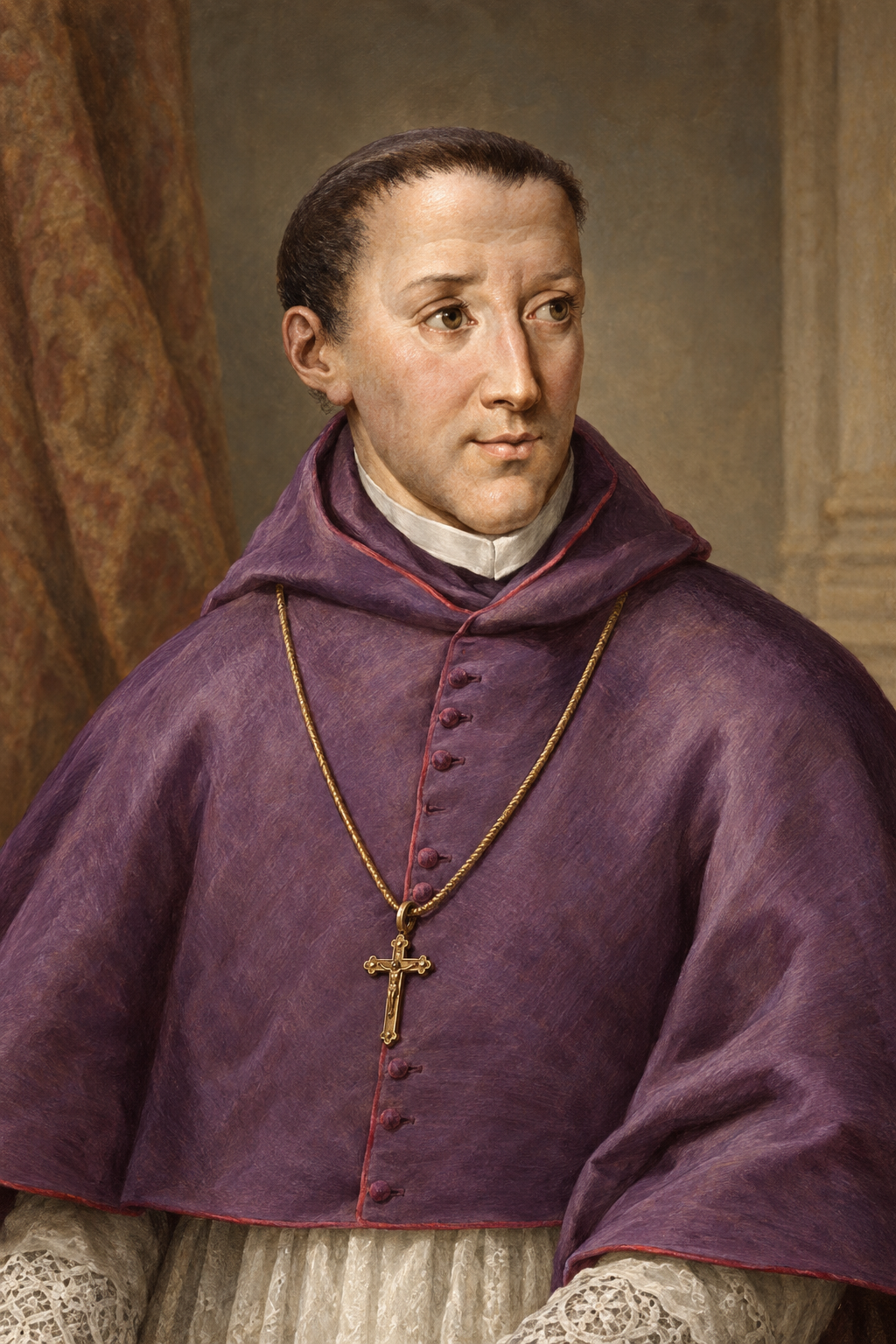
About Juan de Palafox y Mendoza
Juan de Palafox y Mendoza spent his early childhood with a poor family in Fitero, in northern Spain. His father, Jaime de Palafox, acknowledged him when he was nine.
Education took him to Tarazona and then to university studies. His abilities brought him into royal service: he worked in the Council of War and later the Council of the Indies. These responsibilities gave him experience of American affairs before he crossed the Atlantic.
He was ordained a priest in 1629. As chaplain, he accompanied the king’s sister María on her journey to marry the king of Hungary. Appointed bishop of Puebla in 1639, he left for New Spain the following year.
Palafox arrived with two overlapping responsibilities. He was bishop of Puebla and the king’s general visitor, charged with reporting on the administration of the colony. His work brought him into questions of jurisdiction, public finances and the conduct of officials. The reports and correspondence preserved in the Real Biblioteca show how closely his church responsibilities were connected to service of the Spanish monarchy.
His years in Mexico included service as viceroy and captain general as well as his episcopal work.
As bishop, he promoted the formation of priests and the application of the Council of Trent’s reforms. He required future clergy to learn Indigenous languages and supported colleges for their education.
The seminary did not begin entirely with him. The earlier College of San Juan had been founded through Juan de Larios’s initiative in 1595. Palafox developed the institution by bringing colleges together for the training of diocesan priests. In 1646 he donated his books and scientific instruments to support this work. The donation was recorded before a notary on September 5. That collection became the foundation of the Biblioteca Palafoxiana.
He also supported education beyond the seminary, establishing a school for girls dedicated to the Immaculate Conception. He devoted considerable effort to completing Puebla’s cathedral and was able to consecrate it before returning to Spain.
His reforms brought serious conflict with religious orders. A central issue was the administration of parishes serving Indigenous communities, known as doctrinas. Palafox transferred a number of these from Franciscan administration to priests accountable to the bishop. The change concerned both pastoral authority and the material support of the churches. Disputes over tithes also involved the Crown’s financial interests. The religious orders and the diocesan churches defended competing claims through representatives at the royal court. Some proceedings continued long after Palafox’s own time in Mexico.
The conflict with the Jesuits included their payment of tithes and the presentation of licenses to preach and hear confessions. Puebla divided into supporters and opponents of the bishop. The disputes became severe enough that he left the city for safety. A royal order eventually recalled him to Spain, where he returned in 1649.
After his return, he addressed the king in the Libro de las virtudes del indio. The publisher’s description of a modern edition presents the work as an appeal for enforcement of royal laws and protection against the abuses suffered by Indigenous people. Its subject included their work, customs and treatment under colonial rule.
His writing extended across several genres. He produced spiritual poetry, pastoral letters, historical works and religious instruction. Among the pastoral titles were De la paciencia en los trabajos y amor a los enemigos and Suspiros de un pastor atribulado. He also wrote an account of his own spiritual life, Vida interior, and notes on the letters of Teresa of Jesus.
He continued to govern Puebla through deputies and pastoral letters after leaving Mexico, until his transfer to Osma in 1654.
He took possession of the diocese of Osma on March 4 that year and served there until his death in 1659. The cathedral chapter paid for his burial, recording the poverty in which he had died.
His reputation in Mexico had already become a subject of controversy. Supporters circulated portraits and treated some of them with devotional reverence while he was still alive. An inquisitorial prohibition in 1653 ordered portraits collected and banned new representations. UNAM’s historical account explains that the images carried both personal devotion and the competing interests of church factions. The controversy continued after his death, and the prohibition was lifted only in 1760.
In the eighteenth century, the Crown also invoked Palafox’s memory in its own conflict with the Jesuits, adopting him as a defender of royal authority over the Church.
The Catholic Church beatified Palafox at El Burgo de Osma in 2011. Benedict XVI, speaking that day in Zagreb, acknowledged the ceremony and remembered his work in both Mexico and Spain.
In Puebla, the library bearing his name preserves a continuing part of his educational legacy. Later bishops enlarged its collections and remodeled its rooms and bookcases, so its surviving form reflects generations of work as well as his founding gift.
Wondering how to weigh the stories and sources? Learn how to read a saint biography.