Biography
Juan de Ribera
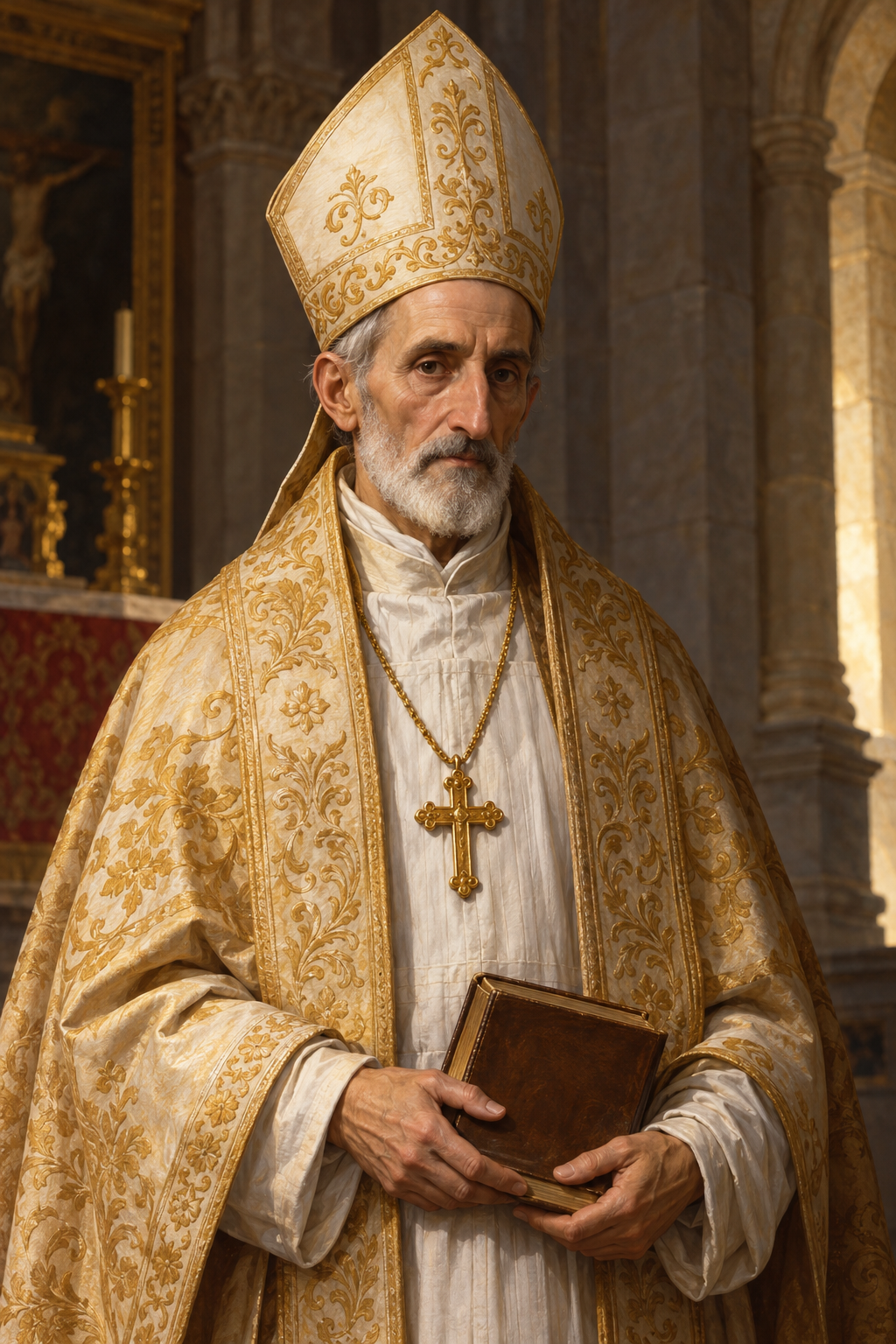
About Juan de Ribera
Juan de Ribera was an archbishop and founder whose work shaped religious life in Valencia. Born in Seville in 1532, he studied at the University of Salamanca. His education included canon law, arts and theology. He became bishop of Badajoz in 1562 and later corresponded with Charles Borromeo about carrying out the reforms of the Council of Trent.
In 1568 he received the title of patriarch of Antioch and was appointed archbishop of Valencia. Reforming the clergy remained a central concern of his ministry. He supported religious communities, including Discalced Augustinian nuns and Capuchins. In 1602 Philip III also appointed him viceroy and captain general of Valencia, joining civil authority to his religious responsibilities.
His most lasting foundation was the Real Colegio Seminario de Corpus Christi. Established in 1583, it was formally inaugurated in 1604 in the presence of Philip III. Its purpose combined the education of priests with careful celebration of the liturgy. The institution’s rector describes these two activities as continuing expressions of its founder’s intentions.
The college stood beside the University of Valencia, where its students studied philosophy and theology. Ribera also treated its architecture and art as part of their formation. He gathered paintings, books and other works around a chapel intended to offer an example for churches throughout the diocese. The college’s history describes a library, study rooms and an aula where students demonstrated their progress.
The college’s construction also reveals the people and materials behind his plans. Auxiliary bishop Miguel de Espinosa directed the work, while the stonemason Guillem del Rey undertook the cloister and chapel. Ribera bought marble columns originally brought from Genoa for the Duchess of Pastrana. The resulting cloister organized the main rooms around a shared space, while service areas occupied a separate courtyard. His constitutions regulated both community life and worship. The chapel had its own staff and administration, reflecting a purpose beyond the students’ immediate needs. Its paintings formed a coordinated religious program. The institution’s history interprets them as visual teaching about the Incarnation, redemption and the Eucharist, placing Ribera’s artistic patronage within his wider work of Catholic formation.
His commitment to Catholic uniformity also led to persecution. Historian Rafael Benítez Sánchez-Blanco identifies three memorials Ribera sent to Philip III in 1601–1602 advocating the expulsion of the Moriscos. These were people of Muslim ancestry who had been baptized as Christians. Benítez’s reconstruction shows that Ribera urged beginning with those in Castile and proposed enslaving adults and children, including children under seven. Benítez also finds that his first biographer, Francisco Escrivá, concealed this last proposal.
Benítez distinguishes advocacy from responsibility for the final royal decision. Ribera did not determine the eventual order of expulsion and opposed beginning with Valencia. His memorials nevertheless supplied arguments used to justify it. The study also explains that Philip III rejected enslavement in the final instructions, despite its place in earlier proposals. This distinction matters: the violence Ribera urged should be stated accurately, without claiming that every recommendation became policy. The recovered archival summary exposes both his pressure on the king and the selective presentation of his views in later biography.
The question did not disappear after his death. Historian Celeste McNamara notes that promoters of his sainthood struggled to present his role in the Moriscos’ expulsion favorably. Her study places Ribera alongside other bishops whose public images were reshaped during long canonization processes. This history makes it necessary to read devotional portraits together with evidence of his exercise of power.
Ribera died in Valencia on January 6, 1611.
John XXIII canonized him on June 12, 1960. In the canonization homily, the pope emphasized his preaching, care for the dying and efforts to improve the lives of priests. He also recalled Ribera’s seven diocesan synods, which addressed doctrine and discipline.
The same homily recalls more ordinary pastoral tasks: teaching local children outside formal classrooms, hearing confessions and bringing Communion to dying people. John XXIII described Ribera addressing priests through personal conversation and pastoral letters, urging prayer, endurance and concord. These remembered activities complement the institutional record of councils and buildings. They show the model of episcopal service presented at his canonization, though the homily’s purpose was celebration rather than a critical assessment of his entire career.
The homily also praised his resistance to Protestant teaching, using the polemical language of religious conflict. That language belongs to the document’s interpretation of his fidelity. It should not be adopted as a neutral description of other Christians or allowed to erase the consequences of his pursuit of religious uniformity.
His local celebration at the Corpus Christi college falls on January 14. A 2025 report from the Archdiocese of Mérida-Badajoz describes communal prayer and Mass there in his honor.
The college also preserves his memory through its libraries, archives and works of art, which it makes available to researchers.
Wondering how to weigh the stories and sources? Learn how to read a saint biography.