Biography
Juan Grande Román
About Juan Grande Román
Juan Grande Román was born in Carmona near Seville on 6 March 1546. A reference in the *New Catholic Encyclopedia* describes him as a cloth merchant before he moved to Jerez de la Frontera in 1566. These early years connect him to work and trade before he became known for hospital service. The entry also tells of a period of solitude near Marchena, interpreting it as vocational discernment. The outward sequence can be reported, while his private thoughts remain accessible only through later biographical tradition.
The Hospitaller Order's account remembers that Grande left the cloth trade, spent time in prayer near Marchena and took the name Juan Pecador, or John the Sinner. It presents this as a turn toward service rather than an entry into priesthood. The name was his chosen expression of humility, not a different person in the records. He moved to Jerez de la Frontera while young and began helping people who had little access to care. An institutional memory may interpret his motives, but the work among poor residents is central across the sources.
In Jerez he sought food and other help for sick people, prisoners and those left without support. The *New Catholic Encyclopedia* traces his first work to a room beside the chapel of Our Lady of Remedies, before the Candelaria hospital was established. These groups had different needs: a prisoner needed access and companionship, while a convalescent might need a bed, food and continuing attention. Grande's work thus began in smaller spaces, before the later institution grew. The story of charity includes practical tasks and the people who assisted him.
Historian Javier Serrano Pinteño reconstructs a network of small Jerez hospitals governed by distinct confraternities and patrons. Their finances, buildings and admission rules varied, and reform threatened established interests. This setting clarifies why a house ready to receive convalescents and poorer sick people mattered. It also guards against reading a sixteenth-century hospital as a modern public medical center. Care depended on religious and civic bodies, donations and local power, and the later attempt to combine houses required negotiation over more than beds or medical routines.
Grande sought church support during the 1574 Jerez epidemic.
The Hospitaller Order identifies Grande with the tradition founded by John of God and says companions joined his work. Its short account puts religious affiliation in 1574, while the order's Jerez shrine history suggests an earlier date for his taking the habit. The two claims need further archival checking before a precise profession date is stored. More certain is the connection: the brothers gave a shared rule and a durable community to hospital service. He also helped extend care into other Andalusian towns, rather than acting only within one Jerez building.
Benítez Reguera reports that the Candelaria hospital had twenty-two beds at its founding stage and cared for approximately twenty-five to thirty people daily. Her study names six brothers including their superior, paid attendants, a steward and a physician. Those details give the community its proper place in Grande's story. They also show the difference between a charitable impulse and a functioning house: beds, meals, clinical attention, accounts and staff had to be maintained. Numbers from an archival study are more useful here than a vague claim that he personally treated everyone.
In February 1591 Cardinal Rodrigo de Castro directed that several Jerez hospitals be incorporated into Candelaria, the house run by Grande and the brothers. Serrano Pinteño identifies the vicars and civic officers who conducted the wider proceedings over several years. Grande and his community thus became central beneficiaries and operators, but were not the only decision makers. The arrangement met resistance from other institutions, including the better funded Hospital de la Sangre. Consolidation moved revenues and responsibilities as well as patients, and its effects unfolded beyond the initial decree.
The order's Jerez shrine history also remembers the reduction from thirteen small hospitals to three. It records that Grande's own house was affected and that the process brought difficult work. The shrine's present site is not the original Candelaria building; the brothers left that earlier institution during the nineteenth-century suppression and returned to Jerez in 1927. This later institutional continuity is real, but the modern hospital should not be described as an unchanged sixteenth-century structure. The story of the founding includes later interruption and restoration.
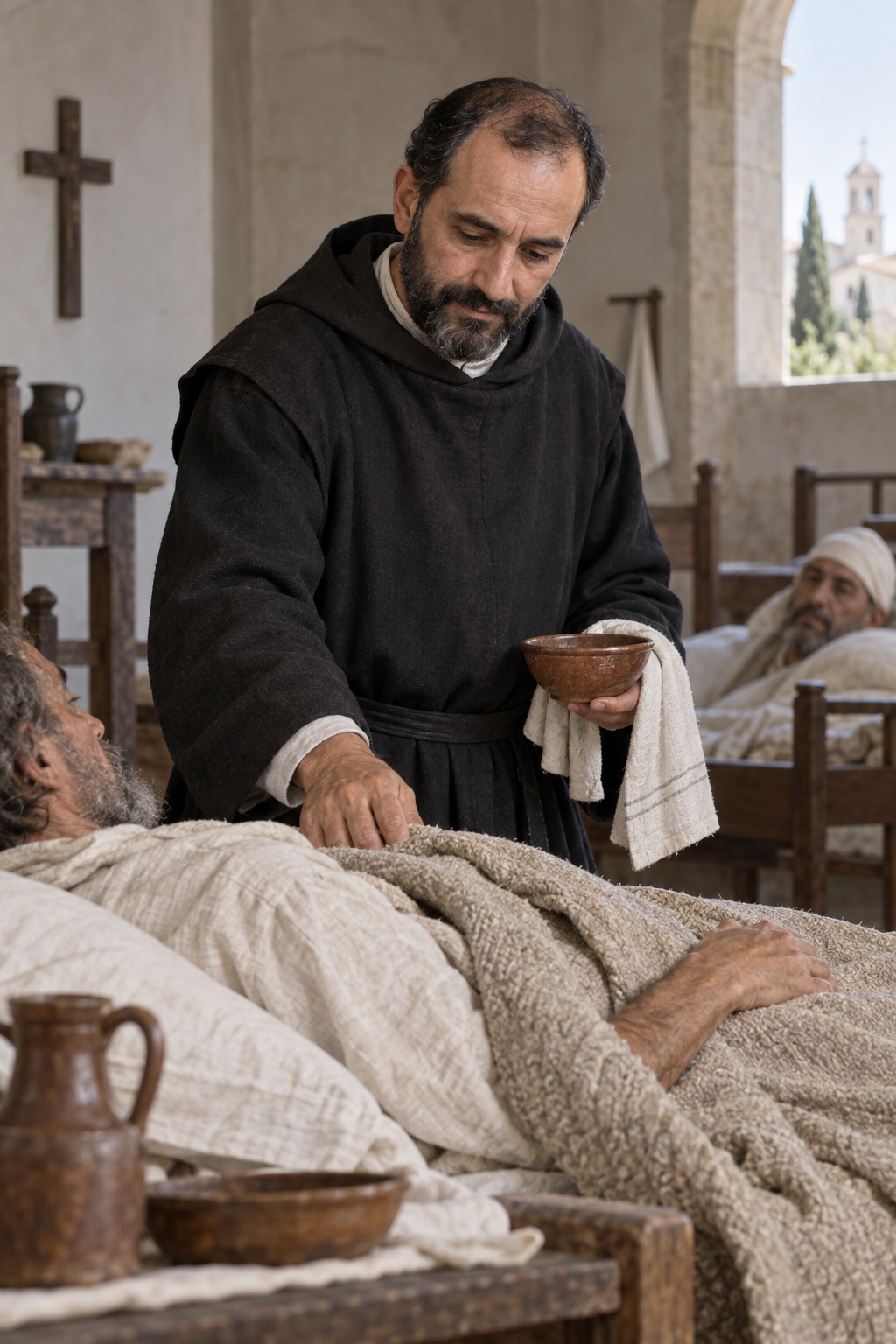
In 1600 plague reached Jerez. The Hospitaller shrine's history says Grande became infected while caring for sick people and died in his hospital on 3 June. The contemporary context was an epidemic across a city whose hospitals had recently been reorganized. The death was remembered as part of a lifelong commitment to people who might otherwise have been turned away. It should not be embellished with unverified last words or a precise list of patients at his bedside. His fellow brothers continued the work after he died.
John Paul II canonized Grande in Rome on 2 June 1996. In the homily, the pope emphasized the joining of prayer and service to people in poverty, sickness and distress. He presented Grande as a model for the Brothers of Saint John of God and for the Diocese of Jerez, of which he was patron. These are the Church's judgments about his significance. They can stand beside the documented administrative history: the hospital's service required cooperation, resources and reform as well as the founder's example.
Beatified in 1853 and canonized in 1996.
The Diocese of Asidonia-Jerez has recently displayed a document concerning the movement of Grande's remains after the old Candelaria church disappeared. The same archive presentation mentions a supposed healing connected to a relic, explicitly as a reported story. It is evidence that his memory remained active in the city, not proof of the alleged cure. The shrine now holds his remains near the order's hospital. His historical legacy rests most securely on the Jerez service, its community of brothers and the difficult work of making care more accessible.
Wondering how to weigh the stories and sources? Learn how to read a saint biography.