Biography
Juana Inés de la Cruz
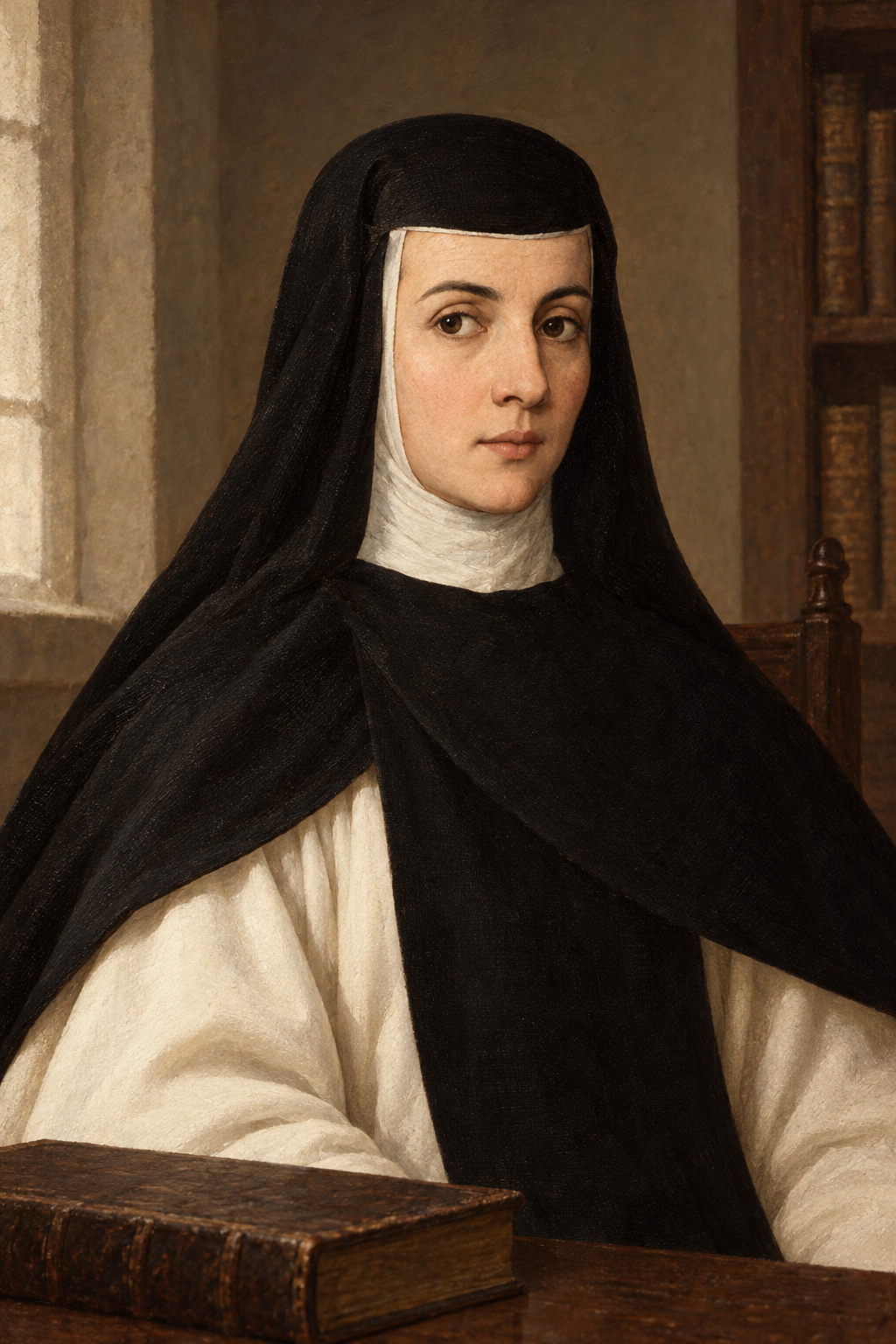
About Juana Inés de la Cruz
Juana Inés de la Cruz wrote poetry, plays, and religious works from a convent in Mexico City. Her life joined the discipline of a Hieronymite nun with an intellectual vocation that reached readers across the Spanish-speaking world. She was born at San Miguel de Nepantla, in what is now the State of Mexico. Her birth year remains disputed: many scholars prefer 1648, while an early biography gives 1651. Her childhood included time at her maternal grandfather’s estate, where books helped nourish her curiosity.
Much of the familiar story of that curiosity comes from Juana’s own later account. She recalled learning to read as a small child and asking to be dressed as a boy so that she could study at the university. When that wish was refused, she continued learning through books. These memories reveal how she understood her vocation; they also need to be read as part of a carefully composed defense of her intellectual life.
As a young woman, Juana entered the household of the vicereine Leonor Carreto. Court connections gave her access to patrons and an audience for her literary gifts. She tried Carmelite religious life in 1667 but did not remain in that community. In 1669 she entered the Hieronymite convent of San Jerónimo. She continued to maintain connections with court society while living within the convent, where visitors and correspondence sustained intellectual exchange.
Her work was not confined to private study. She wrote theatrical works, devotional verse, and villancicos for cathedral celebrations in Mexico, Puebla, and Oaxaca. In 1680 she prepared the literary program for a triumphal arch welcoming a new viceroy. The resulting Neptuno alegórico drew on classical mythology to present an ideal of wise government. Her literary activity served religious institutions and public ceremonies as well as individual readers.
Patronage helped her writing travel. María Luisa Manrique de Lara, countess of Paredes, took manuscripts to Spain and promoted their publication. Inundación castálida appeared in Madrid in 1689, followed by another volume in 1692. These books carried work composed in New Spain across the Atlantic.
In Primero sueño, or First Dream, Juana made the search for understanding itself the subject of poetry. Night settles over the world, and the sleeping body becomes the setting for an ambitious movement of thought. The soul tries to comprehend the immense variety of creation, but the abundance exceeds its powers. It then turns toward a slower method, considering things separately and proceeding by stages. The poem gives sustained attention to the difficulty of knowing, rather than offering an easy claim to complete wisdom.
Its ending returns the reader to ordinary perception. As daylight spreads, visible things recover their colors and the senses resume their work. The speaker wakes. This movement from darkness through intellectual striving to waking allows the poem to hold aspiration and limitation together. Its images draw on the natural world, bodily processes, and classical stories, making the act of inquiry both a literary subject and an experience followed by the reader.
A more public controversy followed her criticism of a sermon by the Portuguese Jesuit António Vieira. In 1690, the bishop of Puebla, Manuel Fernández de Santa Cruz, published her discussion with an admonition signed under the name Sor Filotea de la Cruz. Juana answered in 1691. Her Respuesta defended the pursuit of learning and explained why subjects such as history, logic, and natural philosophy were necessary for interpreting Scripture. The letter’s argument joined religious commitment to intellectual preparation instead of treating study as an abandonment of faith.
Her defense extended beyond her own circumstances. She invoked learned women from biblical and Christian history and argued for women’s capacity to study. She also advocated education of women by other women. These arguments developed within her religious world, drawing on Scripture and recognized authorities to challenge restrictions on learning. The question was not simply whether she personally possessed unusual talent, but whether women could responsibly cultivate their understanding.
Her later withdrawal from public literary activity remains difficult to explain with certainty. Accounts differ over the roles of religious devotion, pressure from church authorities, and other circumstances. In 1695 an epidemic struck her convent. She cared for sick members of the community, became ill herself, and died on April 17.
Juana’s reputation did not remain constant. Margo Glantz traces how admiration during her lifetime gave way to criticism of her elaborate Baroque style, followed by renewed attention in the twentieth century. Editors, historians, and literary scholars recovered and reconsidered her writings. That continuing study has revealed a substantial body of work whose religious, philosophical, and literary questions resist a simple account of either submission or rebellion. Glantz also emphasizes the value of newly discovered documents, which have prompted fresh questions about Juana’s intellectual freedom and the controversies surrounding her work.
The Episcopal Church commemorates Juana on April 18, honoring her advocacy of women’s education and the connection between faith and intellectual life.
Wondering how to weigh the stories and sources? Learn how to read a saint biography.