Biography
Juliana of Liège
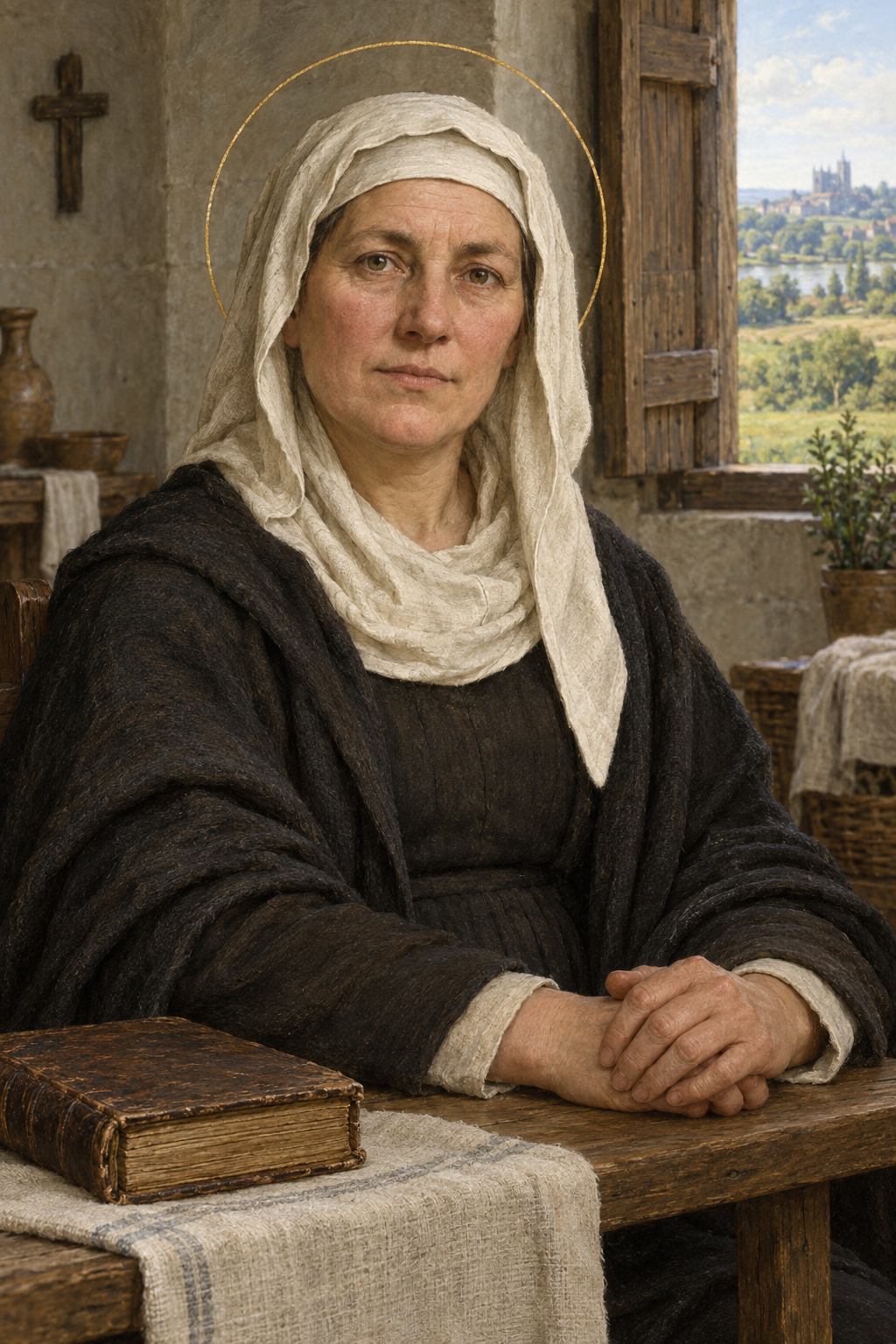
About Juliana of Liège
Juliana of Liège helped turn a local desire for a feast of the Eucharist into a movement that reached the wider Church. Benedict XVI’s account places her childhood near Liège, where she and her sister Agnes were entrusted to the women of Mont-Cornillon after losing their parents. A sister known as Sapience guided her formation. Juliana learned enough Latin to read Augustine and Bernard, joining intellectual ability to a life of prayer. Her remembered vision was of a bright moon marked by a dark interruption. She understood this as a sign that the Church’s calendar lacked a particular celebration of the Eucharist. The vision belongs to her biographer’s account of her religious experience. Juliana did not immediately announce a new feast: she kept the experience private for many years before seeking the support of others.
Mont-Cornillon was a place of work and care as well as devotion. The sanctuary’s history describes Juliana and Agnes being raised at La Boverie, a farm belonging to the community and helping to provide its food. Their education included participation in the farm’s work. The institution itself served people with leprosy and included women and men, both sick and healthy, whose different responsibilities supported their shared life. The healthy members cared for those who were ill. Its affairs also involved two kinds of authority: the city’s administration had responsibilities for temporal matters, while the bishop oversaw spiritual life. This arrangement later became a source of conflict. The community’s adoption of Augustine’s rule under Juliana’s leadership therefore belonged to a practical history of governance, property and service, alongside its commitment to prayer and common goods.
The early Life describes the care with which Juliana tested her proposal. She asked John of Lausanne, a canon of Saint-Martin, to consult learned people while withholding her name. It lists theologians and churchmen whose advice was sought, including Hugh of Saint-Cher and Jacques of Troyes, the future Urban IV. The same text gives a detailed account of preparing an office for the new feast. Juliana encouraged a young member of her community named John to undertake the work. He searched the writings of Christian authorities for material and brought what he composed to her. She examined the words and music and proposed corrections. In the biographer’s presentation, their efforts were complementary: his composition and her prayer and judgment contributed to the finished office. The account gives her an active role without describing her simply as its sole writer.
That project encountered opposition, but it also gained influential friends. Historian Marie-Elisabeth Henneau describes Juliana’s support among women devoted to the Eucharist and among the Dominicans. Bishop Robert of Thourotte’s backing helped secure the feast’s institution in the diocese in 1246. His death that year left her exposed to renewed conflict within her own house. Henneau dates her departure to 1247; Benedict’s account places the ensuing years away from Cornillon in 1248–1258. Juliana found shelter among Cistercian communities, including Robermont, Val-Benoît, Val Notre-Dame and Salzinnes, before settling near Saint-Feuillen at Fosses. She died there on April 5, 1258, and was buried at Villers in Brabant. Her later recognition developed through the continuing memory of a woman whose plans had survived the loss of her own secure home.
Her precise contribution to the liturgy has remained a subject of scholarly discussion. Sherry Reames distinguishes Juliana’s intellectual direction from the technical work of composing all the texts and melodies. Reviewing modern research, she points back to the Life’s account of the young cleric John: he composed material that Juliana could examine and correct. Reames also cautions against imagining her upbringing as that of a choir nun in a long-established cloister. Much of it took place on the farm attached to a religious community whose formal rule developed later. These distinctions give a clearer picture of Juliana’s achievement. Her initiative did not require her to work alone, and collaboration with a cleric did not remove her judgment, persistence or leadership from the creation of the feast.
The feast’s wider history extended beyond Juliana’s lifetime. In the account summarized by liturgical historian Constant Mews, the first office prepared for her in the 1240s preceded the form composed by Thomas Aquinas at Urban IV’s request in 1264. Mews places the movement within Liège’s longer tradition of linking Eucharistic devotion to religious reform. He also notes the slow adoption of the feast before 1317. Its eventual prominence can obscure the patience involved in its beginnings: a proposal inspired by religious women passed through local argument, theological consultation and the work of successive supporters before becoming widely established. Juliana’s legacy includes that process of seeking a public celebration through study, friendship and sustained religious conviction.
At Cornillon, the sanctuary community continues to honor Juliana together with Clare as its patron saints. Its celebration of Juliana on August 7 links the present community’s prayer to the woman whose Eucharistic devotion shaped this place.
Wondering how to weigh the stories and sources? Learn how to read a saint biography.